


Tianrun Cloud (02167.HK) Insight: A 5% accuracy gap becomes the 'life-or-death line' for AI customer service Agent launch

$TI CLOUD(02167.HK)
In the past two years, more and more companies have introduced Agents into customer service scenarios.
However, after in-depth discussions with customer service heads of several companies recently, we discovered a rather representative phenomenon: not all companies that launched AI projects can smoothly reach the deployment stage.
According to feedback from these discussions, only a small fraction of companies that initiated AI projects successfully deployed them, while the majority of projects remained stuck in the same state—small-scale pilots, limited permissions, and never truly going live.
When reviewing these projects, we were surprised to find that during the demo phase, there was almost no difference in performance between successful and failed projects—both could handle conversations smoothly, and their problem-solving rates seemed decent.
The key metric that made the difference was accuracy: successfully deployed projects typically surpassed the 90% threshold, while stalled projects mostly hovered around 85%.
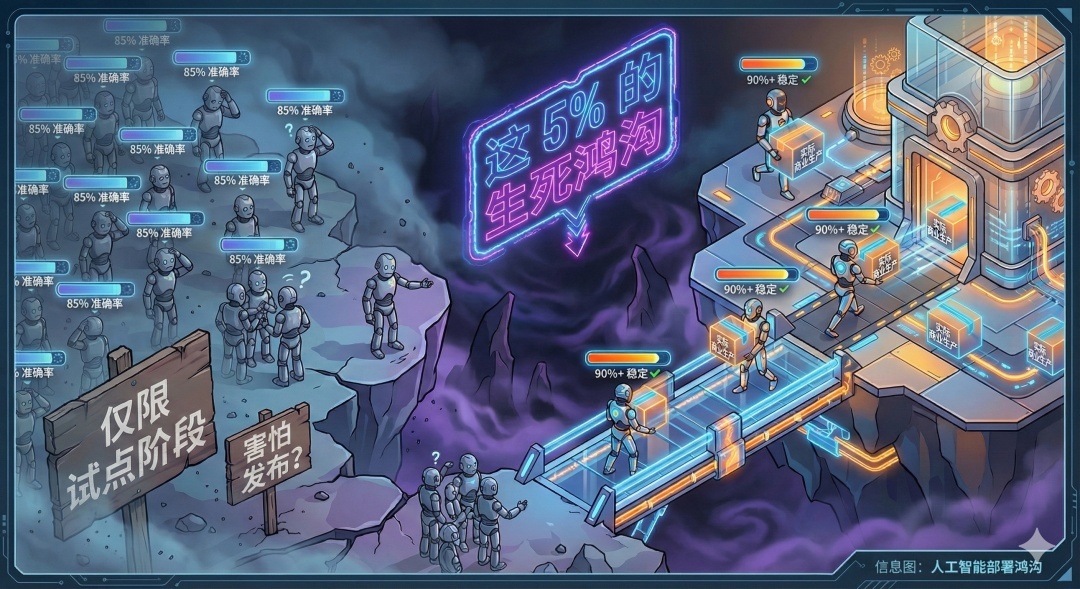
This makes us wonder: why does a mere 5% difference in accuracy determine whether an Agent can be successfully deployed? As business leaders, how can we look beyond the perfect facade to predict the real-world value of an Agent?
I. The Invisible 5% in Demos Is the Real Life-or-Death Difference
To understand this "life-or-death line," we must first recognize a fact: the demo phase inherently fails to expose the most critical differences in an Agent's capabilities.
In demos, Agents operate in a highly idealized environment: questions are relatively standardized, scenario pressure is low, and errors are allowed—even ignored.
Under these conditions, an 85% and a 90% Agent may seem almost identical. But such tests essentially only verify: whether the Agent can "answer questions," not whether it can "handle real business." Once an Agent is pushed into real-world scenarios, this 5% gap quickly becomes magnified.
Real business scenarios have three key features that are almost absent in demos:
① Problem complexity increases significantly and becomes highly combinatorial.
② User expressions are non-standard, filled with ambiguity, emotions, and missing context.
③ Errors are not "reset" but are instead amplified, leading to repeated inquiries, complaints, and escalations.
In such an environment, the difference in an Agent's capabilities is no longer just statistical—it directly translates into business outcomes:
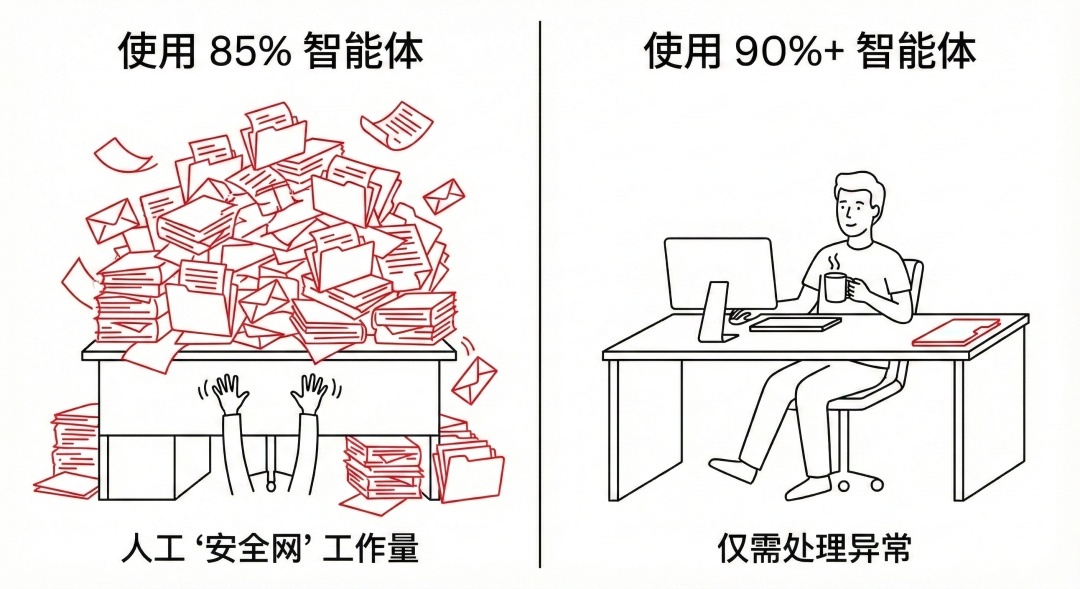
An 85% Agent still makes frequent and unpredictable errors, requiring long-term reliance on human backup, making it difficult to form a stable, replicable service loop.
Meanwhile, a 90%+ Agent's errors become rare events, allowing humans to shift from "backup" to "exception handlers," making a stable business loop possible.
This is why a seemingly small 5% accuracy gap becomes the real dividing line for whether an Agent can be deployed. It doesn't just determine "how good the results are"—it determines whether a stable operational business process can be formed.

II. Looking Beyond Demos: Three Dimensions to Judge Whether an Agent Can Be Deployed
When an Agent project is repeatedly delayed, many business leaders keep returning to demos and feature comparisons, hoping to find answers in the presentation. But practice has repeatedly proven that demos themselves cannot answer the question of "whether it can be deployed."
The truly effective way to judge is to shift the perspective from "showcasing effects" to assessing stability, risk structure, and controllability in real-world operations. In other words, don’t look at what the Agent can do under ideal conditions—look at what it will bring to real business.
Therefore, to determine whether an Agent can cross the "5% life-or-death line," business leaders should systematically examine the following dimensions. If an Agent cannot achieve: stable operation + controllable errors + continuous evolution, then it remains essentially a demo product, not a business system:
First, look for stability, not "occasional accuracy."
Demos only showcase an Agent's peak performance, while real business tests its stability over long-term operation. The key is not whether it can answer standard questions correctly, but whether its outputs remain predictable, explainable, and under control when faced with complex, non-standard inputs.
If an Agent's performance heavily depends on "whether the question is standard," it will still require significant human backup in real business, meaning the risk has not truly been mitigated.
Second, see whether errors are "absorbed" or "amplified."
No Agent is error-free. The real dividing line is not whether it makes mistakes, but whether errors can be identified, corrected, and systematically absorbed. If errors can only be repeatedly escalated to humans, the same mistakes keep happening—then the Agent remains a high-risk system. Only when errors are compressed into rare, manageable events does it have the foundation for gradual delegation.
Third, determine whether it’s a one-time delivery or an evolving system.
Many Agents fail quickly after demos not because of performance issues, but because they are static systems, not evolving "living systems." What really needs to be judged is not just whether it’s accurate now, but whether it has the ability to continuously learn and correct itself as business, rules, and users keep changing.
III. Stop Looking at Demos—Use Real Business for POC
Based on the above, the most rational choice for business leaders is not to keep revisiting demos, but to put the Agent into real business as soon as possible and validate it with real data in a POC.
A truly valuable POC is not another form of demo—it operates under real business constraints: real user questions, real process pressures, real error costs. In such an environment, the differences between Agents are quickly magnified—which scenarios are stable, which problems are prone to errors, whether errors can be located and corrected—these key signals that determine "whether it can be deployed" only appear in real POCs.
This is not a one-time delegation, but a controlled validation of real risks with real data. Exposing problems during the POC phase is far safer than dealing with them reactively after deployment.
If you’re willing, Tianrun Cloud can work with you to put Agents into real business scenarios, using real data and real results to help you make clearer, more controlled deployment decisions through POCs.
$TI CLOUD(02167.HK)
The copyright of this article belongs to the original author/organization.
The views expressed herein are solely those of the author and do not reflect the stance of the platform. The content is intended for investment reference purposes only and shall not be considered as investment advice. Please contact us if you have any questions or suggestions regarding the content services provided by the platform.
