


In 2026, China's L2, L3, and L4 will take three completely different paths


Produced by Zhineng Auto
If 2025 is the year of democratization of assisted driving, with a major regulatory brake in the middle, all automakers have found that the differences in L2-level assisted driving are not significant.
By the end of 2025, L3-specific licenses will be issued for vehicles in Chongqing and Beijing, and consumers will be able to experience it via ride-hailing as early as next month.
We can understand that assisted driving and autonomous driving are indeed "split into three tracks" in 2026.
If 2024-2025 is seen as a stage of technological accumulation, then starting from 2026, L2 will have new national standards, L3 will have specific licenses, and L4 Robotaxi will also become more targeted. The core differences are: Who is responsible for whom? Who pays for whom? Who truly changes mobility?
01
L2 in 2026: "Stability and Responsibility Boundaries" Under National Standards
In the past few years, L2-level assisted driving has been hyped up to L2++, seemingly capable of everything—urban NOA, end-to-end models, and various parking functions. The technical jargon keeps increasing, but the essence is that driving responsibility always lies with the driver, leading to much consumer confusion: "Such a smart car, why can't it do this?"
With the gradual implementation of mandatory national standards, failure alerts, degradation strategies, and driver monitoring for combined assisted driving systems will be written into hard requirements, with strict assessments for "safe exit" in extreme weather, construction zones, and congested conditions.
Regulators will consciously reduce consumers' misunderstanding of L2. Marketing language, feature naming, and UI prompts will become more restrained, with fewer vague expressions like "hands-off, eyes-off." Users will no longer be willing to repeatedly pay for features that "sound impressive but leave all responsibility to me."
L2 is just an assisted driving feature, becoming part of a vehicle's competitiveness, with no separate premium.
02
L3 in 2026: Truly Beginning to Land
We've talked about how L2 will be constrained, so how will China's intelligence develop? The path for automakers is L3. The reason this year-end rollout is important is that it changes the responsible party.
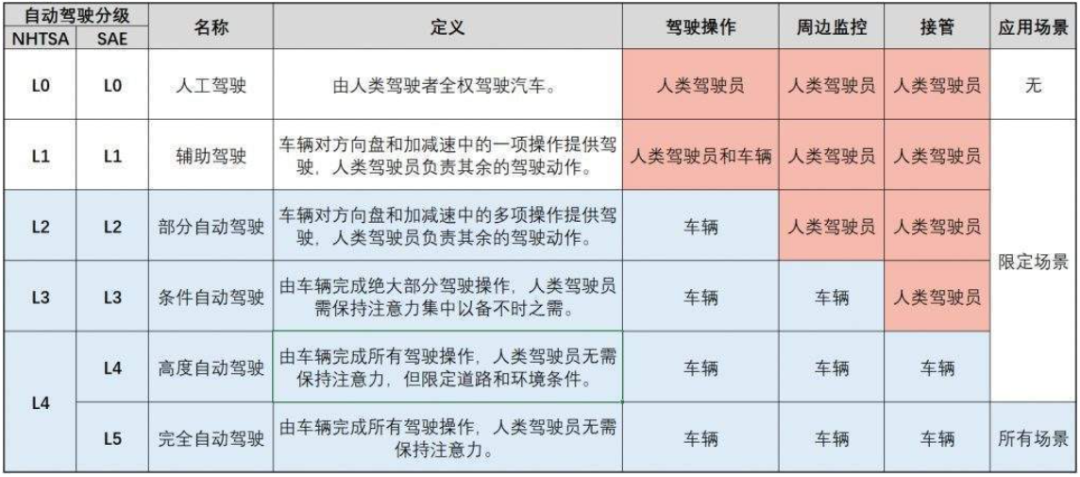
According to the definition in GB/T 40429-2021 "Automated Driving Classification," L3 is conditional automated driving, capable of continuously performing all dynamic driving tasks under design conditions, but requiring a backup driver or remote administrator to respond promptly when the system issues a takeover request.
L3 automated driving cannot completely free the driver's hands and eyes. The operational design domain has clear limits on speed, road type, traffic conditions, and weather. When encountering scenarios beyond its capabilities, the system will issue a takeover request to the driver.
In most cases, hands can be freed, but the driver must remain alert at all times and must immediately take over in emergencies. The driver can briefly take their hands and eyes off, but must complete the transition within seconds of a system warning and cannot be asleep.
Under L3 automated driving scenarios, the responsible parties for accidents include the driver, automaker, autonomous driving software service provider, and others, significantly increasing the difficulty of liability determination. New liability rules need to be established, and future legal regulations must combine technical classification and application scenarios to clearly distinguish responsible parties in pure driverless and human-driver transition scenarios, especially defining the legal nature of "takeover" as a right or obligation.
In November 2023, the Ministry of Industry and Information Technology and three other ministries jointly issued the "Notice on Pilot Programs for Access and Road Travel of Intelligent Connected Vehicles," which for the first time at the national level clarified the access and road travel rules for L3/L4 automated vehicles. It requires pilot automakers and users to provide supporting materials promptly after accidents, otherwise they will be held responsible. It also mandates L3/L4 vehicles to carry liability insurance of no less than 5 million yuan and establish an EDR data locking mechanism.
Of course, many consumers are concerned: Can L3 let me sleep? Can I use my phone? The answer is still no.
At this stage, L3 marks the first time the system is legally recognized as "one of the drivers," which will change the entire industry chain. Automakers can take on more responsibility: they begin to be accountable for algorithms, autonomous driving data enters the regulatory system, insurance models start to change, and accident samples gain legal significance for the first time.
03
L4 in 2026: Moving Forward
As L3 begins to be licensed, L4 appears "quiet" in comparison, as L4 has already defined its application boundaries.
Objectively speaking, if private car L3 succeeds, the ultimate evolutionary direction is the endgame of L4 Robotaxi, which is somewhat like what Tesla has mentioned—what you sell to consumers can also be Robotaxi, making the entire economic model viable.
The core scenarios for L4 remain Robotaxi and specific commercial vehicles. The development logic for L4 will be very clear in limited areas—whether it can operate long-term, at low cost, and stably. L4 players are more concerned with fleet size, operational mileage, takeover rates, and accident rates.
L4 Robotaxi saw significant investment in the U.S. in 2025. With Tesla expanding its scope in 2026, automakers will also use L3 to determine whether to directly enter the L4 Robotaxi field. Currently, players like RoboTaxi in the domestic market are continuously expanding their fleets, and the direction encouraged in 2026 is still clear.
Summary
We can understand it this way: in 2026, L2 is assisted driving, which will continue to penetrate consumers at the 100,000 yuan and below level. This feature is a "reliable assistant tool" to help reduce fatigue; L3, through special licenses, will limit scale and promote automaker technology development, serving as a "responsibility boundary testing ground" between humans and systems, initially rolling out on highways; and L4 will improve ride-hailing service efficiency through operators.
The copyright of this article belongs to the original author/organization.
The views expressed herein are solely those of the author and do not reflect the stance of the platform. The content is intended for investment reference purposes only and shall not be considered as investment advice. Please contact us if you have any questions or suggestions regarding the content services provided by the platform.
