


Prophet Zoltan Pozsar
With the surge in gold prices, discussions about monetary order have returned to the spotlight. Looking back three years ago when Zoltan Pozsar proposed the analytical framework of Bretton Woods III and the hierarchy of money, it seems as if he were a prophet with divine foresight.
Below is a detailed breakdown of Zoltan Pozsar’s macroeconomic framework and its validation in 2026.
Zoltan’s framework is derived from Perry Mehrling’s "Money View," but he combined it with his frontline operational experience at the Federal Reserve and Credit Suisse, applying it to the realm of geopolitics and war financing.
1. Core Worldview: Money is not just a means of payment; it is a hierarchy and a balance sheet.
- Hierarchy of Money: Not all "money" is equal.
- Top Tier: Gold (the purest Outside Money, with no counterparty risk).
- Second Tier: Central bank reserves/cash (embodying national credit).
- Third Tier: Bank deposits (Inside Money, dependent on bank solvency).
- Bottom Tier: Securities/credit instruments.
- Core Logic: During peacetime, the tiers can be exchanged at par; but during crises or wars, the hierarchy breaks, and the value of "Outside Money" far exceeds that of "Inside Money" (credit).
2. The Theory of "Bretton Woods III" (BW III)
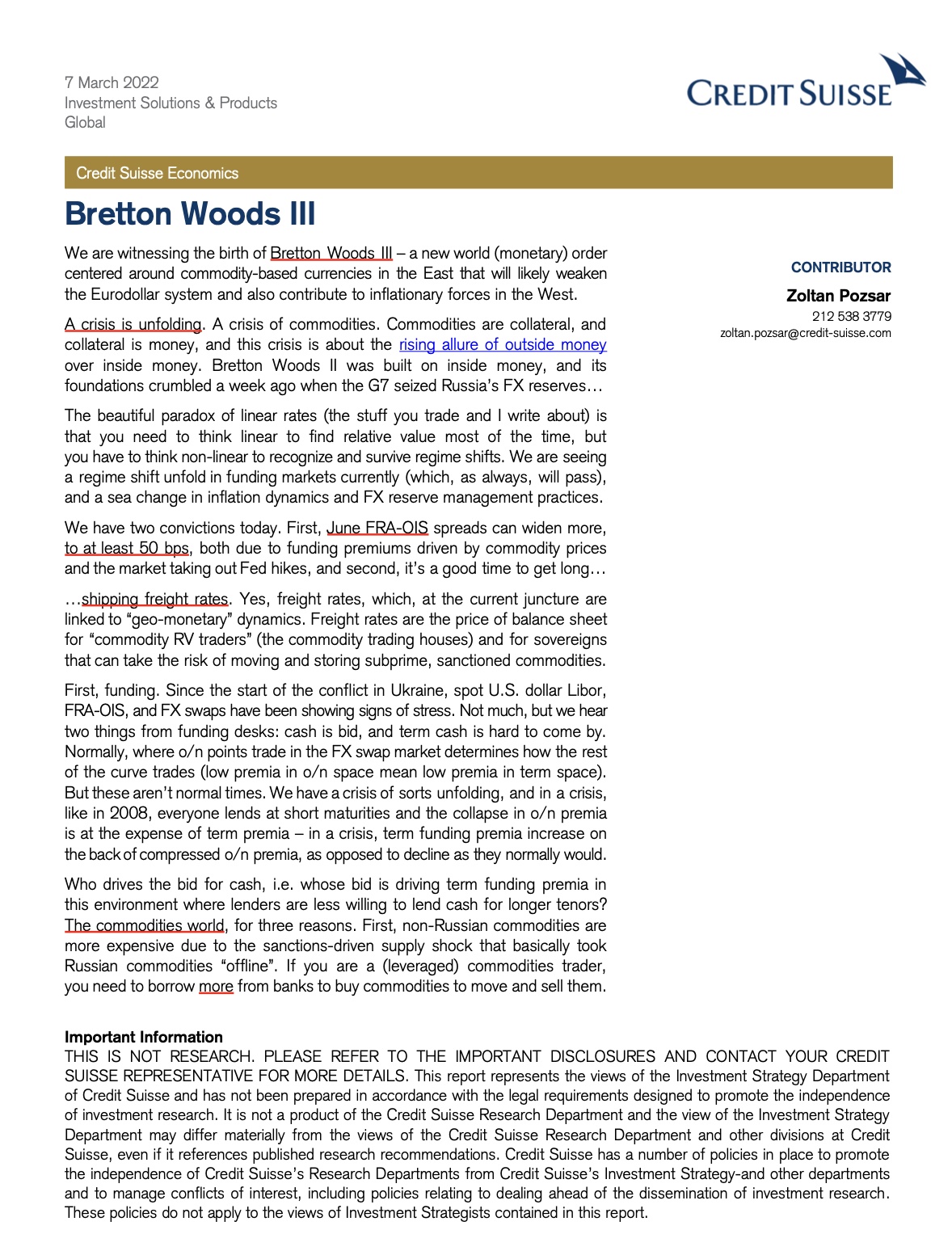
This is his most famous thesis, proposed after the outbreak of the Russia-Ukraine conflict in 2022.
- BW I: Gold-backed dollar (gold standard).
- BW II: U.S. Treasury-backed dollar (credit standard, the era of Inside Money).
- BW III: Commodity-backed currencies.
- Key Predictions:
- As G7 countries froze Russia’s dollar reserves, the credibility of the dollar as a "risk-free asset" collapsed.
- The global monetary order will shift from "U.S. Treasury-backed" to "commodity-backed" (oil, gold, food).
- The "East" (China, Russia, etc.) will use commodity reserves to challenge the financial hegemony of the "West."
- We will face structural high inflation because supply chains must be rebuilt, and commodities are no longer cheap.
3. The Four Prices of Money
Zoltan argues that central banks must manage four prices simultaneously, or the system will collapse:
- Par (face value): Bank deposits must be exchangeable for cash at 1:1 (the 2008 crisis primarily impacted this).
- Interest (rate): The price of future money.
- Exchange Rate: The price of domestic currency against foreign currency.
- Price Level: The price of money in terms of goods.
- Zoltan’s warning: Over the past decades, central banks focused only on the first three, ignoring the fourth (because globalization brought cheap goods). But in the BW III era, the "price level" will become the most unstable variable, as central banks cannot print oil or food, making inflation extremely stubborn.
Looking Back in 2026—What Was Validated? What Failed?
1. The Return of Outside Money (Gold and Commodities)
Zoltan’s Prediction: Central banks will abandon U.S. Treasuries and frantically buy gold, as gold is "Outside Money" with no geopolitical risk.
2026 Validation:
- Spot on. This was Zoltan’s most accurate call. According to data we’ve seen, by the end of 2025, gold prices had broken the historic $4,000/oz barrier.
- Global central banks (especially China, India, Poland, Turkey) have been net buyers of gold for 15 consecutive years, with purchases in 2024-2025 remaining at record highs.
- Conclusion: Trust in credit money (Inside Money) is indeed declining, and gold has re-emerged as the core anchor of the monetary system.
2. The Structural and Stubborn Nature of Inflation (Inflation Volatility)
Zoltan’s Prediction: The era of low inflation is over; we will enter a "wartime economy" dominated by supply shocks, with inflation showing a wave-like pattern (L-shaped recovery is a myth, inflation is sticky).
2026 Validation:
- Mostly correct. Despite the Fed maintaining restrictive rates in 2024-2025, core inflation remains "stubbornly above 2%."
- Supply chain restructuring has indeed driven up costs. As we saw in 2025, rising energy and logistics costs due to geopolitical friction made it extremely difficult for inflation to return to the lows of the 2010s.
3. Geopolitical Financial Fragmentation (East vs. West)
Zoltan’s Prediction: The world will split into two blocs, with supply chains and payment systems decoupling.
2026 Validation:
- Correct. The expansion of BRICS+ and the establishment of internal trade settlement systems are accelerating. While SWIFT still dominates, a "multipolar monetary system" is now inevitable.
The copyright of this article belongs to the original author/organization.
The views expressed herein are solely those of the author and do not reflect the stance of the platform. The content is intended for investment reference purposes only and shall not be considered as investment advice. Please contact us if you have any questions or suggestions regarding the content services provided by the platform.
