


 Total Assets
Xiaomi Robot's Positive Development: The Chinese Approach to the Global Humanoid Robot Competition

As the global humanoid robot competition intensifies today, a clear watershed is forming: on one side is the first-principles path, represented by Tesla, pursuing ultimate industrial efficiency; on the other side, Xiaomi is leveraging its ecosystem integration strategy to become the most certain Chinese contender in this intelligent revolution.
I. Forward Development: The Evolutionary Logic of Rejecting Skipping Grades
True humanoid intelligence should follow the laws of human-like growth and development: from perception, to interaction, and then to action.
Many projects eager for quick success often focus on showcasing backflips or complex gaits, which essentially is the reproduction of actions lacking generalization ability. Xiaomi has chosen a more solid path of deep cultivation:
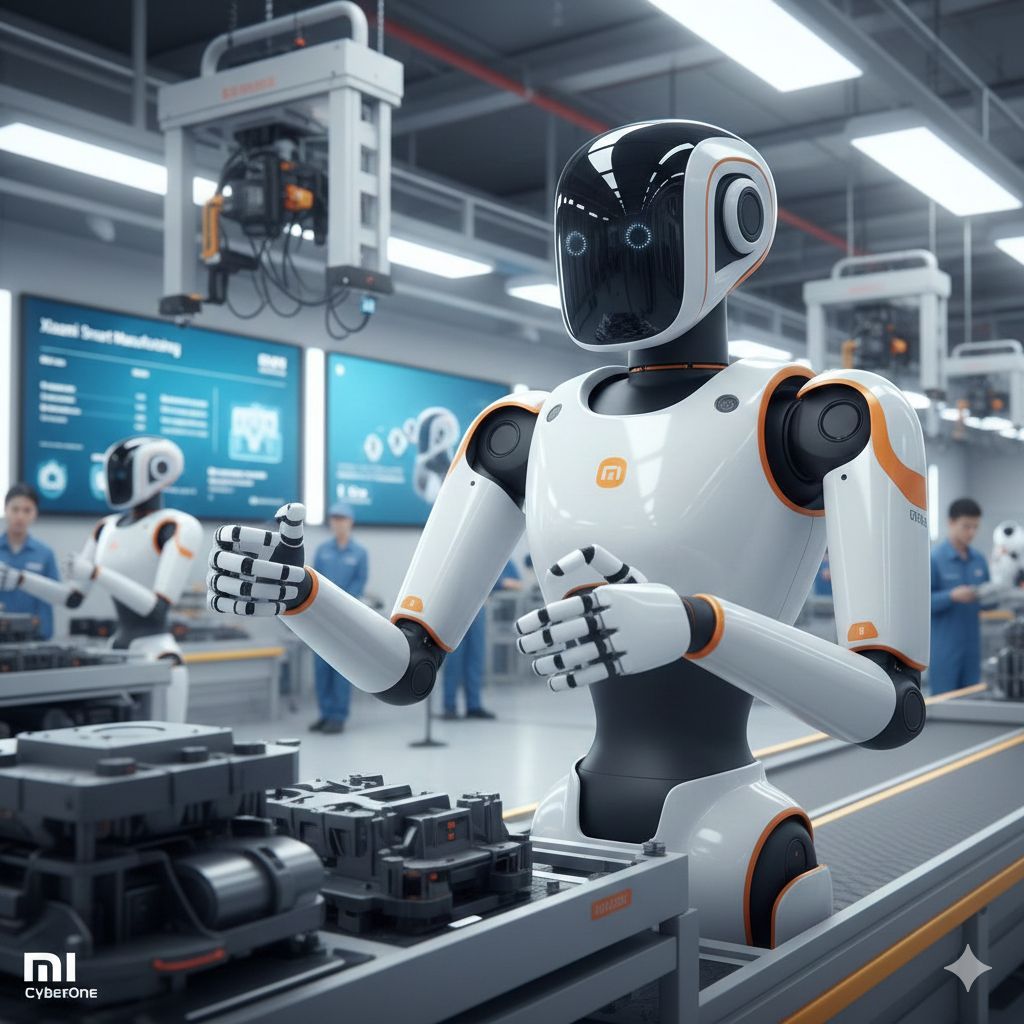
- Perception Layer (Vision and Emotion): In 2022, Xiaomi's first full-size humanoid robot, CyberOne (Tieda), debuted. Its self-developed Mi-Sense depth vision module not only achieved 3D reconstruction of space but also possessed preliminary emotion recognition capabilities. This marks the robot having eyes and basic emotional intelligence.
- Interaction Layer (Language and Logic): Xiaomi deeply integrated its decade-long Xiao Ai voice assistant system. This is not simple voice broadcasting, but the fusion of massive language data with large language models (LLMs), enabling the robot to evolve from hearing commands to understanding intent.
II. Full-Stack Self-Development: Efficiency Domination in Industrial Scenarios
The core moat of Xiaomi's robot lies in its unique closed-loop verification capability.
While startups are still struggling to find testing grounds and coordinate supply chains, CyberOne has already entered the production line of Xiaomi's Yizhou automobile factory. This minimalist path from lab-factory-production line brings exponential iteration advantages: - Data Feedback: The real industrial environment provides a continuous stream of long-tail scenario data for algorithm models.
- Cost Control: Leveraging Xiaomi's accumulated supply chain bargaining power in consumer electronics and smart vehicles, the cost control of its core components (such as precision reducers, high-torque motors) is highly potent. The expected unit cost of $30,000 already poses substantial pressure on overseas competitors priced above $50,000.
III. China-US Divide: The Clash of Two Technological Philosophies
The final stage of the global humanoid robot race presents two distinctly different technological values:
Tesla Optimus (Singular Perfection): Follows a pure vision route, transplanting FSD autonomous driving algorithms onto the robot, pursuing ultimate low cost and large-scale human replacement—a pure super tool.
Xiaomi (Ecosystem Integration): Takes a brain + cerebellum + whole-body coordination route. The open-sourcing of the MiMo-Embodied embodied intelligence large model by the end of 2025 marks Xiaomi's achievement of deep integration between semantic understanding and fine motor skills. It can not only move materials but also understand vague and complex domestic needs like "fetching a cup of warm water from the pantry."
IV. Car-Home-Human: The Only Trinitarian Ecosystem
The key reason Xiaomi is seen as the benchmark for China's embodied intelligence lies in its irreplicable ecological niche. It is the only company globally simultaneously holding these three trump cards:
• Mature automobile manufacturing capability: Provides large-scale precision manufacturing and computing hardware support.
• World's largest consumer-grade IoT platform: Over 600 million connected devices provide the richest interaction scenarios.
• Top-tier consumer electronics brand: Possesses extremely high user reach and brand recognition.
This layout gives the robot the most coherent implementation curve: from factory precision assembly, to commercial scenario guidance, to home care assistant.
V. Conclusion: China's Answer for the Intelligent Era
In 2025, the fourth-generation CyberOne achieved a repeat positioning accuracy of ±0.03mm, with a load-to-weight ratio approaching the industry peak. This is no longer a flashy tech show but a long-termist marathon that endures solitude.
Xiaomi has proven that the ultimate form of humanoid robots should not be cold industrial machinery but intelligent partners that understand, assist, and integrate with humans. With its unique ecosystem depth and pragmatic implementation strategy, Xiaomi is not only representing China in the competition but also defining a new paradigm for the future of global humanoid robots.
The rising Xiaomi robot is precisely the best epitome of China's intelligent power developing forward and making a breakthrough after long accumulation.
The copyright of this article belongs to the original author/organization.
The views expressed herein are solely those of the author and do not reflect the stance of the platform. The content is intended for investment reference purposes only and shall not be considered as investment advice. Please contact us if you have any questions or suggestions regarding the content services provided by the platform.
