


 Rate Of Return
<p>Bros, <span class="security-tag" type="security-tag" counter_id="ST/US/TSLA" name="Tesla, Inc." trend="0" language="en">$Tesla(TSLA.US)</span> is still falling so much today! I get trapped every time I enter, I really fell into a trap. After the earnings report came out last night, it feels like they're not even pretending, so shameless. It's stagnant now, losing money (currently), seems like it's over. All in all, Let's go!</p>

🚀📦 One of the core assets worth holding for the long term over the next decade: $Amazon(AMZN.US)'s moat is deeper than you think.
If one word had to describe $Amazon(AMZN.US)'s long-term competitiveness, it wouldn't be "e-commerce," but "infrastructure-as-a-service."
What Amazon has truly made difficult to replicate is never the products themselves, but the global logistics network and last-mile fulfillment system it has built. Years of sustained, high-intensity capital expenditure have resulted in faster delivery speeds, lower unit costs, and a self-reinforcing positive feedback loop that grows with scale. This advantage cannot be caught up with through short-term investment; it's a barrier built over time with cash flow.
Even more crucial is the cloud.
Amazon Web Services remains the foundational layer of global cloud infrastructure, with annual revenue reaching the hundred-billion-dollar scale. It's not about "leading in one cloud product," but about having established a systemic advantage in feature coverage, security architecture, enterprise ecosystem, and government client penetration. Among the top 1,000 core customers, over 90% have adopted Graviton, meaning AWS is using its self-developed chips to firmly control the variable of "cost-performance."
Generative AI has further amplified this advantage.
Rather than saying AWS is "chasing AI," it's more accurate to say AI is amplifying the value density of cloud infrastructure. Bedrock has become a recurring revenue engine generating billions of dollars, with corporate investment in models, computing power, and toolchains showing a clear acceleration trend. The adoption rate of Trainium2 has surpassed any previous generation of internal chips in AWS's history, offering significant cost-performance advantages over traditional GPUs. This isn't about a single breakthrough, but about AWS's overall synergy in computing power, chips, and software stacks.
The moat in retail is also evolving.
With over 250 million Prime members globally, it's not just subscription revenue, but a highly sticky "consumption operating system." The combination of frequent shopping, content consumption, and service usage extends user lifetime value and provides a natural cross-selling entry point for advertising, finance, logistics, and other businesses.
In groceries and instant delivery, Amazon is replicating its e-commerce playbook: first build the infrastructure, then compress fulfillment costs, and finally amplify the scale advantage. Grocery delivery already covers thousands of U.S. cities and continues to expand; instant delivery has significantly increased Prime member shopping frequency in India and shows strong early signals in the U.S. and U.K. These businesses face profit pressure in the short term, but in the long run, they are "laying the foundation" for higher-frequency, more essential consumption scenarios.
Advertising is becoming an underestimated growth engine.
Prime Video's ad reach has expanded to 16 countries and over 300 million viewers. More importantly, Amazon is deeply embedding AI into its advertising system, improving advertisers' return on investment through automated creative generation, placement optimization, and performance evaluation. This makes advertising not just a "monetization tool," but part of the ecosystem's synergy.
In summary, what makes $Amazon(AMZN.US) unique is:
It simultaneously controls consumer access, cloud infrastructure, logistics networks, and data assets, with strong synergistic effects between these modules.
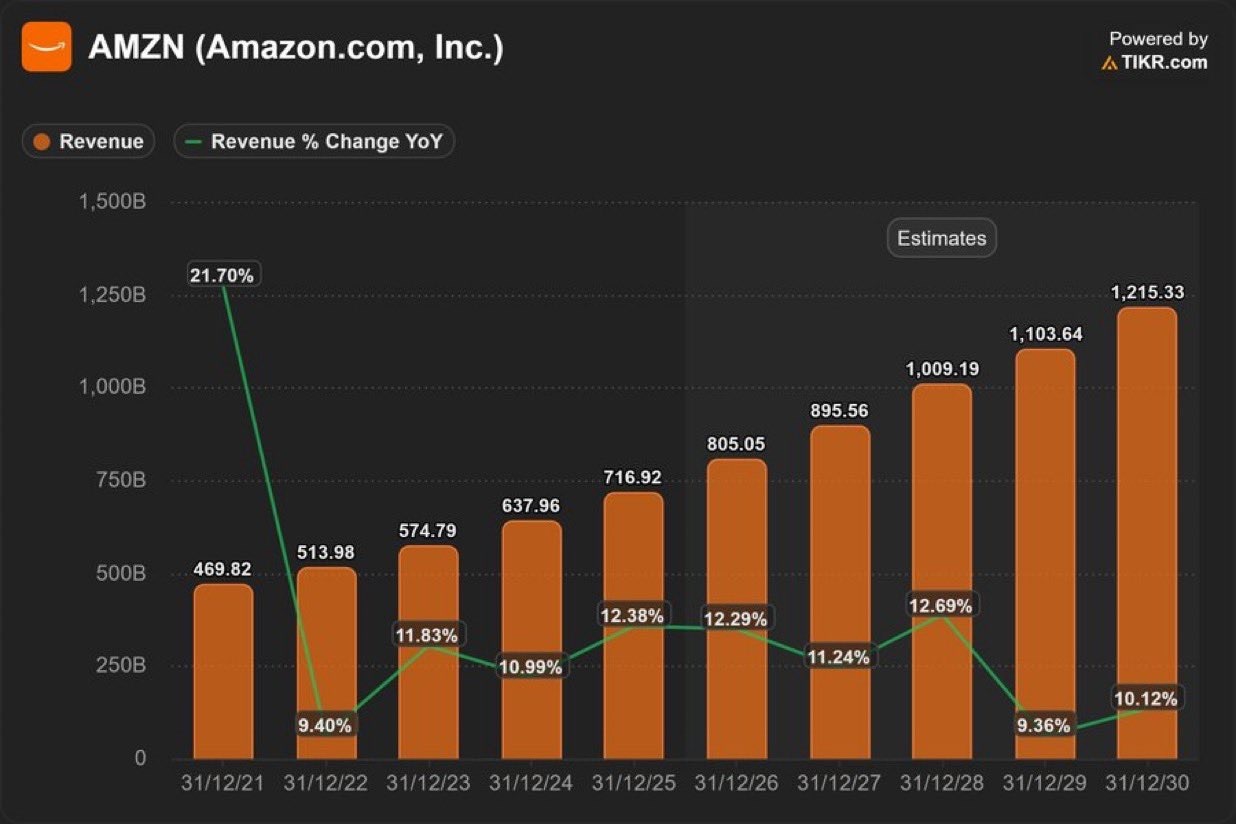
When the revenue structure is sufficiently diversified, cash flow is strong enough, and the long-term runway is wide enough, scale itself becomes part of the moat. That's why the market is starting to seriously discuss a question—whether Amazon has a chance to join the "trillion-dollar annual revenue" club in the coming years.
This isn't a story of linear growth, but a system that continuously reinforces itself.
📬 I will continue to analyze those companies that "can weather cycles," focusing on how they translate scale, technology, and ecosystems into long-term returns.
If you also prefer certainty over a ten-year horizon rather than short-term emotional fluctuations, feel free to subscribe.
#AMZN #Amazon #AWS #CloudComputing #ArtificialIntelligence #Ecommerce #LongTermInvesting
The copyright of this article belongs to the original author/organization.
The views expressed herein are solely those of the author and do not reflect the stance of the platform. The content is intended for investment reference purposes only and shall not be considered as investment advice. Please contact us if you have any questions or suggestions regarding the content services provided by the platform.
