


KO (Trans): Will Deepen End-to-End Digitalization
Below is Dolphin Research's transcript from KO's FY25 Q4 earnings call. For our earnings take, see 'Coca-Cola: Betting on AI, is the 'happiness in a bottle' playing a long game?'.$Coca Cola(KO.US)
- Key Financials Recap
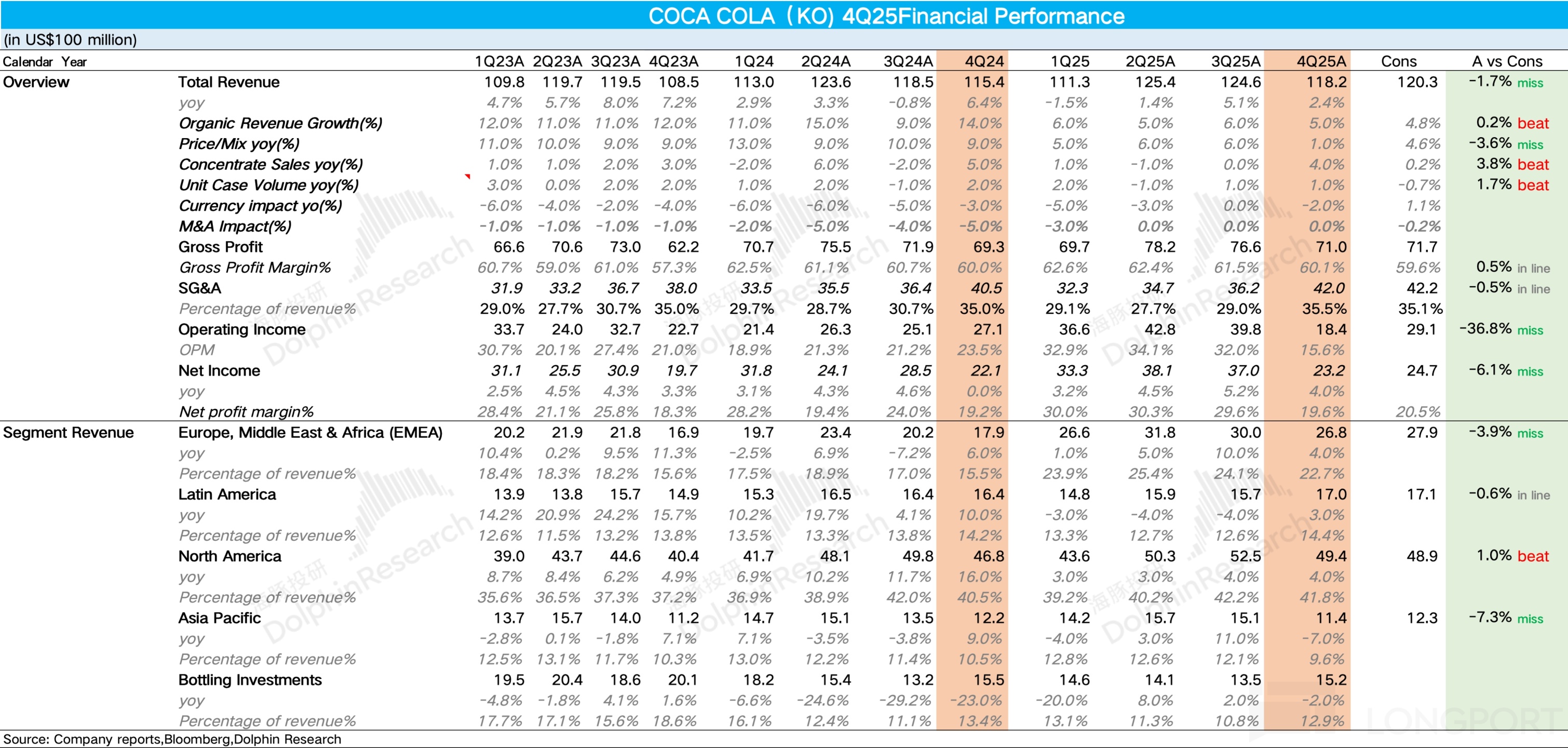
II. Management Highlights
1) Decade strategy scorecard and leadership transition
The four pillars set in 2017 (consumer-centric portfolio, system capability, enterprise digitalization, and unlocking talent) have been delivered. Key outcomes include $12bn of incremental portfolio value, bringing total to $32bn, with 75% of $1bn+ brands in non-CSDs.The Coca-Cola master brand added over $60bn in retail sales, remaining the world's most valuable F&B brand. Bottler collaboration efficiency improved with refranchising near completion, digitalization enables precision reach to consumers and customers, and a risk-taking, growth-first culture is in place.
2) Regional performance review
North America: Core brands (Coca-Cola, Sprite Zero, etc.) grew volumes. Innovation such as Sprite Chill and Coca-Cola Holiday Creamy Vanilla performed well.Accelerated cold equipment rollout, expanded value offerings, and lifted on-shelf availability and visibility.
LatAm: Coca-Cola Zero and Sprite Zero were strong. Mexico's dairy brand Santa Clara entered the $1bn+ brand club.Fanta linked to Halloween marketing, with focus on refillable packs, value propositions, and attractive price-points.
EMEA: Activated around holidays and the Winter Olympics. In the U.K., leveraged the Premier League partnership for customized products.In Italy, hosted a Winter Olympics torch relay music festival, with the Coca-Cola truck touring alongside the torch.
APAC: Japan growth offset declines elsewhere, as headwinds came from weak consumer spend, soft industry trends, and a high base last year.Executed precision channel strategies, optimized brand pricing and pack architecture, and focused on value offerings.
3) Three strategic priorities for the next phase
· Deepen engagement with young consumers: Tie marketing more tightly to in-market execution. In the U.S., 10 brands now rank among the top 20 beverages for young consumers, with Coca-Cola No. 1, and the aim is to further improve reach to this cohort.
· Be closer to consumers, speed market response: Innovation hit rates have improved but remain below ambition. The company will leverage deeper consumer insight to anticipate category growth and lead innovation.
· Build a digital-first RAD system: Embed digital across every touchpoint with consumers, customers, and the system. Current bottler collaboration is only a starting point, with full-chain digitalization to follow.Brand goals: add more $1bn+ brands and scale existing $1bn+ brands into multi-billion ones, leveraging a $32bn brand base and industry-leading route-to-market to drive long-term growth.
III. Q&A
Q: How will price/mix vs. volume balance in 2026 organic growth?
A: The 1% price/mix in FY25 Q4 reflected short-term noise. Underlying 4 pts of pricing were offset by -3 pts of adverse mix, and mix was roughly flat over the past four quarters.In 2026, we expect to revert to a 50:50 price vs. volume balance, with caution given needed recoveries in India, China, parts of ASEAN and Europe, plus a near-term Mexico excise tax volume headwind. Execution should support volume recovery in those markets, and we remain growth-oriented overall.
Q: 2026 macro assumptions? Contribution from developed vs. emerging?
A: We still see a 'light-rain' macro, not as bad as market fears. India, China, and ASEAN are the long-term volume engines and should recover through 2026 on a sequential basis.Mexico's excise tax headwind is mainly in Q1 and will be mitigated thereafter. For the year, pricing contributes more early on, then price and volume trend toward balance, with the goal of broadening growth across more markets and brands.
Q: Sustainability of 30% OPM in North America? Any over-earning?
A: North America is central to margin expansion and has fully leveraged the three levers above. There is still room to improve through everyday excellence and marginal gains.We expect moderate, sustained expansion over time, not over-earning, and do not see a need for outsized reinvestment.
Q: Strategies for high-volatility markets (China, India, Mexico) into 2026?
A: China: Consumer confidence and spend remain below pre-COVID levels, but we continue to gain share. We are taking a long-term build approach, focusing on core brand quality leadership, with potential small fluctuations in 2026.India: 2025 was affected by industry structure and weather. We have been investing ahead, and growth is expected to resume in 2026.Mexico: Leveraging LatAm's mature RGM toolkit and prior experience managing tax headwinds to offset the excise impact, while using 2026 World Cup marketing and the system's centennial to drive growth.
Q: North America 2026 drivers (fairlife capacity, World Cup, Hispanic consumers)?
A: New fairlife capacity in 2026 will continue to contribute. World Cup activations should provide a meaningful lift.The Hispanic consumer segment should recover from the negative impact seen in Q1 2025. Overall, we expect to carry Q4 2025 momentum and deliver broad-based growth even with pressure on low-income consumers.
Q: What drove adverse mix in FY25 Q4? EPS impact from lower equity income?
A: The -3 pts mix in Q4 was split equally across three factors: faster growth in lower-margin emerging markets vs. developed, outperformance of lower-margin categories within developed markets, and timing from year-end marketing and the global New Year kickoff plan. These were one-offs, not trend shifts.Equity income fell mainly due to the Nov-2025 divestiture of Coca-Cola Consolidated, which is the primary EPS drag. Other factors were minor, and we have not disclosed a specific EPS impact.
Q: Capital allocation after 2026 FCF improvement? Any step-up on the four pillars?
A: Priorities: 1) Biz. investment (25% to company-owned bottlers; 75% to concentrate and finished-goods capacity, incl. fairlife, etc.); 2) keep growing dividends (63-year track record); 3) maintain flexibility for M&A and buybacks.We plan to lean in on the four strategies in 2026, while awaiting the IRS tax dispute ruling to preserve cash flexibility. Focus remains on core-business cash generation to fund long-term strategic investment.
Q: Responsibilities as Executive Chairman? Key innovation opportunities and execution?
A: Executive Chairman role: unlike a non-executive chair, two core areas apply. 1) At the request of the new CEO, support operations through the leadership transition, sharing stakeholder communication, etc. 2) As BOD representative, focus on capital allocation, risk, and long-term talent, ensuring efficient BOD–management communication, with final operating decisions remaining with the CEO.Innovation: The portfolio was streamlined from ~400 to ~170 brands, improving success rates. The next wave centers on local-first innovation, grounded in local consumer insight to find scalable opportunities and cultivate local $1bn+ brands (e.g., Mexico's Santa Clara, innocent), while speeding time-to-market and combining local creation with global scale to drive value.
Q: Will India step up marketing/innovation spend? Digital buildout and fulfillment vision?
A: India will continue to invest ahead, not only in marketing and innovation but also with unprecedented line builds, as the market is still in the industry build-out phase. The long-term strategy is 'build capacity, stimulate demand', and proceeds from refranchising will be reinvested in India.Digital: India has robust digital infrastructure. The Coke Buddy B2B platform now covers about one quarter of outlets, enabling digital ordering and AI SKU recommendations.The vision is an end-to-end digital platform that connects consumers, customers, and experiences, moving from digital reach to transaction conversion. With digital and capacity buildout, we aim for precise in-market execution and demand response, setting the benchmark for India's digital route-to-market.
