


 Rate Of Return
<p>Bros, <span class="security-tag" type="security-tag" counter_id="ST/US/NVDA" name="NVIDIA Corporation" trend="0" language="en">$NVIDIA(NVDA.US)</span> is still falling so much today! <span class="security-tag" type="security-tag" counter_id="ST/US/AAPL" name="Apple Inc." trend="0" language="en">$Apple Inc.(AAPL.US)</span> is down too, and <span class="security-tag" type="security-tag" counter_id="ST/US/TSLA" name="Tesla, Inc." trend="0" language="en">$Tesla(TSLA.US)</span> is just dumping shares. Last night I was wondering if <span class="security-tag" type="security-tag" counter_id="ST/US/MSFT" name="Microsoft Corporation" trend="0" language="en">$Microsoft(MSFT.US)</span> could hold steady, but it followed the drop today. All in all, the market action tonight is so shameless, not even pretending. Let's just watch the show, bros.</p>

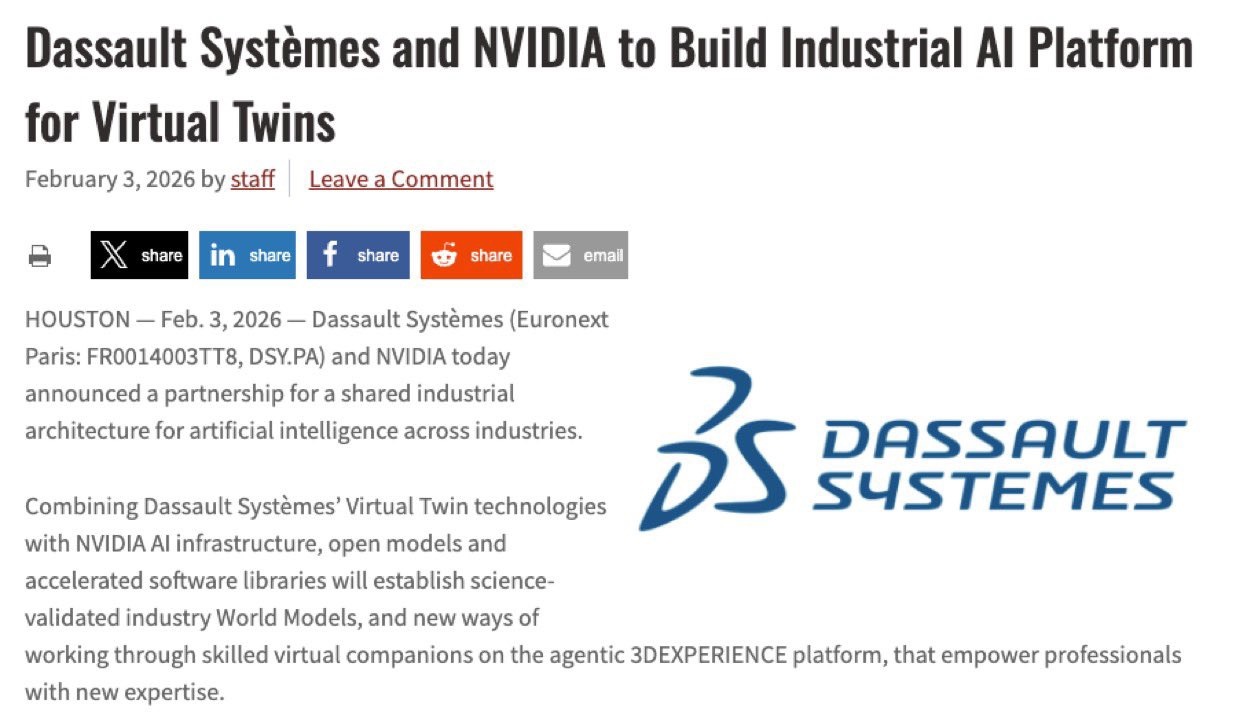
🧠⚙️ $NVIDIA(NVDA.US) × Dassault Systèmes: Digital Twins are pushing AI from a "tool" to "system infrastructure"
Today's collaboration between $NVIDIA(NVDA.US) and Dassault Systèmes has "digital twin" as its surface keyword, but what's truly important isn't the technical term, but the qualitative change happening in AI.
This step signifies that AI is beginning its transition from an "efficiency tool within the digital world" to "infrastructure that maintains system controllability in the real world".
Once this line is crossed, the demand logic will no longer be swayed by economic cycles.
It's no surprise which industries will see digital twins implemented first:
Semiconductors, Energy, Chemicals, Aerospace & Defense.
They share a highly consistent characteristic—system complexity has already surpassed the limit of what humans can manage based on experience.
Whether it's the process window of a wafer fab, the real-time dispatch of a power grid, or the multi-variable coupling path of a chemical reaction, any single misjudgment isn't just a matter of "reduced efficiency," but directly triggers a systemic accident or massive loss.
In these scenarios, what digital twins solve isn't "can we be a little faster," but a more fundamental question:
Can the system still operate stably?
This also determines that it is inherently not an optional expense.
During an economic downturn, companies can postpone capacity expansion, cut experimental projects, and slow down the rollout of new features;
But as long as factories are still producing, power grids are still operating, and equipment is still reacting, the perception, prediction, and control of system status cannot be interrupted.
Once a digital twin enters a production system, it quickly transforms from a "project" into a "status system."
It's not a one-time software delivery, but a long-running foundational layer:
Continuously receiving real-world data
Continuously generating simulated states
Continuously participating in dispatch and decision-making
More crucially, the data that accompanies it—historical operating conditions, failure paths, extreme scenarios—possesses a strong irreversibility.
This data cannot be recreated, nor can it be deleted; deleting it would be like erasing the system's memory.
Under cyclical pressure, companies can reduce computing power usage frequency and delay new model training,
But foundational operations and data retention cannot stop.
This is also why the deterministic demand for digital twins will likely first manifest in storage and foundational networks.
Computing power is elastic; data is not.
Once the real world is continuously mapped into computable objects, data will only monotonically accumulate, not recede with the cycle.
From this perspective, digital twins and the current AI hype are actually two different logical threads.
AI hotspots are driven more by technological breakthroughs and capital sentiment;
Whereas digital twins are passively propelled by the complexity of the physical world.
Even if the AI narrative cools down in phases, real-world systems won't become simpler; they will only continue to grow more complex.
As long as complexity doesn't decrease, the demand for digital twins cannot disappear.
Therefore, digital twins are more like a type of passively emerging infrastructure:
Not built because the economy is good, but because systems cannot be managed without it.
This is precisely the fundamental reason why it's extremely difficult to be disproven by cycles and is likely to evolve into a supercycle.
📬 I will continue to track the critical inflection points where AI moves from an "efficiency tool" to a "real-world system foundational layer," especially those deterministic demands unaffected by macro cycles.
If you care more about structural changes than emotional narratives, welcome to subscribe.
#NVDA #DassaultSystemes #DigitalTwin #AIInfrastructure #IndustrialAI #Semiconductors #Energy #Defense #LongTermInvesting
The copyright of this article belongs to the original author/organization.
The views expressed herein are solely those of the author and do not reflect the stance of the platform. The content is intended for investment reference purposes only and shall not be considered as investment advice. Please contact us if you have any questions or suggestions regarding the content services provided by the platform.
