


BIDU (Trans): Focus on shareholder returns, stronger mgmt. execution ---
Below is Dolphin Research's compiled Trans of $Baidu(BIDU.US) FY25 Q4 earnings call. For the earnings take, cf. 'BIDU: Buybacks Set a Floor, But the Turnaround Needs a Narrative'.
I. Key Financials Recap
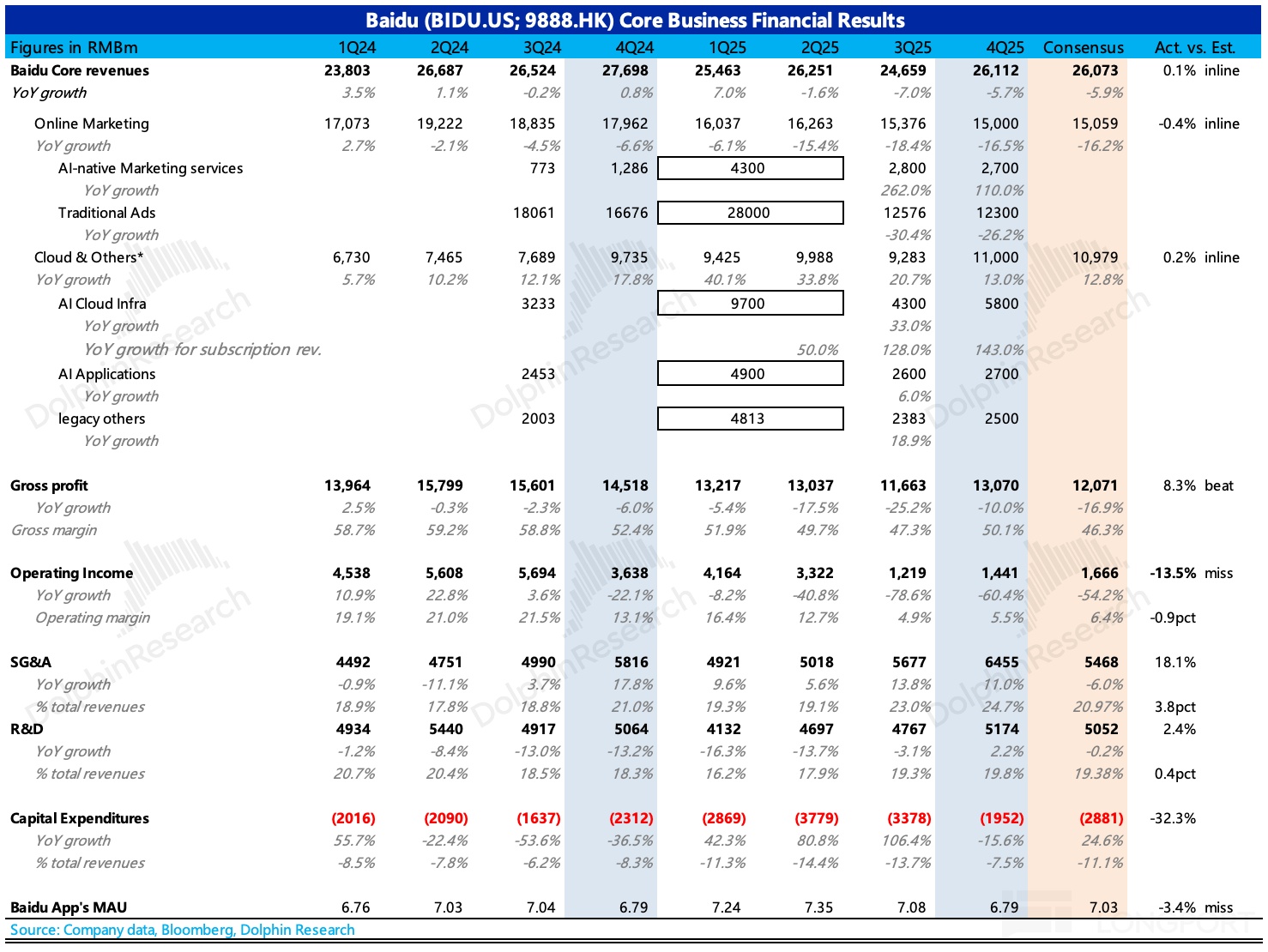
Core AI biz. metrics (Q4 2025)
- Baidu General Business revenue: RMB 26.1bn.
- Core AI-powered Business revenue: >RMB 11.0bn, 43% of Baidu General Business.
- AI Cloud Infra - subscription revenue for AI accelerator infra: +143% YoY, accelerating vs. Q3's +128%.
- Apollo Go fully driverless orders: 3.4mn rides delivered, total orders up >200% YoY.
Core AI biz. metrics (FY2025)
- AI Cloud Infra revenue: Approx. RMB 20.0bn, +34% YoY, outpacing the industry.
- AI applications revenue: >RMB 10.0bn.
- Apollo Go fully driverless orders: >10mn rides delivered, >20mn cumulative rides provided to the public.
- AI-native marketing services (digital humans and agents) revenue: +110% YoY.
II. Earnings Call Details
2.1 Management Highlights
(1) Core AI capabilities and infra
Kunlun Chip: Built on in-house architecture to deliver scalable, stable, high-performance AI compute, broadly compatible with diverse models and frameworks. This lowers integration cost and speeds deployment, and has been rolled out at scale across leading enterprises in financial services, telecom, IT and internet.
AI Cloud: Among the most advanced infra in China. Its full-stack, end-to-end AI architecture is increasingly differentiated, with sustained advantages in stability and cost efficiency by owning and optimizing all four layers. Revenue mix is shifting toward a more recurring, healthier structure.
Foundation model (ERNIE): Application-first approach. Recently reorganized the model org into two dedicated teams: one to advance ERNIE's state-of-the-art base model capabilities, and another to tailor models for specific biz. needs to lower cost, improve latency, and optimize scale and efficiency. This ensures tech leadership and ease of scaling across businesses.
(2) AI applications progress
AI Search: Ongoing AI-led search transformation to lift result quality and expand tasks users can complete directly. Examples include AI-generated infographics in results and MCP-enabled actions for shopping and booking. By integrating the open-source agent framework OpenClaw into the Baidu App, nearly 700mn MAUs benefit directly.
ERNIE Assistant: Expanded multimodal capabilities drove MAU to >200mn in Dec. Adoption of the AI Search API accelerated, with calls up >110% QoQ.
Digital humans: In Dec 2025, the number of digital humans livestreaming on Baidu platforms rose nearly 200% YoY. Ultra-realistic digital human production cost fell to roughly one-third of the prior quarter, delivering best-in-class value, with partnerships signed with JD, Zuoyebang and TikTok.
MeDo (zero-code dev platform): By early Feb, users worldwide had created over 1mn AI apps on the platform.
Enterprise AI apps: ETN (vision intelligence platform) is used by coffee chains and QSRs for automated compliance and safety checks. FM Agent (self-evolving agent) has been validated across manufacturing, energy and financials.
(3) Physical AI / Autonomous Driving (Apollo Go)
Scale and growth: Q4 delivered 3.4mn rides, with weekly peak >300k, and total orders up >200% YoY. Cumulative rides now exceed 20mn, reinforcing global leadership.
Global expansion: footprint now spans 26 cities.
- UK: advancing partnerships with Uber and Lyft, targeting autonomous testing in London in 1H26.
- Switzerland: launched tests in St. Gallen.
- Middle East: progress in Abu Dhabi (service launched via Auto Go) and Dubai (secured first fully driverless testing permit and announced service via Uber).
- Asia: entered Korea (Seoul metro area); expanded Hong Kong tests (Tsuen Wan, Airport Island and Tung Chung corridors).
Safety and biz. model: Safety is paramount. A fully driverless vehicle sees one airbag-triggering accident per >12mn km. With growing experience across markets, the company is confident about further scaling and achieving positive unit economics in more cities.
(4) Other
Shareholder returns: Announced a new $5bn buyback and adopted its first dividend policy, underscoring a sustained focus on shareholder value creation.
Org changes: Set up the Personal Super Intelligence Group (PSIG), integrating Baidu Wenku and Baidu Netdisk. The aim is to accelerate new app launches through deeper collaboration and foster an application-led growth curve.
2.2 Q&A
Q: Model iterations have been very active. How do you view the current competitive landscape? BIDU recently updated ERNIE 5.0 and made org changes. Can you discuss the strategy behind this, and how you see the interplay between model evolution and applications in your AI strategy?
A: Model launches have indeed been active, with fierce and fast-evolving competition. But we have always believed applications matter more than models, as models ultimately create value through applications.
That is why we take an application-driven approach. Model improvements are guided by the most valuable and promising use cases, which has been consistent across ERNIE iterations. We recently released an updated ERNIE 5.0.
We have also proactively evolved our organization to stay agile in a fast-moving market. We reorganized the model team around distinct focus areas.
One team continues to push frontier capabilities at the base-model layer to maintain technical leadership. ERNIE shows clear strengths in creative writing, multimodal understanding and instruction following.
We are confident we will keep improving ERNIE in key application scenarios. Meanwhile, high-value use cases feed ERNIE with real-world data and feedback, driving faster model iteration.
Another team is closer to specific needs and application scenarios, focused on lowering cost, boosting speed and improving efficiency, or leveraging the best available model for a given use case, all to help enterprises adopt AI based on real needs.
We recognize model capabilities are broad and use cases are diverse, and no single model can lead across everything. So we lean into ERNIE where it is strongest, while staying open to other models where they are a better fit to deliver the best application outcomes.
In short, we will keep an application-driven approach, iterating and optimizing models based on real demand while improving the apps themselves. The goal is to deliver better results and tangible value for users and enterprises.
Q: BIDU's AI Cloud delivered strong growth in 2025. What were the key drivers behind this resilient revenue performance? How should we think about 2026 growth for AI Cloud?
A: In 2025, AI Cloud revenue (AI cloud infra plus AI applications) reached RMB 30.0bn. AI Cloud Infra revenue rose 34% YoY, outgrowing the market.
Within that, subscription revenue from AI accelerator infra grew 143% YoY in Q4 and has become the main growth driver. Momentum is strong, and we remain highly confident in sustaining robust growth into 2026.
Our growth is underpinned by accelerating enterprise AI adoption. We see rising demand for both training and inference workloads and expect AI compute demand to continue expanding, creating significant opportunities.
Baidu's full-stack, end-to-end AI architecture is a key differentiator to capture this opportunity. It is anchored by our industry-leading AI infra that balances performance, efficiency and cost.
Our AI infra is powered by a diversified chip portfolio. We have deep expertise in heterogeneous compute and unified scheduling to efficiently manage resources across chip vendors, achieving industry-leading performance and efficiency, while our in-house chip capabilities offer a material competitive edge.
As Robin mentioned, our self-developed Kunlun AI chips deliver strong performance, compatibility and cost efficiency. They have been deployed at scale among leading enterprise customers in financial services, telecom, energy and the internet sectors, with very positive feedback.
Kunlun is also a critical component of our own cloud compute capacity and plays an important role in our overall AI infra. As AI demand grows, the advantages of our AI infra will become even more evident.
Beyond infra, we are continuously evolving our industry-leading agent infra to help enterprises rapidly build and scale AI agents.
We keep introducing cutting-edge capabilities. For example, we recently enabled simplified open-source Claw deployment on Baidu AI Cloud so even non-coders can quickly spin up their own open-source Claw agents.
Looking to 2026, as enterprise AI deployments deepen, we are confident our cloud biz. will continue to outgrow the industry. We expect AI Cloud Infra to maintain strong momentum, with AI accelerator infra remaining the core driver, powering a more sustainable, higher-quality growth profile for the overall cloud business.
Q: AI revenue keeps scaling. How do you view the current stage of these AI businesses? When could they reach 50% of Baidu General Business, and what will drive future growth?
A: Our core AI businesses include AI cloud infra, AI applications (e.g., Baidu Wenku and Baidu Netdisk), Apollo Go Robotaxi, and AI-native marketing services (agents and digital humans).
These lines are organized around product and service characteristics, with AI enabling each to deliver real customer value and commercial impact. In Q4, AI revenue exceeded RMB 11.0bn, or 43% of Baidu General Business, rising quickly in recent quarters to become a core growth driver.
Each AI business has a clear strategy and competitive edge.
First, AI cloud infra. We see enterprises moving from pilots to production, where our end-to-end capabilities deliver strong performance at competitive cost. AI Cloud Infra outgrew the industry in 2025, and subscription-based AI accelerator infra re-accelerated meaningfully in Q4.
Second, AI applications. We have long believed AI's ultimate value accrues at the application layer, and we have built one of China's most comprehensive AI app portfolios. As AI capabilities evolve and new use cases emerge, we see significant room to scale.
Third, Apollo Go Robotaxi. It is scaling fast while expanding internationally. We lead globally on operating scale, safety record, efficiency and cost structure.
Fourth, AI-native marketing services such as agents and digital humans. They improve engagement and conversion, with strong market uptake and large future potential.
Over the mid-to-long term, as enterprise AI deployments deepen, AI app monetization improves, and physical AI use cases like autonomous driving expand, we are confident in the growth trajectory. These AI businesses reinforce one another through our full-stack capabilities, and based on current visibility, we expect core AI to become the majority of Baidu General Business in the foreseeable future.
Q: How do you frame capital allocation among shareholder returns, organic investment and strategic opportunities? Also, comment on Kunlun's longer-term strategic role within the group.
A: You have likely noticed a series of recent actions. These include enhanced disclosures, operating efficiency gains, org optimization, progress on the proposed Kunlun spin-off and standalone listing, and a new buyback program and our first dividend policy, alongside the formation of PSIG integrating Wenku and Netdisk.
Collectively, these moves reflect a coherent execution framework, demonstrating improved managerial delivery and a sustained commitment to shareholder value creation.
Take the new buyback as an example. We are focused on providing clear and sustainable returns. In Feb, the BOD approved a new $5bn buyback to be executed regularly in a disciplined and transparent manner, and we also announced BIDU's first dividend policy.
We believe the policy plus a sizable buyback will strengthen our shareholder return profile and broaden our investor appeal, further diversifying the base.
As you noted, the proposed spin-off and standalone listing of Kunlun is another strong example, and listing progress has been solid. Kunlun reflects over a decade of investment and is a critical infra layer within our four-layer AI architecture. We believe the spin and separate listing will be well received and unlock substantial value for BIDU.
Looking ahead, we are confident in the company's intrinsic value and will continue to unlock it through various initiatives. We remain committed to sustainable, consistent shareholder returns, with more actions to come at the appropriate time.
Q: On Robotaxi, congrats on expanding to more countries, including my hometown Hong Kong. What is the 2026 overseas strategy and key competitive edge?
Also, given Waymo's recent valuation, how do you plan to unlock Apollo Go's value? Would you consider a spin-off?
A: As noted last quarter, Robotaxi has reached a global inflection point. With continued safe operations and positive mileage, more countries and regions are building favorable environments, and we expect industry acceleration in 2026.
Apollo is a clear global leader. We have completed over 20mn cumulative rides. At peak, weekly fully driverless rides exceeded 300k. To date, the Apollo Go fleet has driven over 300mn km, including over 190mn km fully driverless, with an excellent safety record, and we continue to advance leading tech to improve safety and comfort.
We are also accelerating international expansion to capture global opportunities. Our footprint now spans 26 cities across continents and covers both left- and right-hand-drive markets, with reliable performance across varying traffic patterns and urban environments. Notably, few players are entering Robotaxi, while we have built and are scaling the business.
We also have a fundamental cost advantage. RT6 is the world's first purpose-built, mass-produced vehicle designed from the ground up for L4 autonomy. Priced below $30k per unit, RT6 delivers the best cost structure in the industry; combined with leading operating efficiency, this enables the lowest global cost per mile while maintaining top-tier safety. We were the first to reach UE breakeven in Wuhan by end-2024, and most major cities have higher ride-hailing prices than Wuhan.
To accelerate global rollout, we leverage diversified strategic partnerships. For example, we are working with Uber and Lyft to launch in London this year, and with Uber in Dubai, enabling faster, more efficient market entry.
We view Apollo Go as a strategic growth engine with significant long-term potential. Many large cities face driver shortages. Robotaxi capacity enhances safety and stimulates ride-hailing demand, supporting higher tax revenues, while freeing up parking land and creating incremental monetization opportunities for these real assets.
We are focused on three areas. First, scaling safe and comfortable operations by deploying more vehicles. Second, continually improving unit economics with a goal of achieving UE breakeven in more cities this year. Third, expanding domestically and internationally with flexible biz. models.
On strategic options, we will stay flexible and evaluate the best path to maximize long-term shareholder returns. Our focus remains on execution and sustainable growth, and we believe the autonomous ride-hailing sector is still undervalued. Over time, valuations should better reflect its transformative potential, creating meaningful upside for Apollo Go.
Q: Consumer-facing AI competition has intensified lately, especially over CNY. How do you assess the landscape? What differentiates BIDU's AI-to-C offerings like ERNIE Assistant, and how do you think about monetization?
A: The AI-to-C market is highly competitive. Some peers adopted very aggressive tactics over CNY to scale users quickly. As tech and products evolve rapidly, we believe strategy must stay anchored in real user needs, and we remain committed to enhancing products and services through AI innovation.
Within our flagship Baidu App, ERNIE Assistant strengthens our coverage from information sync to solutions and task completion across the full user journey. For information sync, we have significantly improved how users obtain information.
For example, with RAG we improved answer accuracy and relevance, while maintaining low error rates and minimal hallucinations for high-trust content. We also integrated multilingual AI Search API capabilities so users can access broad sources during conversations, improving richness and usefulness for scenarios like travel planning. In Dec, ERNIE Assistant MAU surpassed 200mn, with rapid growth in dialogue rounds and interactions.
For task completion, we are integrating MCP agents to connect users with tools and real-world services. In Q4 alone, we added nearly 100 services, notably across healthcare, travel, education and e-commerce. For instance, via the Baidu Health MCP integrated in ERNIE Assistant, users can access a suite of healthcare services from online to offline. In e-commerce, our MCP modules delivered very strong QoQ GMV growth.
Separately, the standalone ERNIE App serves as a platform for innovation and experimentation. Our early multimodal features resonated well with younger users. Recently, we added workplace productivity-focused AI capabilities to tackle complex professional tasks, and we are seeing early positive signs.
We take a prudent approach to monetization, prioritizing product excellence and user experience. Monetization will follow as products mature.
Q: On AI investment, how do you view AI-related capex over the next 12–24 months? What returns and margin impacts should we expect, and where do you see efficiency gains to support margins and cash flow?
A: First on capex and AI investment, since the Mar 2023 launch we have invested over RMB 100bn, and we expect to maintain this investment intensity going forward.
Second, we are very focused on returns and understand investor attention on ROIC. That is why we have worked to improve financial performance, delivering solid progress on key metrics in recent quarters.
For example, in Q4 Baidu GP grew double-digit QoQ, and non-GAAP OP rose Approx. 30% QoQ. Margins also improved. Importantly, operating cash flow turned positive in Q3 and remained positive in Q4, reaching nearly RMB 4.0bn in 2H, and FCF also turned positive in Q4.
Third, we have identified alternative financing channels to support needs, including operating and finance leases, and access to low-interest bank loans, some at rates below 2%. These help us sustain AI investment and business growth while maintaining a healthy long-term funding structure.
In sum, we will maintain AI investment intensity while balancing investor focus on profitability and return timelines. We believe operating cash flow will stay positive even with significant AI investment.
Risk Disclosure and Statement:Dolphin Research Disclaimer and General Disclosure
