


 Likes Received
 Rate Of Return
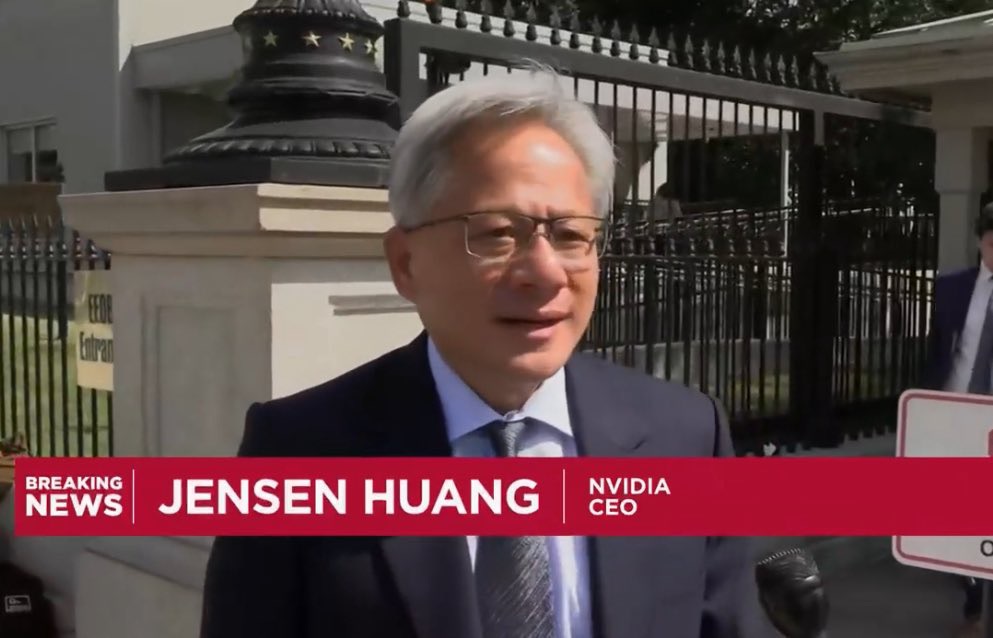
🎯 Jensen Huang's Latest Interview: NVDA is No Longer Just a Chip Company
If you're still viewing NVIDIA through the old lens, you might have completely missed the main storyline.
Jensen Huang's latest interview reveals the true ambition of this market cap giant—it's not making chips, it's building AI factories; it's not managing a company, it's designing a precision machine.
Here are the 5 most thought-provoking core insights from this interview 🧵👇
1/ From Chips to Data Centers: A Complete Strategic Rebuild
Huang stated plainly that the scale of modern AI problems is no longer solvable by a single GPU. NVIDIA's positioning has shifted from "chip supplier" to "data center-level system designer."
Their goal is not linear expansion, but non-linear acceleration. From algorithms, software, hardware, networking to cooling, they provide a complete, optimized "AI factory" solution.
In other words, NVIDIA is no longer selling parts, but the production lines for the AI era.
2/ Management as Design: He's Building the Company Like a Machine
To achieve this level of extreme co-design, the management approach must change completely.
Huang directly manages over 60 top experts from different fields—from memory, CPU, optics to algorithms. He doesn't hold one-on-one meetings; instead, he throws problems directly to the entire team.
The benefit is simple: break down departmental silos and make systems thinking the default mode.
3/ The Craziest Bet: Making CUDA Ubiquitous
He mentioned again in the interview that NVIDIA's riskiest decision was embedding CUDA into every consumer GeForce GPU.
This move once nearly wiped out profits and caused the market cap to plummet. But Huang's logic was clear: the success of a computing platform depends on the developer ecosystem and user base.
By putting CUDA into millions of gamers' PCs, NVIDIA unknowingly laid the deepest moat for the AI revolution.
4/ AI Scaling: After One Bottleneck, Comes Another
How does Huang view the next step for AI? He sees it as a cycle of breaking through bottlenecks:
· Data bottleneck → solved by synthetic data
· Inference bottleneck → complexity far exceeds training
· Agent bottleneck → AI will move towards collaborative teams
The ultimate constraint remains computing power, and behind that, energy. The only solution: extreme co-design to maximize performance per watt.
5/ His Decision-Making Style: Build Belief First, Then Consensus
Many wonder how Huang drives such bold transformations.
His method: first paint the future using first principles, then gradually build consensus through rounds of conversations, meetings, and presentations.
By the time major decisions like acquiring Mellanox or going all-in on deep learning are officially announced, everyone already feels "it was inevitable."
Summary
The true core logic of NVIDIA is laid bare in this interview:
· Not making chips, but building AI factories
· Not just managing a company, but designing it as a machine
· Not chasing short-term profits, but betting on the ecosystem to win the future
If you're still looking at NVIDIA through the old framework, perhaps it's time to think again:
They aren't participating in the AI era—they are building it.
$NVIDIA(NVDA.US) $C3.AI(AI.US)
The copyright of this article belongs to the original author/organization.
The views expressed herein are solely those of the author and do not reflect the stance of the platform. The content is intended for investment reference purposes only and shall not be considered as investment advice. Please contact us if you have any questions or suggestions regarding the content services provided by the platform.
