


BYD: Crown Lost; A 'Toyota' Abroad Next?
$BYD COMPANY(01211.HK) released its Q4 2025 results after the Hong Kong close on Mar. 27 (Beijing time). Key takeaways are below.
1. Revenue beat was driven by BYD Electronics; auto revenue in line: Q4 revenue was RMB 237.7bn, slightly above the RMB 236.7bn consensus, largely on strong QoQ growth in non-core businesses. In the core auto segment, revenue was RMB 181.5bn, broadly in line, but ASPs kept slipping.
In the core auto sales line, Q4 revenue reached RMB 181.5bn, matching market expectations. However, vehicle ASPs continued to trend down.
2. ASP still on a downtrend: In Q4, auto ASP fell by RMB 1,500 QoQ to RMB 135,000, as clearance discounts offset the mix-upside from premiumization and exports. Inventory-clearing pressure restrained the structural ASP benefits.
To prepare for higher NEV purchase tax thresholds in 2026 (PHEV pure-electric range requirement rising from 43km to 100km), BYD rolled out deep terminal discounts and tax make-good promotions on models facing phase-out. These price cuts directly countered the ASP uplift from premiumization and export mix gains.
4. Auto GPM improved, but less than expected: The market expected easing price wars, Q4 scale benefits, and stronger overseas sales to lift auto GPM by at least 200bps QoQ to 22.5%. Actual auto GPM was 21.6% (+100bps QoQ), held back by supply chain cost inflation and a spec bump at same price to make core DM-i models (Qin, Song series) compliant with 2026 tax thresholds, which raised BOM costs.
Auto GPM came in at 21.6% (+100bps QoQ), missing the 22.5% consensus. Supply chain cost upticks and mandated feature upgrades to meet the 2026 tax exemption thresholds drove higher BOM costs.
5. Overseas ASP and margin rose QoQ; domestic still under heavy pressure: By region, overseas high ticket sizes remain the primary driver of mix optimization. In 2H25, overseas ASP reached RMB 186,000 (+RMB 3,000 QoQ), about 1.5x domestic ASP (RMB 127,000, -RMB 3,000 QoQ).
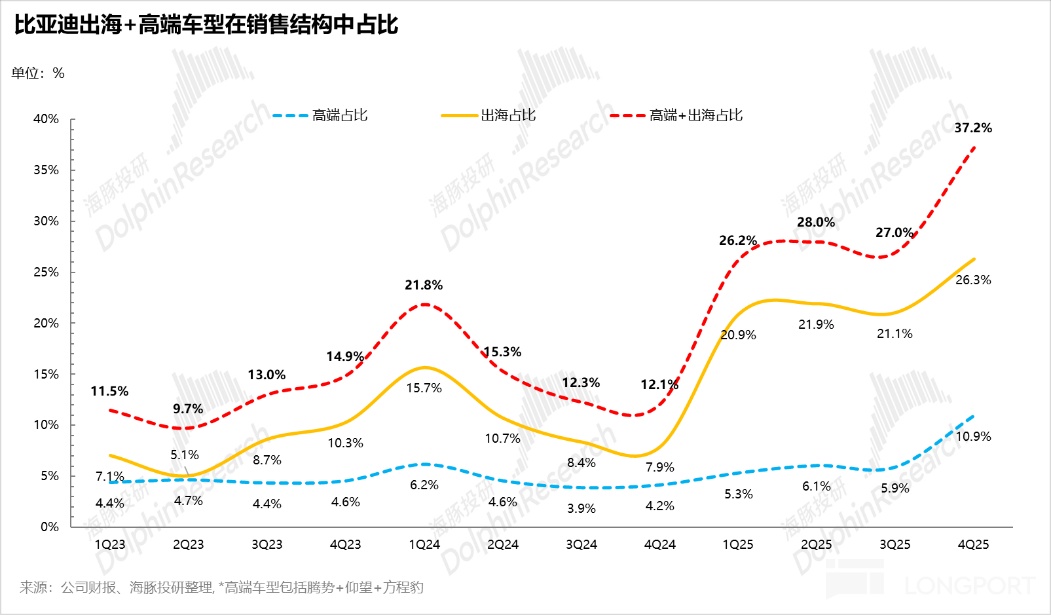
With overseas volume mix jumping to 26.3% in Q4, these higher-priced models served as a ballast for overall ASP. They anchored the blended price against a steeper decline.
6. Net profit per vehicle at RMB 6,700, below expectations: Net profit per vehicle was RMB 6,700, as cost reductions lagged, selling expenses rose sharply QoQ, and other income (likely lower subsidies) capped profit release. Domestic sales pressure persisted through Q4.
Dolphin Research view:
Overall, Q4 missed on quality versus expectations. Revenue beat was driven by non-core BYD Electronics, while auto ASPs continued to fall, cost declines were insufficient, and auto GPM, though warmer, still missed consensus.
The main drag on per-vehicle GP and NP remains weak domestic performance under heavy pressure. In 2H25, domestic ASP and auto margins still fell QoQ, BYD struggled to defend its former leadership, and market share erosion continued, while overseas growth acted as a ballast.
That said, Q4 pressure and the Q1 slide are largely in the price. The key now is the outlook for 2026.
From BYD's 2026 strategy, its Mar. tech event focused on MW fast charging and Gen-2 Blade batteries. This frames a clear 2026 product playbook:
1) Rebuild BEV competitiveness via long range and ultra-fast charging
BYD aims to deliver ICE-like refueling parity with fast-charging at scale (10%–70% in 5 minutes at ambient, 10%–97% in 9 minutes). Gen-2 Blade boosts energy density by 5% and, paired with a 1000V platform and high-efficiency motors, enables step-change range (e.g., Denza Z9 GT BEV range above 1,036km).
It couples this with an aggressive infra and marketing push (20,000 flash-charging stations by end-2026 and 1-year free fast-charging). Critically, 6C fast-charging is cascaded to RMB 150–200k core models (e.g., Song Ultra EV, Sealion 06 EV), directly targeting Geely and XPeng in the 800V mass segment.
For PHEVs (e.g., Song Pro DM-i), pure-electric range is approaching the 200km class. BYD's 2026 lineup is expected to see material range upgrades.
2) 'Intelligent driving for all' pushes downmarket; Q2 is the key validation window
To close gaps, BYD has pivoted to in-house hardware and software, reducing third-party reliance for tech control and cost. Launched in Jan. 2026, the DiSus 5.0 intelligent driving stack uses an end-to-end foundation model to materially improve AEB and enable mapless city NOA.
The early-year event did not clearly confirm a full cascade of city NOA to RMB 100–150k core models. The crux is whether its in-house city NOA, slated for SOP around Apr., can truly deliver 'intelligent driving for all' at the RMB 100k level, fortifying its mainstream moat.
3) Build DM 6.0 to defend the PHEV base
Supply chain checks suggest DM 6.0 thermal efficiency could exceed 48%. With variable-flux motors, full-battery range improves further and charge-depleting fuel consumption could drop to 1.8–2.79L/100km (vs. DM 5.0 at 2.9L/100km), a tangible step-up.
However, given a likely 2H26 launch, this will not provide near-term relief for current PHEV volume pressure. The benefit will be back-end loaded.
Dolphin Research believes supercharge network build takes time, purchase tax changes bite, and new subsidies tilt to RMB 167k+ mid-to-high price bands, which is unfavorable for BYD's RMB 100–150k core. The domestic base faces significant challenges.
Combined with pricing disclosed at prior events, BYD is shifting sub-RMB 200k models toward defending profit and stabilizing the base, rather than reigniting an aggressive price war. We see limited scope for a sharp domestic volume rebound in 2026.
Dolphin estimates 2026 China sales up a modest 5%–10% to 3.75–3.92mn units in a neutral-to-optimistic case (share stabilizes). In a bear case, sales could fall 5% to 3.39mn.
Against this backdrop, overseas becomes the key 2026 earnings driver:
Overseas volumes surged to 350k units in Q4 2025, and in Jan.–Feb. 2026 accounted for as much as 51% when domestic slowed. More importantly, higher ASP and margin abroad make overseas the true profit ballast.
In 2H25, overseas ASP reached RMB 186,000 (+RMB 3,000 QoQ), about 1.5x domestic ASP at RMB 127,000 (-RMB 3,000 QoQ). With Q4 overseas mix up to 26.3%, high-priced models anchored blended ASP.
If 2026 exports reach 1.5–1.6mn units, and per-vehicle NP abroad is ~RMB 20,000, overseas could contribute RMB 30–32bn in net profit. That would be nearly two-thirds of total auto profits, creating a profit cushion against domestic competition.
Based on these fundamentals, we run a SOTP for 2026 under a neutral-to-optimistic case:
Assuming 3.75–3.92mn units in China and 1.6mn overseas, we estimate 2026 net profit at RMB 47.0–47.7bn. This implies global blended NP per vehicle of ~RMB 8,600–8,800.
Battery/energy storage valuation: Given high growth in storage, the market may assign a standalone multiple under a bullish setup. We estimate 2026 storage shipments at 75GWh (vs. 50GWh in 2025, +50% YoY), with NP/Wh of RMB 0.07 (40% discount to CATL), implying NP of ~RMB 5.3bn and a 30x PE, or ~RMB 159bn in market value.
Auto valuation: Excluding battery/storage profit, 2026 auto NP is ~RMB 41.7–42.4bn. At 20x PE, implied market value is RMB 834–848bn.
BYD Electronics: Add current market cap of ~RMB 40–50bn. Sum-of-parts yields a total equity value of RMB 1.03–1.06tn at a relatively optimistic sentiment peak.
Bottom line: Versus current A-share market cap, upside is ~7%–15%, implying limited elasticity. While the Apr. intelligent driving event could be a near-term catalyst, the long-term multiple depends on overseas localization ramp and sustained volume beats.
PS: BYD has a complex structure spanning autos, handset components and assembly, secondary batteries and PV, but Dolphin Research's deep dives from last Jul. — 'BYD: The Best Battery Maker in the Auto Game' and 'BYD: After the Surge, Stability First' — isolate the core. Autos remain the key lens; readers new to the name can refer back to these two pieces.
Detailed analysis follows:
I. Auto GPM warmed but missed expectations
Each print, the market focuses on auto GPM. In Q4, with volumes known and no heavy discounts under the 'anti-involution' stance, BYD delivered 1.34mn units, down 12% YoY.
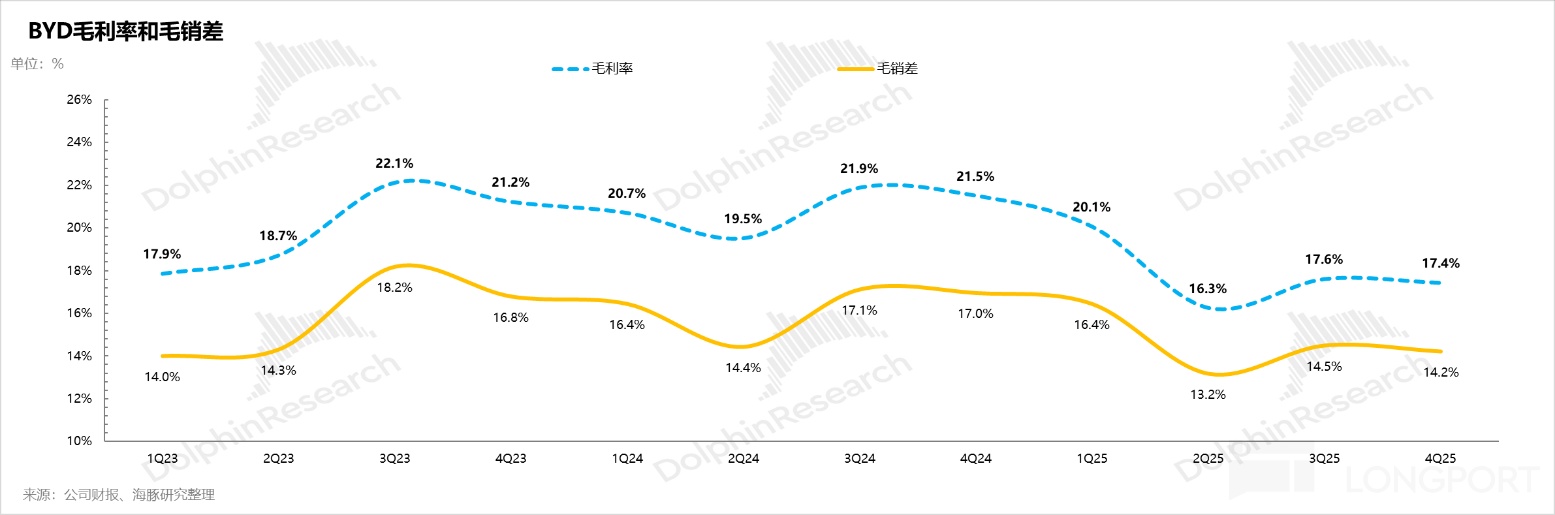
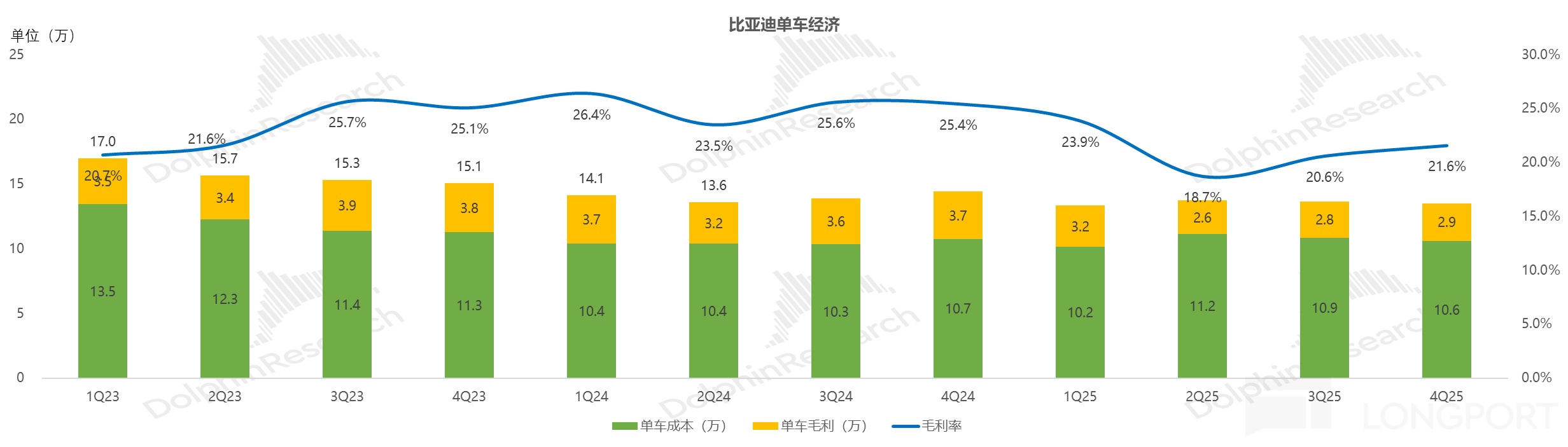
Given no large-scale promotions, a higher mix of overseas and premium models, and some scale effects (deliveries +20.5% QoQ to 1.34mn), the market had expected auto (incl. battery) GPM to rise QoQ by ~190bps to 22.5%. Actual auto GPM was 21.6% (+100bps QoQ), below the 22.5% consensus.
Meanwhile, ASP was RMB 135,000 in Q4, down RMB 1,500 from Q3's RMB 137,000. ASPs remain on a downward track.
Auto GPM of 21.6% rose by only 100bps QoQ, missing the 22.5% consensus. The shortfall mainly reflects insufficient per-vehicle cost reductions.
Per-vehicle unit economics:
1) ASP: clearance discounts muted mix benefits
In Q4 2025, ASP continued to decline. Despite an improving sales mix toward higher-priced models, blended ASP fell ~RMB 1,500 QoQ to RMB 135,000, as inventory-clearance discounts outweighed mix benefits.
Legacy inventory still being cleared in Q4: To address the 2026 tax threshold step-up for NEVs (PHEV pure-electric range from 43km to 100km) and avoid steep post-holiday depreciation, BYD offered deep terminal discounts and tax make-good packages on soon-to-be-retired models. These cuts directly offset and temporarily masked the price uplift from product mix upgrades.
Higher-end and export mix rising: Despite ASP pressure, mix improved. In Q4, high-ticket exports and premium brands (Denza, Yangwang, Fangchengbao ex-Tai 3) rose 10ppt QoQ to 37.2% of sales.
By region, overseas ASPs are the primary mix driver. In 2H25, overseas ASP was RMB 186,000 (+RMB 3,000 QoQ), ~1.5x domestic ASP at RMB 127,000 (-RMB 3,000 QoQ).
With overseas mix up to 26.3% in Q4, these high-priced models served as a ballast for overall ASP. They helped prevent a steeper blended decline.
2) Per-vehicle cost: scale helped, but 'forced spec bumps' ate the savings
In Q4, per-vehicle cost fell to RMB 106,000, down ~RMB 2,500 QoQ, but short of the sub-RMB 105,000 market expectation. a) Scale effects: 1.34mn deliveries in Q4 (+20.5% QoQ) diluted fixed manufacturing costs.
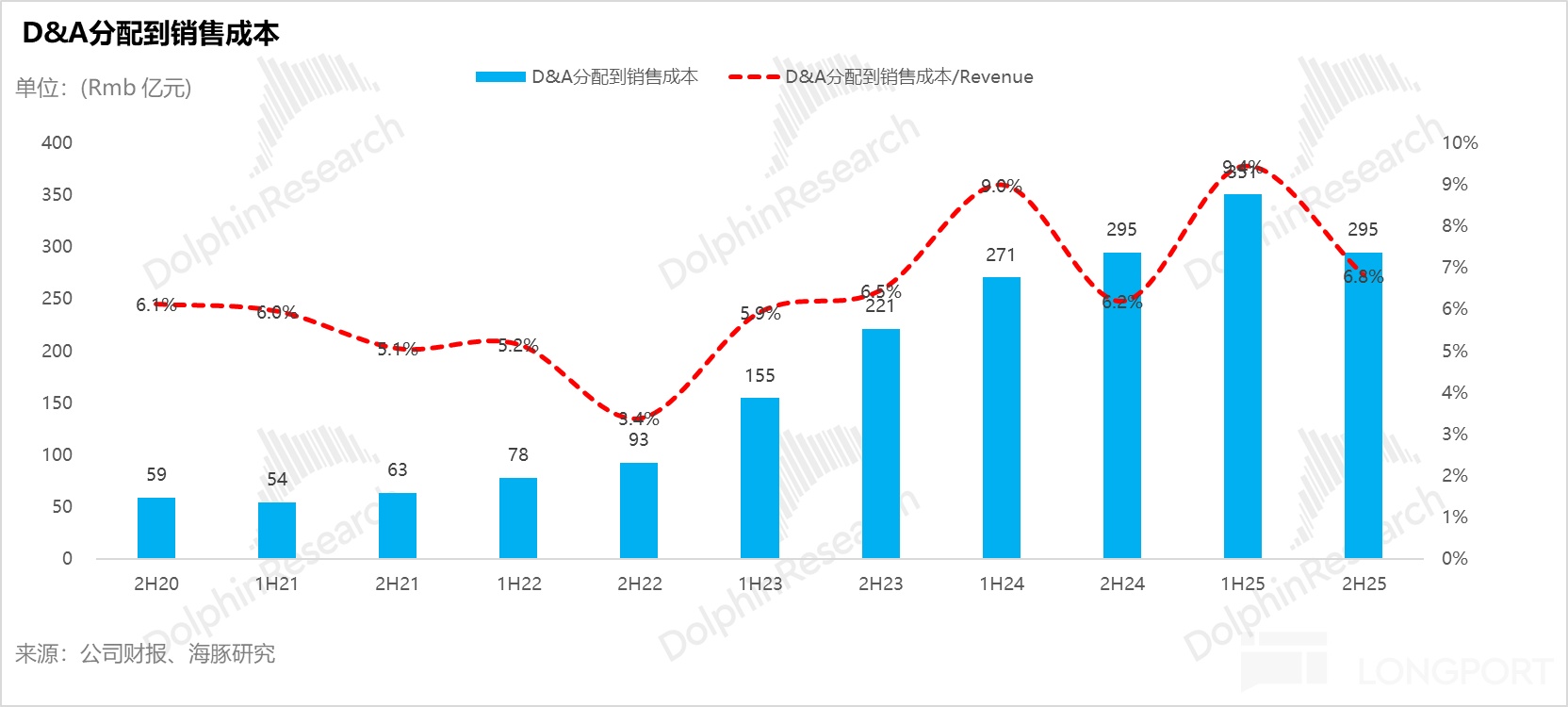
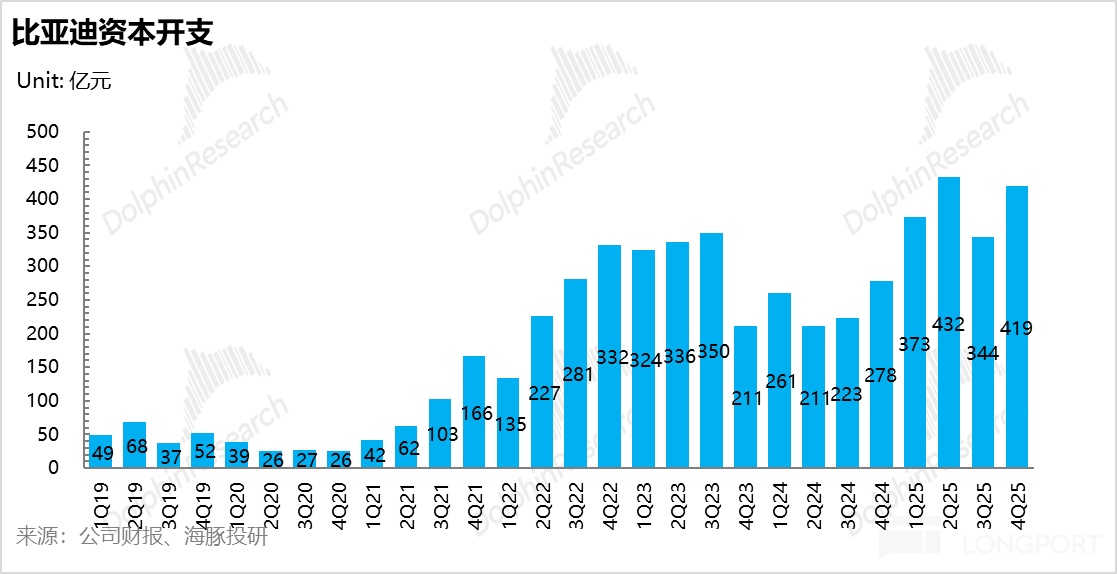
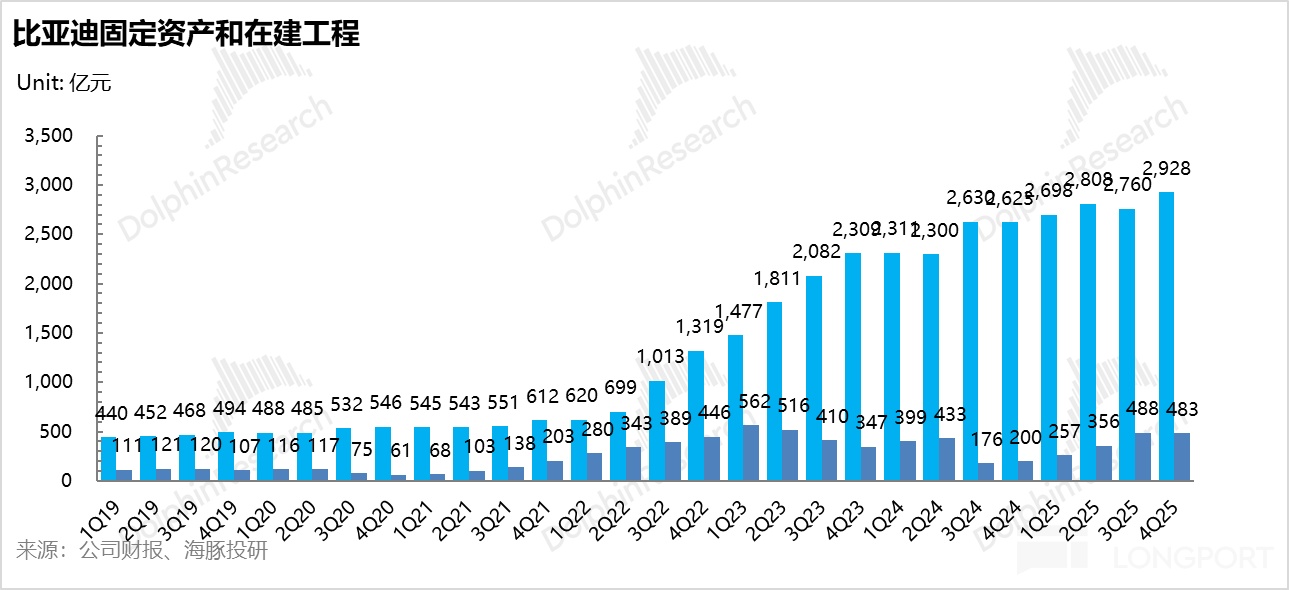
b) D&A burden eased: In 2H25, D&A as a share of revenue fell to 6.8% from 9.4% in 1H25 (-260bps), reflecting scale and extended asset lives, which freed some gross margin headroom. That said, with renewed capex for overseas localization and next-gen battery plants in Q4, future depreciation pressure bears watching.
c) Spec bump at same price raised BOM: This was the key shortfall. On one hand, there were transient supply chain cost fluctuations in Q4.
On the other, to meet the 2026 tax exemption threshold for core DM-i models (Qin, Song), BYD increased electric range above 100km without price hikes. Higher battery capacity per vehicle raised BOM costs and eroded scale-driven savings.
3) Per-vehicle GP: RMB 29,000, below the RMB 30,000 bar
Per-vehicle GP was RMB 29,000 in Q4, up a modest RMB 1,000 QoQ as cost saves slightly outpaced price cuts. Ongoing terminal promotions and insufficient cost downs kept profitability below the RMB 30,000 market bogey.
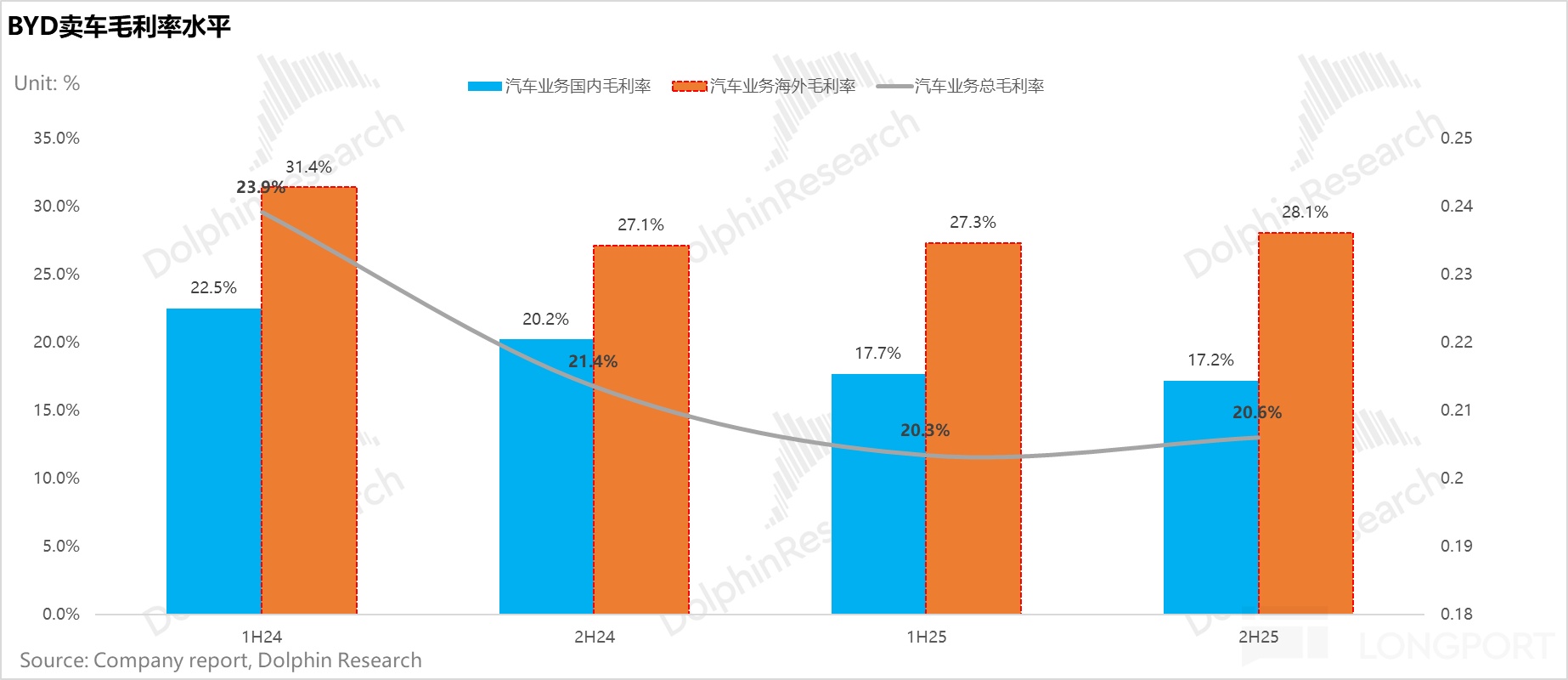
At the margin level, Q4 auto GPM was 21.6%, below the 22.5% consensus. The pressure is domestic, while overseas continued to deliver.
Domestic margin erosion: Clearance discounts and defensive price moves dragged 2H25 domestic auto GPM down another 50bps QoQ to 17.2%, weighing on group margins. Domestic competition remains intense.
Overseas margin strength: Overseas GPM rose 80bps QoQ to 28.1%, widening the onshore-offshore spread to ~1,100bps. High overseas margins continue to backstop group profitability.
II. Per-vehicle net also missed
Q4 consolidated NP attributable to shareholders was RMB 9.3bn, below the RMB 10.1bn consensus. BYD Electronics (BYDE) NP was RMB 380mn, far below the expected RMB 1.2bn, the biggest drag on reported profit.
Ex-BYDE, core auto NP was ~RMB 9.04bn, below the RMB 9.6bn consensus. Still, aided by marginal GP improvement, auto NPM rose ~50bps QoQ to around 5.0%.
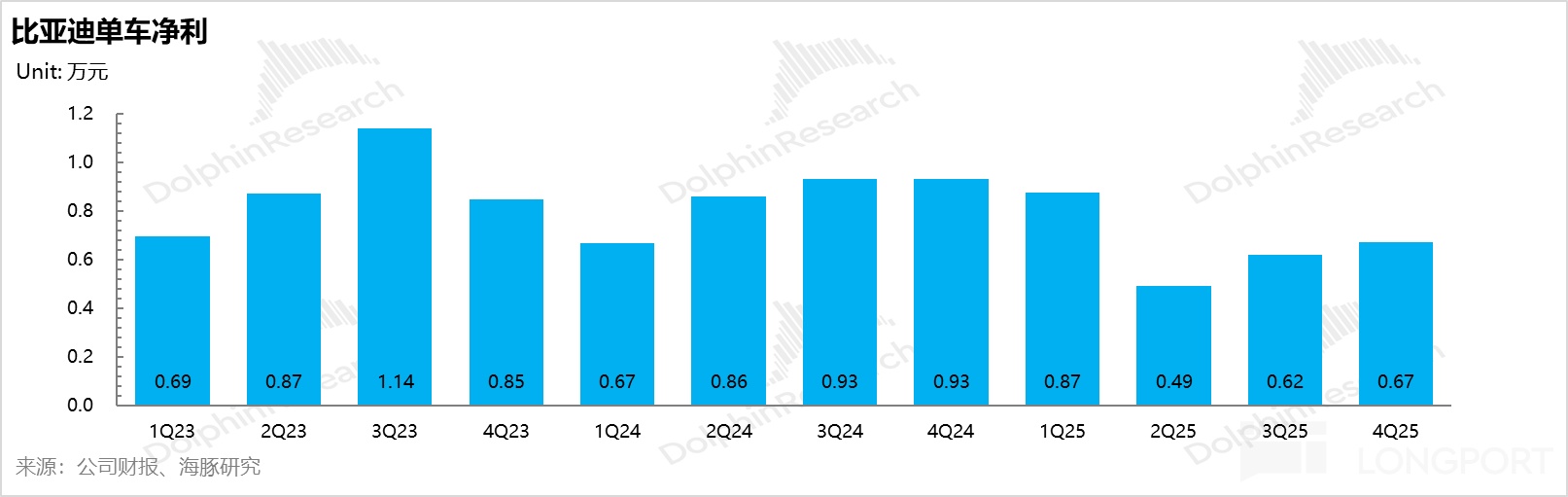
Per-vehicle NP was RMB 6,700, up ~RMB 500 QoQ on scale, but shy of the RMB 7,100 consensus. Key reasons:
1) Auto GPM recovery was modest. 2) To clear legacy models and face year-end price competition, sales and channel investments lifted SG&A materially, absorbing margin gains.
3) Other income declined (likely lower subsidies), limiting final profit release. Profit conversion remained constrained.
Details:
1) R&D: steady investment for intelligent driving and new product cycles, well controlled
R&D spend was RMB 14.2bn in Q4, up RMB 80mn QoQ and below the RMB 15.5bn consensus, with focus on in-house AD algorithms, next-gen e-drive and new platforms. This underpins 2026's dense launch cadence.
New product cycle: refueling parity for electrification, pushing to RMB 150k models
On Mar. 5, 2026, BYD launched Gen-2 Blade and MW fast charging. Key upgrades include:
a) Much faster charging: 10%–70% in 5 minutes and 10%–97% in 9 minutes at ambient, 12 minutes even at -30°C, approaching ICE parity. b) Higher range: +5% energy density vs. Gen-1; Denza Z9 GT BEV range reaches 1,036km.
c) 1000V e-powertrain boosts highway motor efficiency from 82% to 91.5%, adding 12% range. d) Infra push: 'Flash-Charge China' targets 20,000 fast-charge stations by end-2026.
The crucial move is dropping 6C fast charging into RMB 150–200k core models (e.g., Song Ultra EV, Sealion 06 EV). This breaks the 2025 pattern where supercharging sat above RMB 200k and directly counters Geely and XPeng's 800V move downmarket.
Intelligent driving: pivot to in-house stack, launching 'ID for all'
BYD has shifted to a self-research closed loop in hardware and software to secure tech autonomy and cost. The DiSus 5.0 stack, announced in Jan. 2026, uses an end-to-end model aiming for AI self-evolution in driving.
The 2026 linchpin is to bring city NOA to RMB 100k mainstream models, realizing 'ID for all'. An intelligent driving event is slated around Apr. 2026, with in-house city NOA targeted for SOP around then, a key proof point.
2) Selling expenses: RMB 7.7bn, up sharply QoQ
Selling expenses were RMB 7.7bn in Q4, up RMB 1.58bn QoQ and above the RMB 7.4bn consensus. Drivers include:
a) Most mid/low-end models use dealer channels; higher volumes mechanically lift selling expenses. b) To clear legacy inventory and fight year-end pricing, BYD ramped channel and marketing spend.
c) Overseas channel build-out: BYD is accelerating to support 2026 overseas scale-up, planning to double Europe stores to 2,000 by 2026 and target 3,000 by 2030, on par with VW and Toyota. This requires upfront opex.
3) G&A: up only RMB 50mn QoQ, well below the RMB 5.71bn consensus
G&A was RMB 4.93bn in Q4, up just RMB 50mn QoQ, reflecting tight control. Cost discipline remained solid.
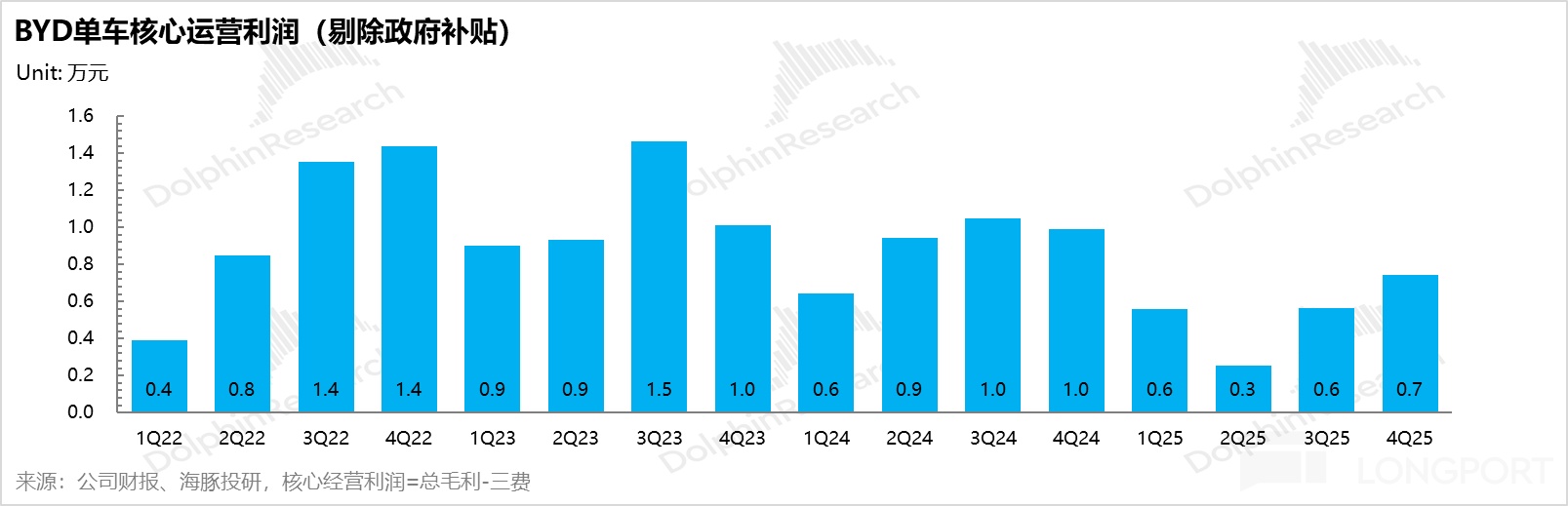
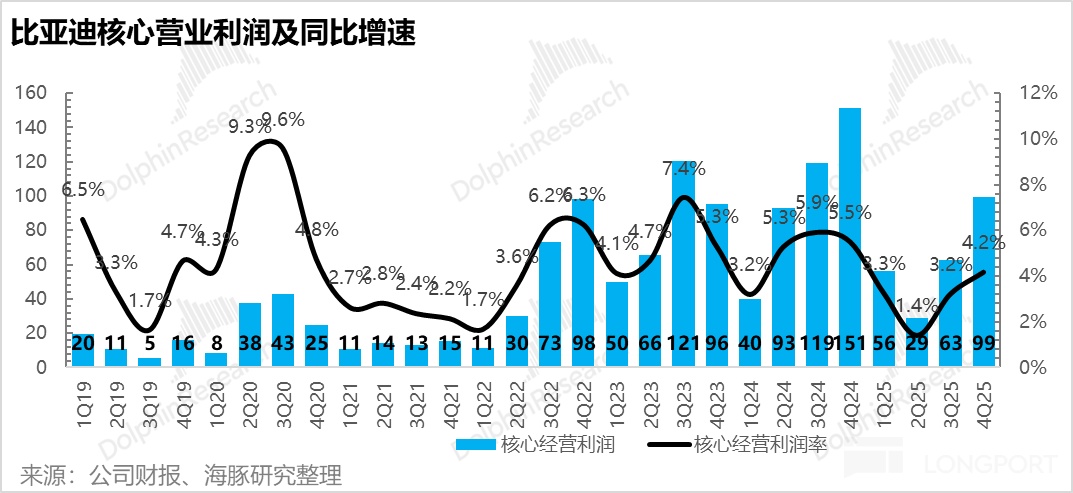
On a per-vehicle basis, core operating profit (core OP = GP minus Opex) continued to recover. Per-vehicle core OP rose from RMB 5,700 in Q3 to RMB 7,400 in Q4, driven by higher auto GPM and volume leverage, with core OPM up from 3.2% to 4.2% QoQ.
III. Domestic share under pressure; BYD seeks to break through via overseas expansion and tech upgrades
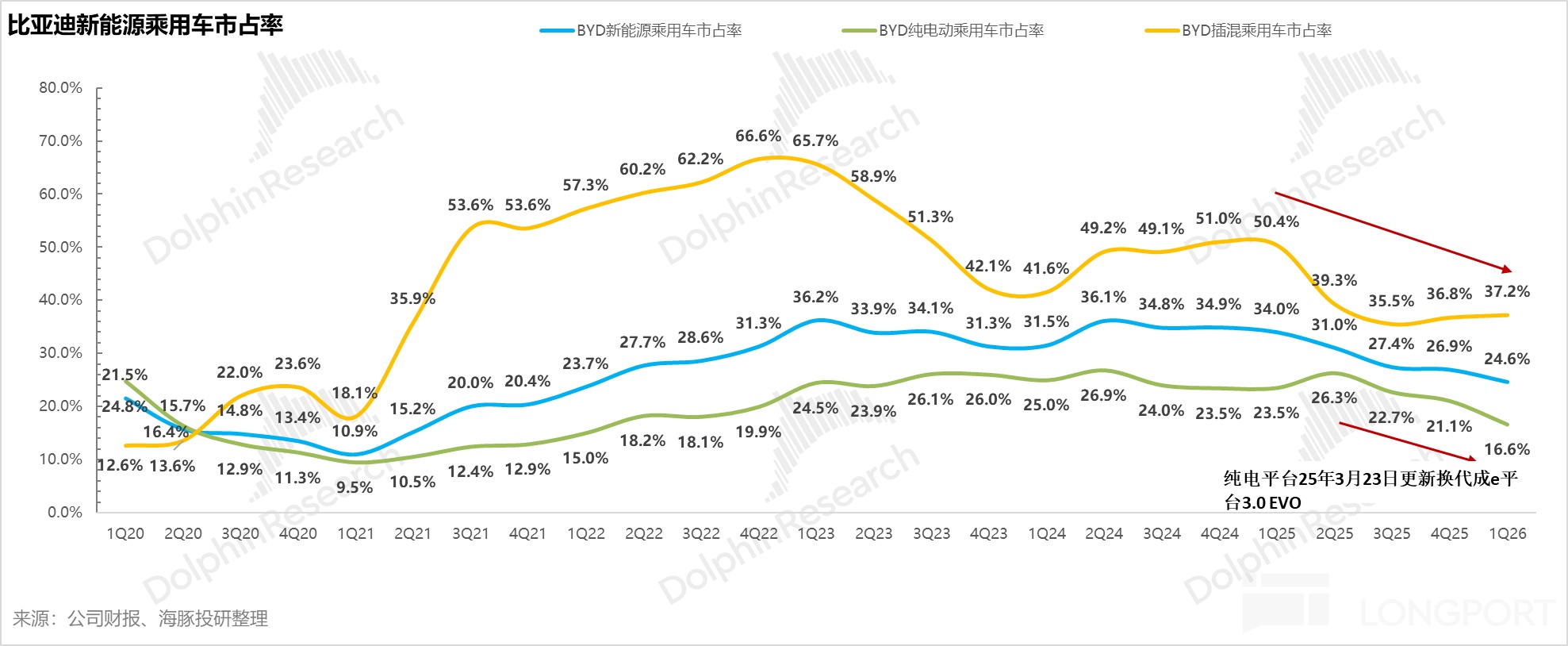
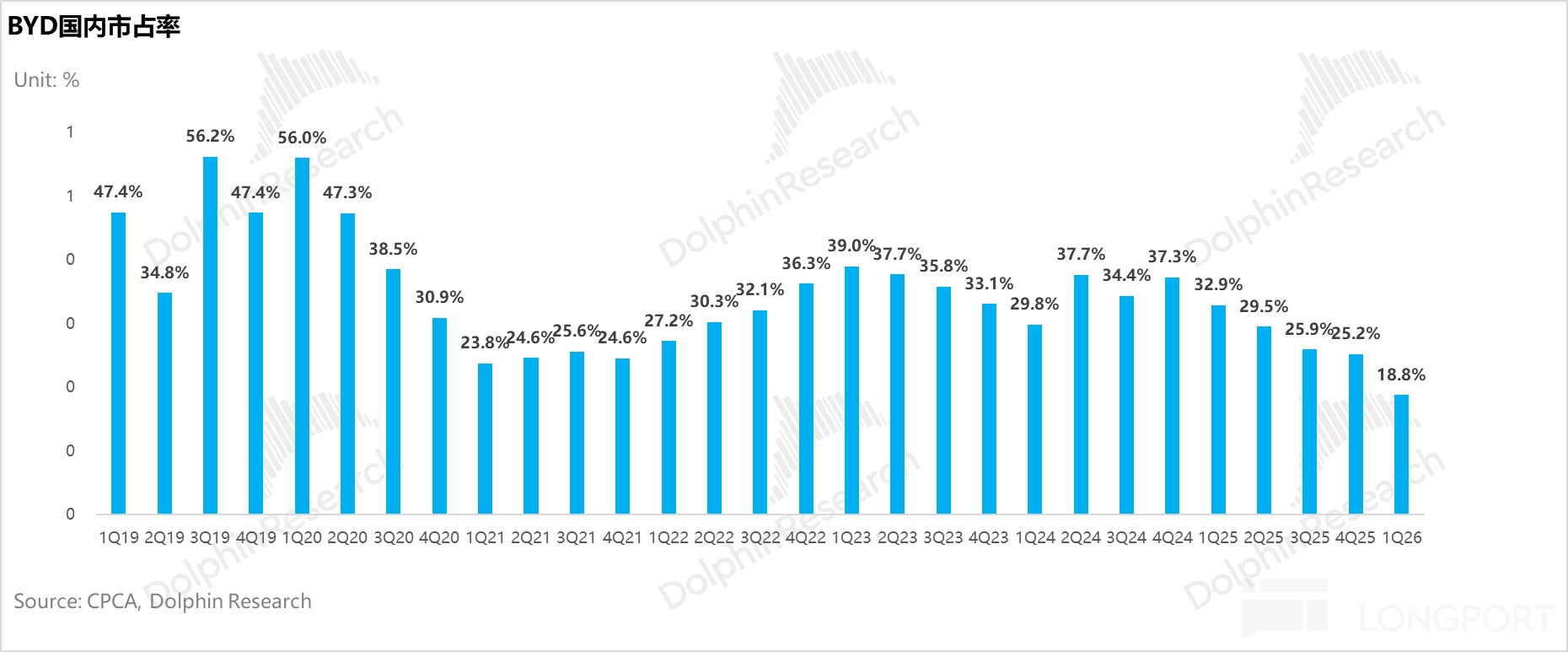
After peaking at 36% in Q2 2024, BYD's domestic share entered a downtrend. Despite overseas growth buffering, its domestic NEV share fell from a 2024 peak of 37.3% to 18.8% in Jan.–Feb. 2026, almost halving.
Overall share slipped 50bps QoQ to 26.9% even with overseas strength, and the downtrend had not stabilized by Jan.–Feb. 2026. This shows 2025's 'ID for all' cycle did not fully reset expectations, and 'anti-involution' policy constrained price-led share recapture.
Specifically:
- PHEV tech gap narrowed; domestic competition fierce, while 'anti-involution' curbs pricing
Tech moat challenged: Even as BYD improved DM in 2025 (charge-depleting fuel down to 2.6L/100km), rivals like Geely (Thor) and Chery (C-DM) rapidly closed gaps in efficiency and performance, eroding BYD's early advantage. 'Intelligent' variants faced delayed feature rollout, higher BOM, and limited near-term demand for highway NOA, muting sell-through.
'Anti-involution' caps price cuts: Since mid-2025, regulators tightened pricing oversight to prevent vicious competition. As the leader, BYD's pricing is scrutinized, limiting the past playbook of deep undercutting to reshuffle share.
Mainstream bands face encroachment: In the RMB 100–200k core, competitors fought toe-to-toe. Geely's Galaxy series leveraged 'high-spec + value' to double sales, lifting Geely NEV share to 16.3% in Feb. 2026, with Leapmotor, Changan, and Great Wall advancing in niches.
BYD's PHEV share held near 36% through launches like Qin PLUS 128km, but dominance has faded. Sustained defense is required.
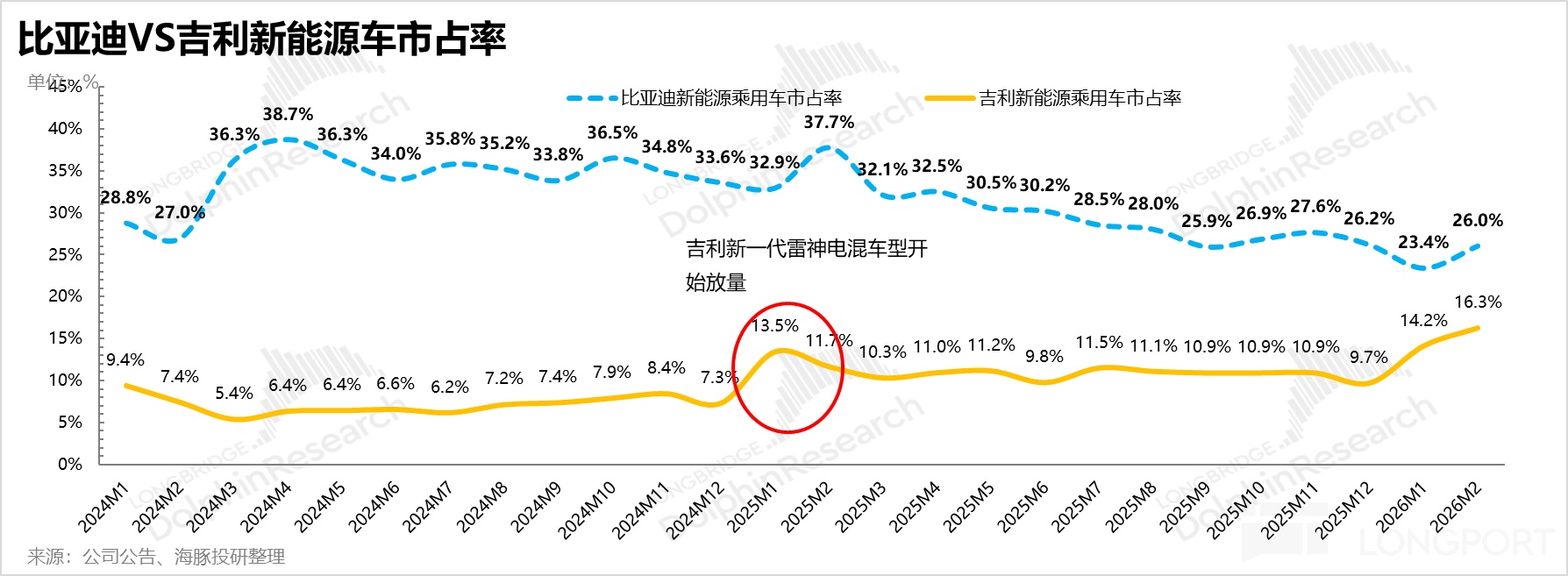
2) BEV lineup constrained by infra and slow tech cascade; share losses accelerated
BEV share fell from 26.3% in Q1 2025 to 16.6% in Jan.–Feb. 2026. Although BYD introduced the Super E platform in Mar. 2025 with ultra-fast charging, high-performance motors, and SiC power modules (supporting 1500V/200°C and '5 minutes charge for 400km range'), it was initially limited to RMB 200k+ models like Han L and Tang L.
With limited trickle-down and a still-ramping proprietary fast-charge network, BYD could not fully check rivals in the mainstream BEV segment. Execution must accelerate.
2026 focus: 'tech for all' and global capacity
To stem domestic share losses, BYD set a 2026 plan to democratize technology and speed model refresh. It will rapidly cascade Gen-2 Blade and MW fast charging to RMB 150k+ models to lift competitiveness in the core bands.
Meanwhile, a 'self-build + partnership' fast-charge network aims for large-scale rollout in 2026 (20,000 stations), easing charging pain points and helping recover share. This underpins the domestic reset.
Overseas remains the top 2026 priority:
IV. Overseas: from growth engine to profit pillar, accelerating high-margin delivery
Overseas volumes broke out in Q4 2025, with 350k exports (+~50% QoQ from 232k), lifting overseas mix by 5.2ppt QoQ to 26.3%. In early 2026, when domestic slowed on tax changes, overseas share of total volumes spiked to 51%, offering strong structural support.
More importantly, superior ASP and margins abroad turn scale into profits:
In 2H25, overseas ASP was RMB 186,000, ~1.4x domestic RMB 130,000, and overseas auto GPM reached 28.1% vs. 17.2% domestically, a near 1,100bps gap. This implies overseas per-vehicle GP of RMB 52,000 vs. RMB 22,000 domestically, and per-vehicle NP above RMB 20,000 even after expenses.
Notably, premium brands like Denza and Fangchengbao still sell mainly onshore. Overseas outperformance comes largely from the main brand's pricing power and a milder competitive landscape.
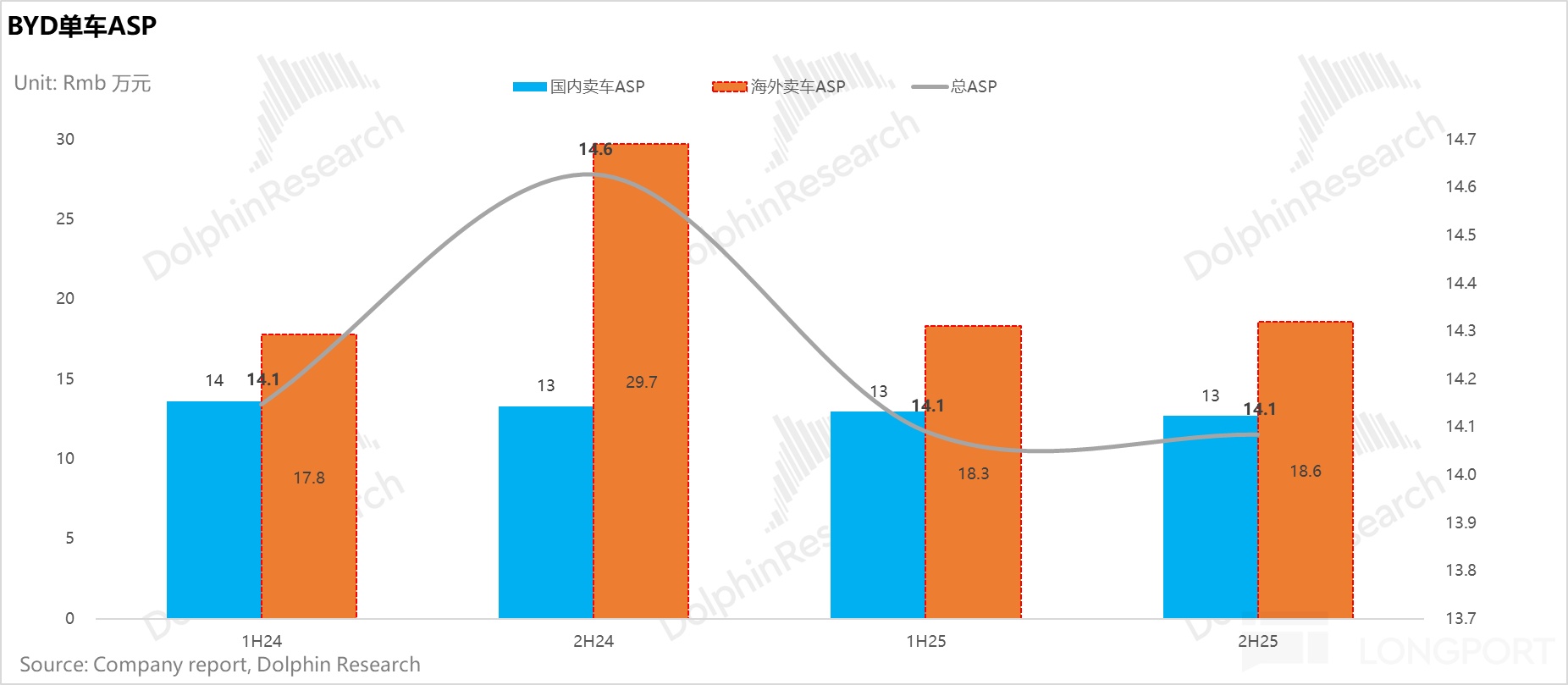
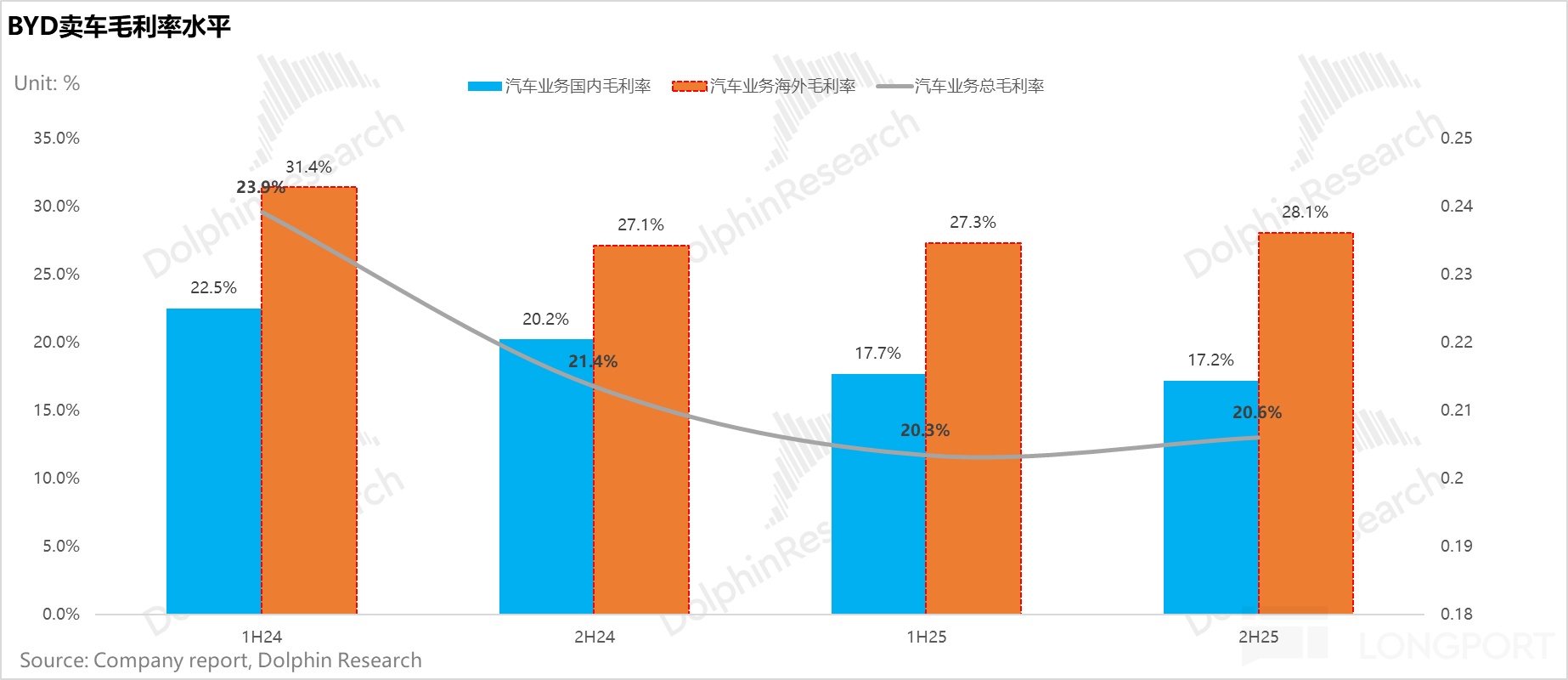
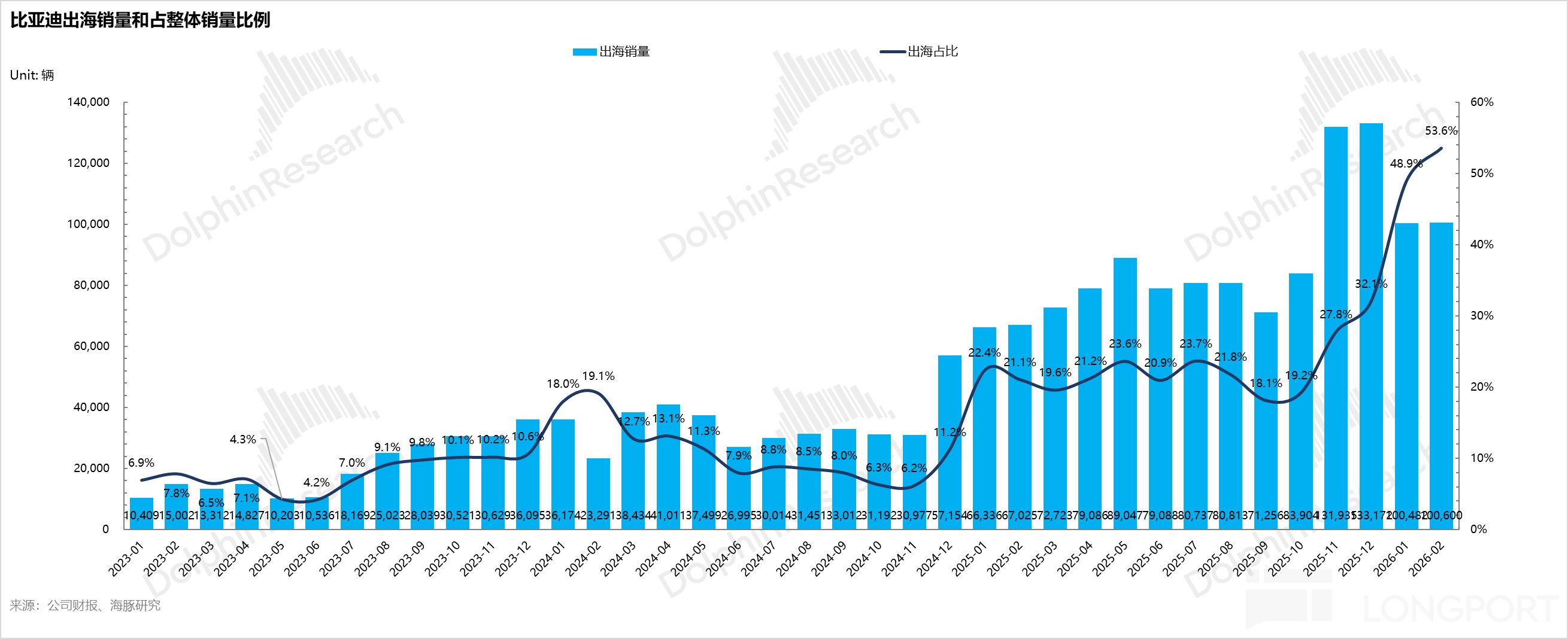
To counter domestic red-ocean pressure and tax headwinds, 'overseas expansion' is a core 2026 strategy, with a 1.5–1.6mn export target (+45%–55% YoY), driven by localization and channel scale-up:
a) Accelerate localized capacity to navigate tariffs
BYD is building a global manufacturing network to mitigate trade risks and improve delivery efficiency. In the Americas and Europe, Brazil is online with plans to expand to 300k units of annual capacity, and Hungary is slated to start in Q2 2026 with 150k units.
Capacity in markets like Indonesia and Turkey is also progressing. By end-2026, overseas localized capacity should exceed 510k units, supplemented by KD assembly to shorten supply chains and respond to regional demand.
b) Rapid channel expansion to deepen reach
BYD plans to double its Europe retail network from ~1,000 outlets at end-2025 to 2,000 in 2026 by partnering with major dealer groups. This should boost brand reach and local service capabilities.
Successful overseas expansion should offset domestic volume pressure and low-margin drag. If exports hit 1.5–1.6mn units in 2026, and overseas NP per vehicle is ~RMB 20,000, net profit contribution would be RMB 30–32bn, about two-thirds of auto profit.
This positions overseas as a solid profit cushion against domestic competition. It is the core earnings pillar for 2026.
V. Premium push: mix lift hinges on downmarket blockbusters; structural upgrade yet to be proven
The market's two hoped-for growth drivers — overseas expansion and premiumization — show a clear divergence: overseas is strong, premiumization is progressing slowly. BYD still faces challenges in intelligence experience, brand premium, and sales/service.
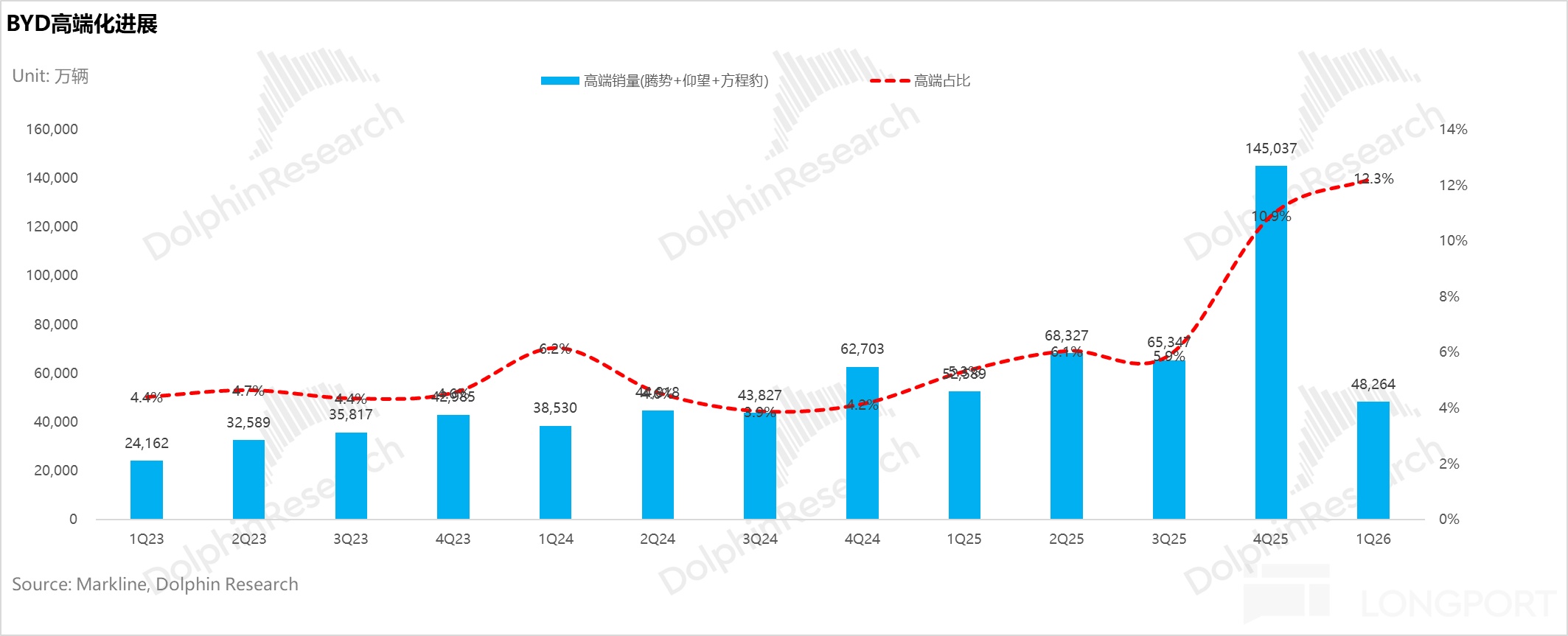
On paper, Q4 2025 premium brand sales (Denza, Yangwang, Fangchengbao ex-Tai 3) hit 145k units, nearly doubling QoQ. Premium penetration rose from ~6% in Q3 to ~11% in Q4, suggesting a breakthrough.
But the spike was driven almost entirely by Fangchengbao Tai 7, a 'value premium' priced at RMB 179,800–219,800. With 'rugged off-road + 135km EV range' value, Tai 7 sold 34k units in Dec. 2025 alone.
Excluding Tai 7 (≤RMB 200k) and the more entry Tai 3, core premium sales were only 67k units in Q4, up ~17% QoQ. Premium share still hovered near 5%.
Thus, premiumization lifted headline volumes via a blockbuster, but structural issues remain:
Growth is reliant on 'value premium' rather than broad-based high-end strength: Gains skew to ≤RMB 200k models trading price for volume, not across the >RMB 300k high-premium bands that define true luxury. Brand pull above RMB 300k needs strengthening.
Brand positioning trade-offs: Fangchengbao is pushing downmarket with entry models like Tai 3 to scale, which risks diluting its premium image over time. Sustainable high-end equity is not yet established.
True premiumization — sustained premiums and share in RMB 300–400k — will depend on launches like Denza N8L/N9 and delivery of intelligent features. The road is long; progress is early.
VI. Inventory normalized; destocking largely done
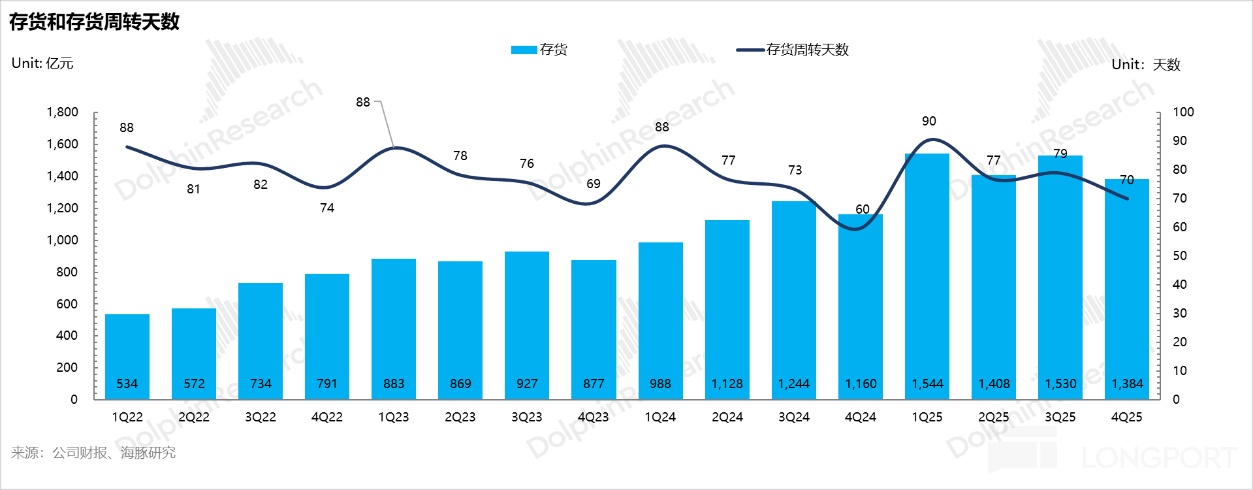
BYD has been destocking since Q2. With a June 'circuit-breaker' on SKUs, faster rebate cycles, and inventory discipline, days on hand improved from the Q1 peak of ~90 days to ~70 days in Q4.
Inventory is back to a reasonable level, paving the way for 2026 launches. Balance sheet risk has eased.
<End>
Dolphin Research archives:
Earnings season
Aug. 30, 2025 earnings take: 'BYD: The 'Price Warrior' Under Siege — Double-Edged Sword?'
Mar. 24, 2025 earnings take: 'BYD: Spending and Earning — Who Else but the 'Car King'?'
Hot topics
Oct. 14, 2025: 'New Auto Tax Thresholds: Another Hit to BYD?'
Jun. 4, 2025: 'BYD: Could It Become the Next Evergrande?'
Jun. 12, 2025: '60-Day Payables: Who Faces the Real Cash Squeeze among BYD, Geely, Great Wall, NIO, etc.?'
Deep dives
Feb. 26, 2025: ''ID for All' — Can It Create Another BYD?'
Feb. 19, 2025: 'Up 30%! What's Behind BYD's 'ID for All'?'
Risk disclosure and disclaimer:Dolphin Research Disclaimer and General Disclosures
The copyright of this article belongs to the original author/organization.
The views expressed herein are solely those of the author and do not reflect the stance of the platform. The content is intended for investment reference purposes only and shall not be considered as investment advice. Please contact us if you have any questions or suggestions regarding the content services provided by the platform.
