


 Likes Received
 Rate Of Return
🚨🔥 $Tesla(TSLA.US) Governance Landscape Rewritten: Elon Musk Wins Not Just the Lawsuit, but the Rules Themselves
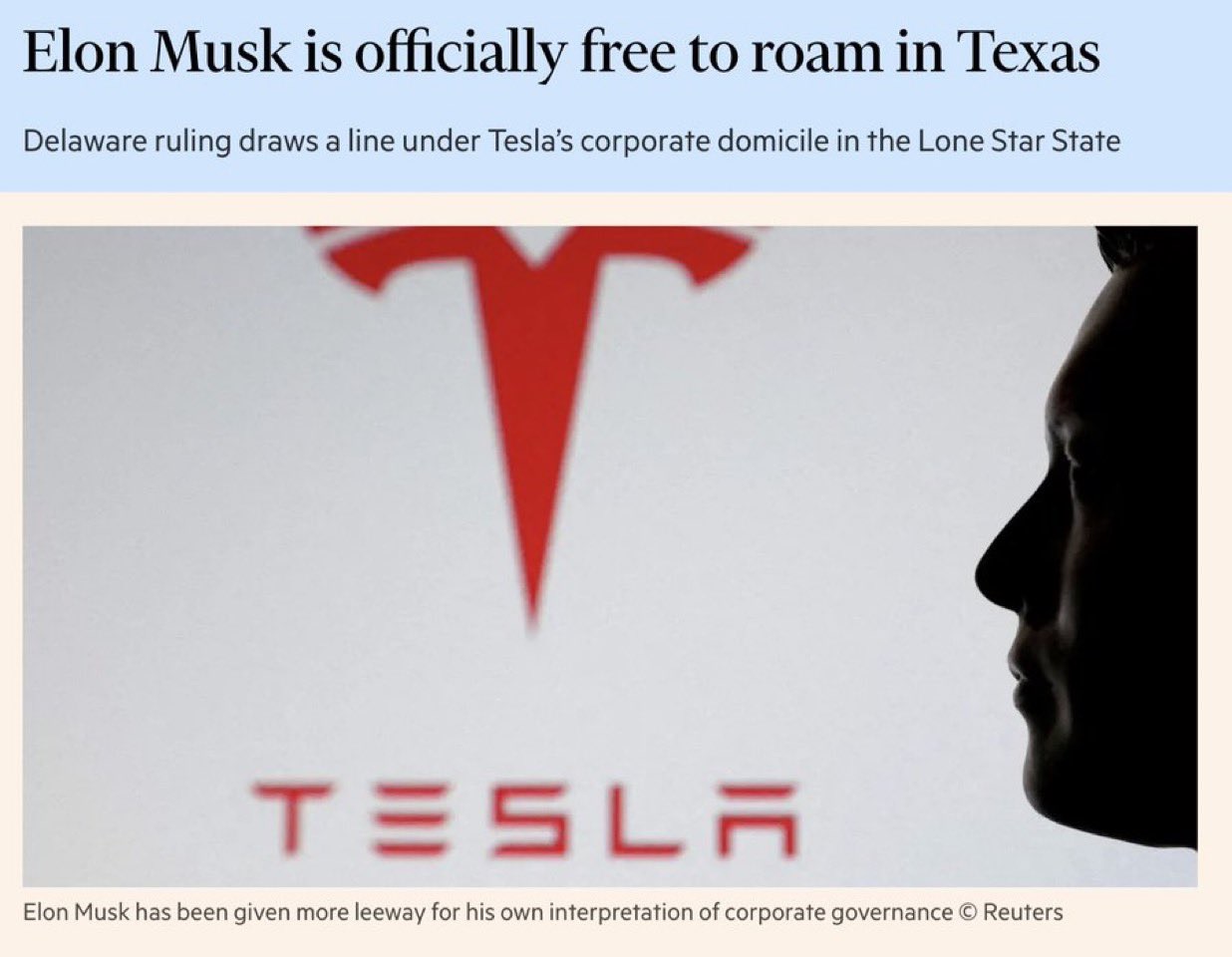
The legal dispute of Tesla in Delaware has ended. It looks like the conclusion of an ordinary lawsuit, but what really happened is a switch of the rulebook.
The key is not "the case was dismissed," but the reason given by the court:
Tesla had already moved its headquarters to Texas in 2024, therefore Texas law applies, not Delaware law.
This point directly changes the entire game structure.
In the past, Delaware was one of the core battlegrounds for U.S. corporate governance.
Mature rules, strong shareholder protection, and clear litigation mechanisms are also why a large number of public companies chose to incorporate there.
But the other side of this system is stricter constraints on management.
Texas, however, operates on a completely different logic.
It leans more towards businesses and founders, with significantly fewer restrictions on management.
The most direct change this brings is a leap in the litigation threshold.
To initiate a lawsuit similar to this one, investors would need to hold about 3% of $Tesla(TSLA.US) shares, a scale of roughly $34 billion.
In reality, this means most investors have already lost the practical ability to initiate such lawsuits.
This is not simply "harder to sue," but a restructuring of the governance power structure.
<Tesla is transitioning from a traditional public company to a more typical "founder-led structure."
This structure is essentially a rebalancing between efficiency and constraints.
On one hand, the decision-making chain is shorter, and execution efficiency is higher.
Long-term investment directions like FSD, robotics, and energy will face less interference from short-term shareholder pressure.
On the other hand, governance constraints weaken, and transparency and checks-and-balances mechanisms decline simultaneously.
This forms an implicit market contract:
Investors cede part of their governance rights in exchange for higher upside potential with uncertainty.
Whether this model holds depends on outcomes, not the process.
If the company continues to deliver growth, technology, and profitability, this structure will be accepted and even reinforced by the market.
But once mistakes occur, the lack of checks and balances could amplify negative shocks.
Another potential impact is the spillover of this model.
$SpaceX, also based in Texas, is likely to replicate a similar governance logic if it enters the public market in the future.
This means this is not just a $Tesla(TSLA.US) case, but could become a reference for a new path in corporate governance.
What the market really needs to observe next is not this lawsuit, but two more critical questions:
First, are investors willing to continuously accept a "founder-first" structure?
Second, will this structure be emulated by more companies?
After the rules change, the valuation logic will also change accordingly.
This is more like a repricing process concerning power, efficiency, and risk.
Under such a structure, whether it's the long-term premium brought by higher efficiency or the potential risks accumulated from lower constraints is more worthy of continuous observation.
The copyright of this article belongs to the original author/organization.
The views expressed herein are solely those of the author and do not reflect the stance of the platform. The content is intended for investment reference purposes only and shall not be considered as investment advice. Please contact us if you have any questions or suggestions regarding the content services provided by the platform.
