


TSM: AI's Undisputed Leader — Who Can Challenge It?
TSMC released its Q1 2026 results (through Mar-2026) pre-market in the U.S. on Apr 16 Beijing time. Key takeaways are as follows.
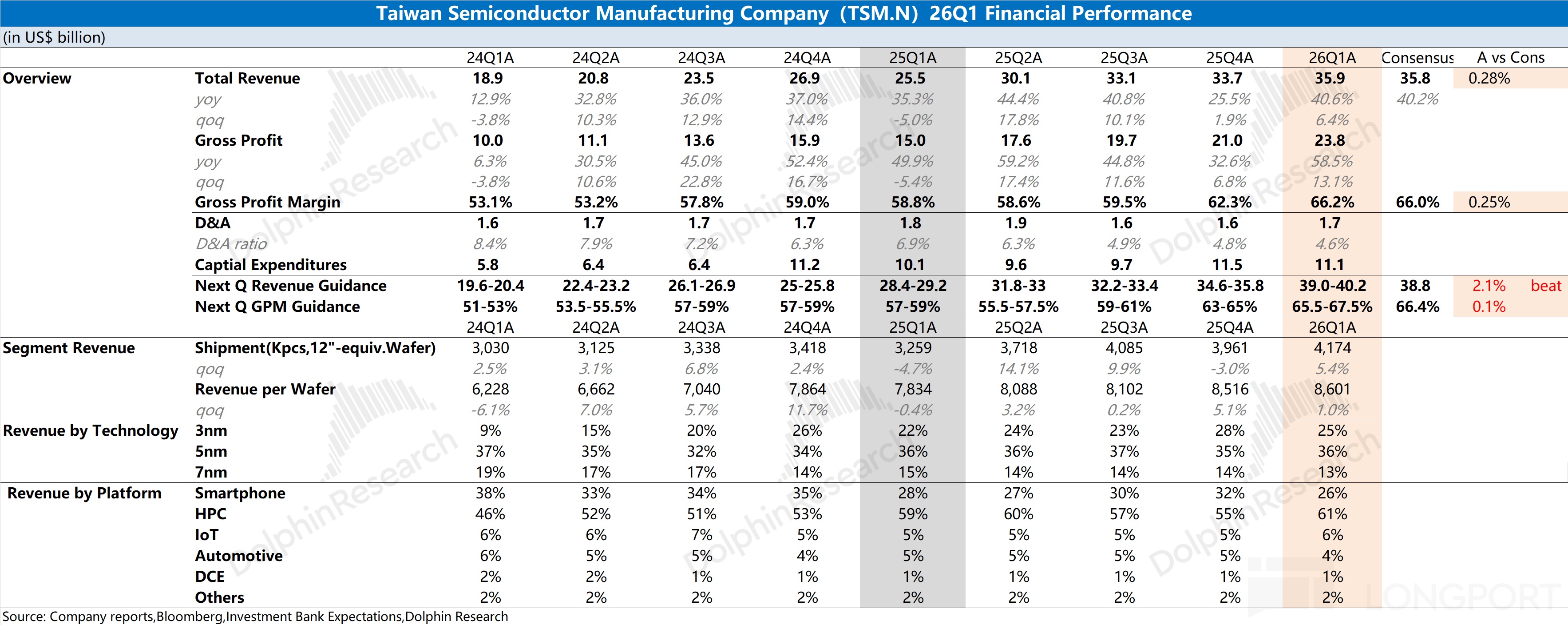
1) Revenue: Q1 revenue was $35.9bn, up 6.4% QoQ, driven by AI chips as customers began shifting to the 3nm platform. Despite FX headwinds from a stronger USD vs. TWD, revenue topped the high end of guidance ($34.6–35.8bn). On a TWD basis, revenue rose 8.4% QoQ, clearly ahead of the company's ~6% QoQ guide.
Volume/price (12-inch equivalent): ① Wafer shipments were 4,174k, up 5.4% QoQ. ② Blended ASP per wafer (12-inch eq.) was $8,601, up 1% QoQ.
2) GPM: Q1 GPM was 66.2%, above the guided range (63–65%). Margin expansion was driven by higher ASP and lower unit costs, with scale effects diluting fixed costs per unit. With AI demand, GPM has firmly held above 60%, and the company has lifted its long-term (5+ yrs) GPM target from 53% to 56%.
3) Biz. details: nodes, end-markets, and regions
a) By node: $Taiwan Semiconductor(TSM.US) kept advanced nodes (7nm and below) at a high 74% mix. On strong AI demand, 3nm and 5nm were fully loaded, contributing 25% and 36% of revenue, respectively. As 2nm ramps, AI chips will migrate from 5nm to 3nm, further skewing the mix toward advanced nodes.
b) End-market: QoQ growth was led by AI chips, while smartphones saw seasonal pullback. HPC remained the largest contributor at $21.9bn, or 61% of revenue, on demand from NVDA, AVGO and other AI customers.
c) By region: North America remained the largest market at 76%, covering NVDA, AAPL, AMD and other key customers. China revenue was about $2.5bn (7% mix), the third-largest market.
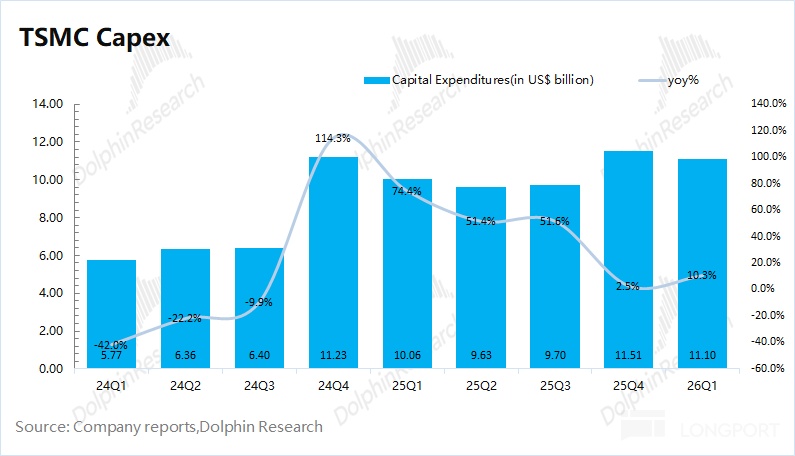
4) Capex: Q1 capex was $11.1bn. With full-year 2026 capex raised to $52–56bn, the next three quarters could total about $44bn, indicating spending will skew to 2H.
5) Guidance: Q2 2026 revenue of $39.0–40.2bn (above the raised buy-side at ~$38.8bn) and GPM of 65.5–67.5% (in line with the raised 66–66.5% buy-side).
Dolphin Research view: Full-year guide raised, chain position intact
The print was solid, consistent with monthly disclosures. Q1 revenue of $35.9bn beat the top end of guidance despite USD/TWD headwinds. On a TWD basis, QoQ growth was 8.4%, an even better underlying run-rate.
More important this quarter were GPM, capex, and forward guidance.
① GPM: Q1 GPM reached 66.2%, near the raised buy-side at 66–66.5%, on higher ASP and unit cost declines from scale. Dolphin will break this down in detail in the main text.
Management guided Q2 GPM to 65.5–67.5%, broadly matching the raised buy-side (66–66.5%). AI moving from 5nm to 3nm supports higher blended ASP and margins.
② Capex: Q1 capex was $11.1bn. Full-year 2026 capex was raised again to $52–56bn (from $52–56bn previously stated as a high watermark), implying roughly $44bn over the next three quarters.
Spending will concentrate in 2H (Avg. ~$14.5–15.0bn per quarter), aligning with ASML's 'back-half weighted' outlook yesterday.
③ Ops guidance: TSMC raised its 2026 revenue growth target to '30%+' (from ~30%), signaling confidence and aligning with mainstream expectations.
Beyond the core metrics, the market is focused on several areas.
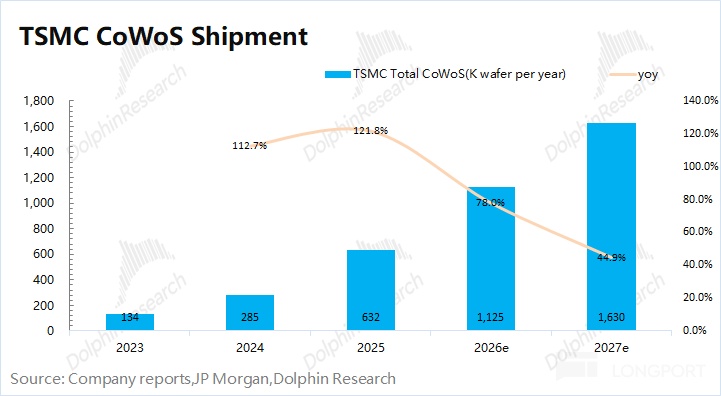
a) CoWoS capacity: Leading AI accelerators (NVDA, AMD and TPUs) use CoWoS packaging, and TSMC supplies the vast majority of global capacity (90%+). Even if chip designers want to ramp, CoWoS allocations constrain AI shipments, making TSMC a choke point in the AI supply chain.
Industry data and expectations suggest current CoWoS capacity is ~80k wafers/month, potentially reaching ~120k by end-2026. Dolphin estimates 2026 CoWoS shipments could exceed 1.1mn wafers (+77% YoY), with NVDA and AVGO as key customers.
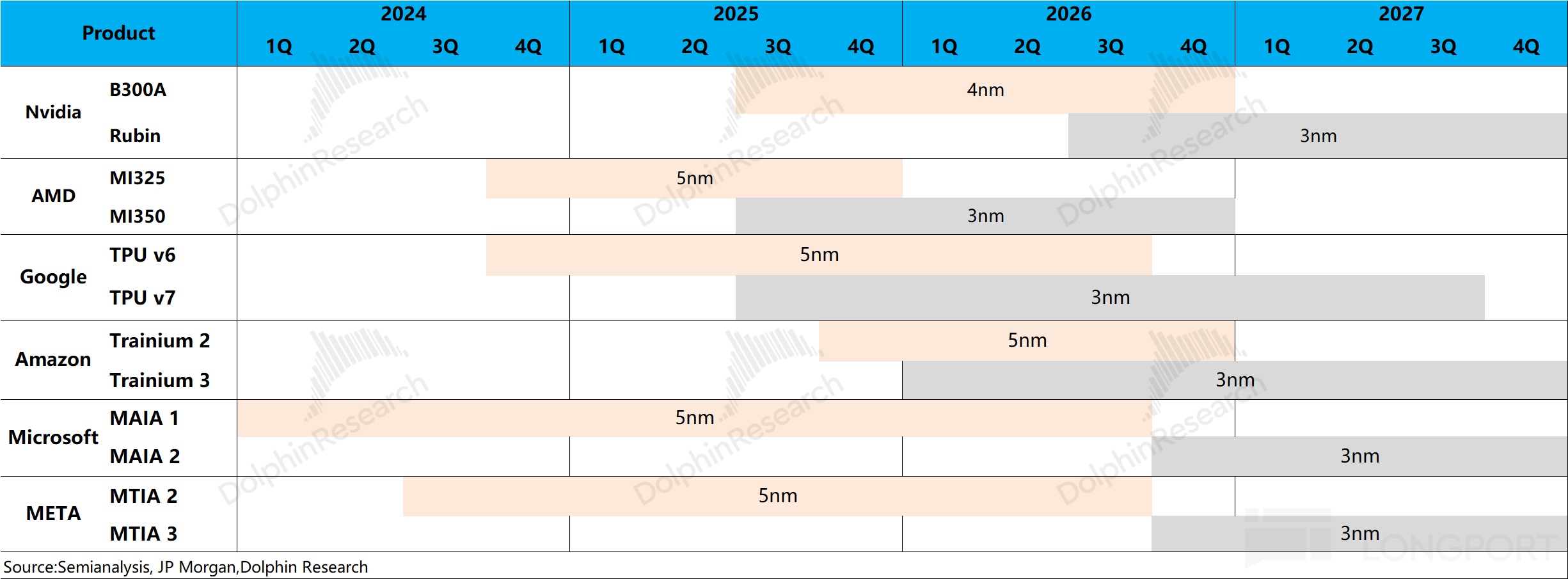
b) 2nm progress and node migration: 2nm is entering high-volume ramp in 2026, with portions of smartphone demand from AAPL and QCOM moving to 2nm. Meanwhile, AI has fully upgraded to 3nm, and Rubin, MI350 and Google's TPUv7 will use TSMC's 3nm.
As the mix migrates to more advanced nodes, blended ASP should rise, and capex will continue to grow.
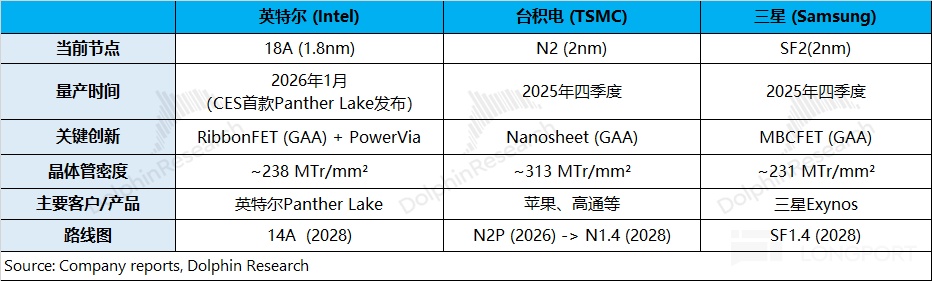
C) Foundry competition: As TSMC starts 2nm volume, Samsung and Intel are following with SF2 (2nm) and 18A (1.8nm), respectively.
However, gaps remain vs. TSMC: ① Samsung and Intel's latest nodes have transistor densities under 250 MTr/mm², even below TSMC's prior-gen N3P at 294 MTr/mm². ② Yields at INTC and Samsung remain relatively low and are focused on internal chips, while TSMC serves a large base of external marquee customers.
If INTC and Samsung improve yields amid tight AI supply, they could pick up some 'spillover orders'. With TSMC capacity tight, GOOGL and INTC recently expanded cooperation, partly to ease supply bottlenecks.
At a ~$1.9tn market cap, TSMC implies ~24x 2026E P/E (assuming +38% revenue, 64.7% GPM, and a 16.5% tax rate). Versus its historical 20x–30x band, the current multiple sits slightly below mid-range.
Back to the print, results were good but not a blowout. The street has already moved GPM toward ~66%, and Q1 was in line with those revised expectations.
Positively, the quarterly guide was above the raised buy-side. With a full-year revenue outlook in place, next quarter's revenue matters less at the margin. The 2026 growth target was lifted to '30%+', but as most institutions already expected 30%+, it is not a major surprise. TSMC management has long maintained a conservative guiding style.
TSMC is setting record revenues while lifting GPM toward ~66%, underscoring its pricing power in the chain. In AI manufacturing, its CoWoS capability is a clear edge, capturing nearly all current AI chip production.
Until INTC/Samsung achieve technical and yield breakthroughs, TSMC remains the only scalable CoWoS option. Regardless of downstream jockeying, it is the most resilient link in the AI chip chain.
Below is Dolphin's detailed read on the quarter:
I. Revenue: volume and ASP both higher
Q1 2026 revenue was $35.9bn, above the $34.6–35.8bn guide. Revenue grew 6.4% QoQ on AI demand, with workloads migrating from 5nm to 3nm.
USD strength vs. TWD diluted the reported growth. On a TWD basis, revenue rose 8.4% QoQ, indicating stronger underlying momentum.
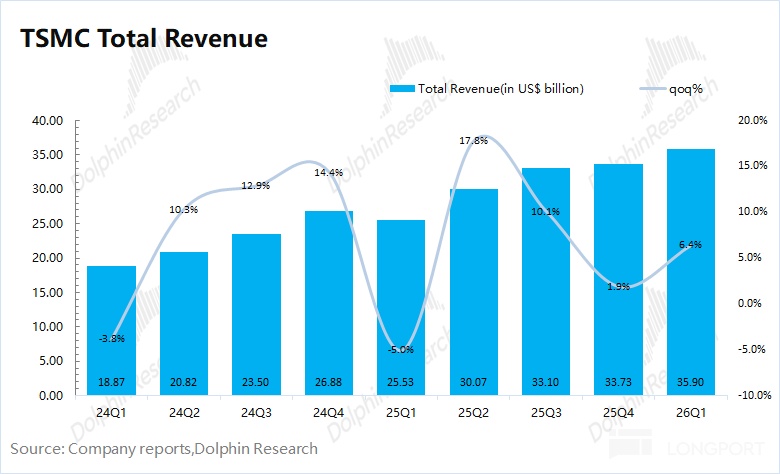
Given monthly disclosures, the revenue trajectory was well anticipated. How did volume and pricing contribute this quarter.
Dolphin breaks down the drivers by volume and price.
1) Volume: Q1 2026 shipments were 4,174k wafers, up 5.4% QoQ. The company raised 2026 capex to $52–56bn, up $13–15bn YoY, signaling continued capacity expansion.
2) Price: Q1 blended ASP per wafer (12-inch eq.) was $8,601, up 1% QoQ. With 2nm entering volume and AI workloads shifting from 5nm to 3nm, the mix will further tilt to advanced nodes, supporting higher blended ASP.
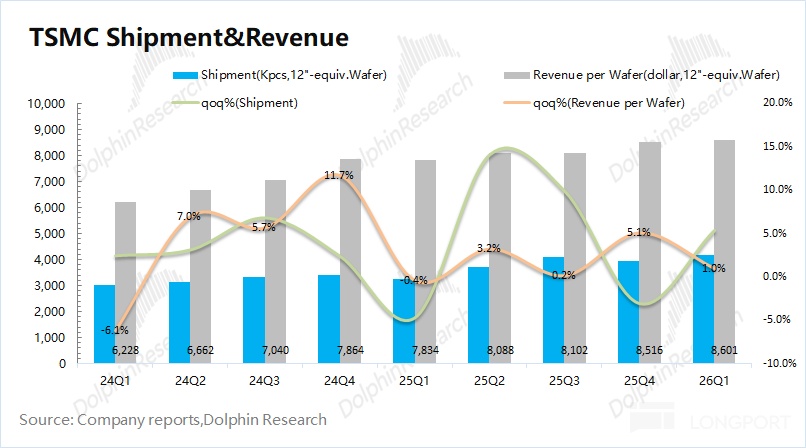
II. Gross profit and margin: marching higher, breaking 66%
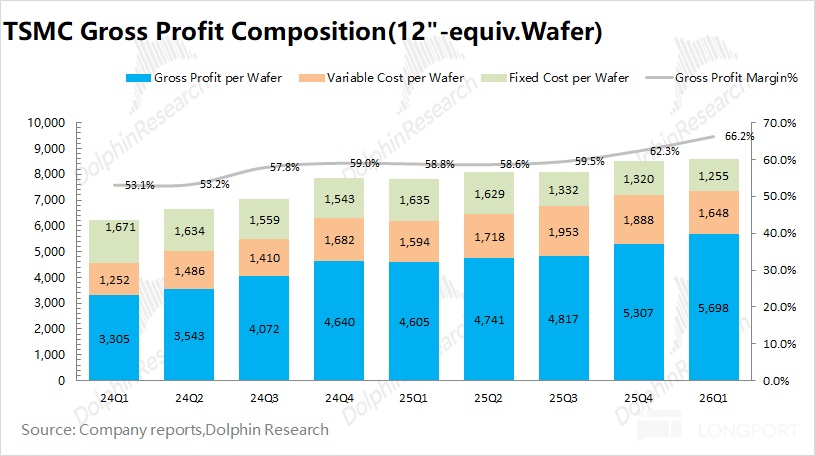
Q1 2026 gross profit was $23.8bn, up 13% QoQ. GPM was 66.2%, up 390bps QoQ and near the raised street at 66–66.5%, driven by higher ASP and lower unit costs.
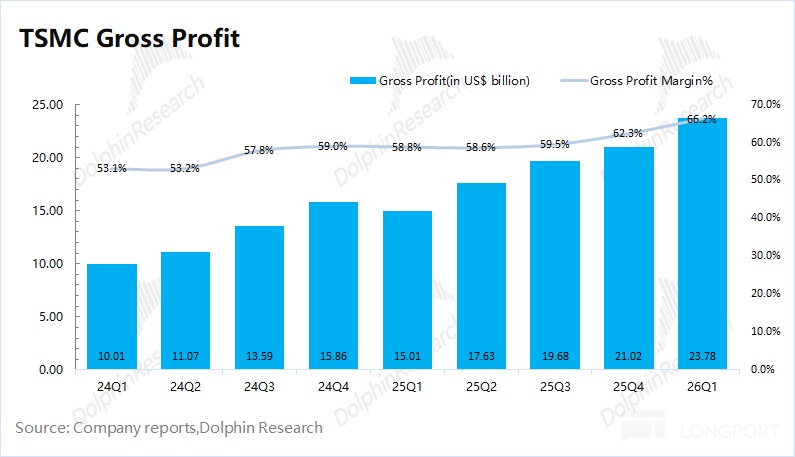
Revenue and margin are the two most watched metrics, with revenue largely pre-discounted by monthly prints. Margin was a key focus this quarter, and Dolphin decomposes the main drivers.
'GP = per-wafer revenue − fixed cost − variable cost'
1) Per-wafer revenue (12-inch eq.): About $8,601 per wafer, up $85 QoQ.
Q1 usually sees seasonal ASP pressure on lower smartphone mix. But as AI migrates from 5nm to 3nm, blended ASP rose against seasonality.
2) Fixed costs (D&A): Avg. fixed cost was ~$1,255/wafer, down $65 QoQ.
On a TWD basis, total D&A rose QoQ. But with USD strength, D&A in USD terms was roughly flat, and higher shipments diluted fixed cost per unit.
3) Variable costs (other mfg. costs): Avg. variable cost was ~$1,648/wafer, down $240 QoQ, helped by seasonal normalization in other mfg. expenses.
Putting it together, per-wafer GP was ~$5,698, up $390 QoQ. Margin gains came from both price and unit cost improvements.
III. Wafer mix: AI shifts to 3nm, smoothing quarterly swings
3.1 Mix by application
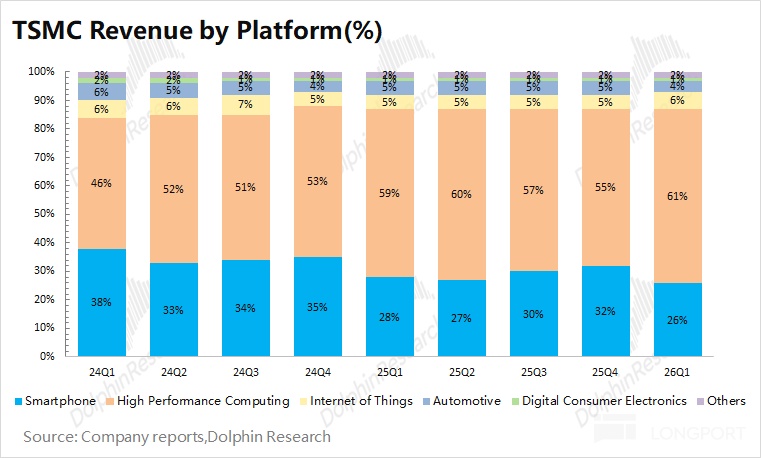
HPC remained the largest contributor at 61%. On NVDA's GB-series and other AI demand, HPC revenue was about $21.9bn, up 18% QoQ, driven mainly by NVDA Blackwell and AVGO TPU shipments.
Smartphones showed seasonal weakness. Revenue was $9.33bn, down 13% QoQ. Together, smartphones and HPC made up 87% of revenue.
3.2 Mix by node
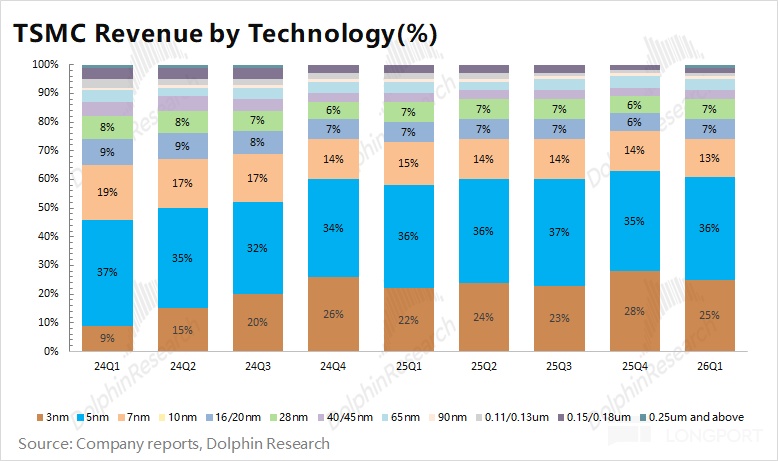
7nm and below held at 74% of revenue, underscoring the importance of advanced nodes. Within this, 3nm was 25% and 5nm was 36%.
Q1 typically sees seasonal declines as the most advanced nodes (e.g., 3nm) are heavily used by smartphone chips. After the Q4 peak season, Q1 shipments normally fall QoQ.
The migration of AI from 5nm to 3nm smoothed this seasonality, helping revenue grow QoQ in Q1.
As 3nm smartphone chips move to 2nm, AI chips (Rubin, TPUs, etc.) will increasingly occupy 3nm. The node mix will continue to shift forward, lifting blended ASP and widening the lead over peers.
3.3 Mix by region
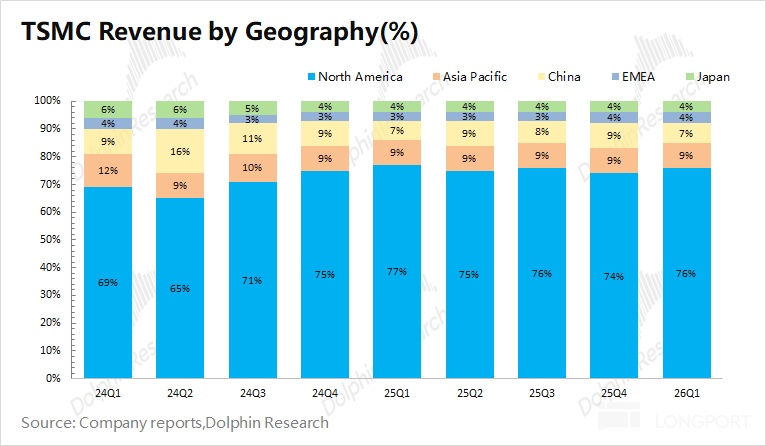
North America remained the largest at 76%, reflecting deep ties with AAPL, NVDA, AMD, QCOM and others. This underscores strong commercial linkage with the U.S.
Outside North America, Asia-Pacific and Mainland China were the other two major contributors at 9% and 7%, respectively. Mainland China revenue stayed around $2.5bn this quarter, still a top-three market but now below a 10% mix.
<End>
Related Dolphin Research on TSMC
Jan 15, 2026 call notes 'TSMC (Trans): Capex up by ~$10bn YoY, set after talks with downstream'
Jan 15, 2026 earnings take 'TSMC: the real AI heavyweight, who says no'
Oct 16, 2025 call notes 'TSMC (Trans): 2nm to start volume by year-end, higher investments next year'
Oct 16, 2025 earnings take 'Dominant TSMC: the strongest in the AI era'
Jul 17, 2025 call notes 'TSMC (Trans): full-year revenue growth raised to 30%'
Jul 17, 2025 earnings take 'TSMC: backbone of semis'
Apr 17, 2025 call notes 'TSMC (Trans): 30% of future 2nm capacity to be in the U.S.'
Apr 17, 2025 earnings take 'Tariff noise vs. robust guide: TSMC stays steady'
Jan 16, 2025 call notes 'TSMC: 2025 capex raised to $38–42bn (Q4 2024 call)'
Jan 16, 2025 earnings take 'TSMC: the unshakable anchor'
Risk disclosure and disclaimer: Dolphin disclaimer and general disclosure
The copyright of this article belongs to the original author/organization.
The views expressed herein are solely those of the author and do not reflect the stance of the platform. The content is intended for investment reference purposes only and shall not be considered as investment advice. Please contact us if you have any questions or suggestions regarding the content services provided by the platform.
