


TSM (Trans): Stays 'cautious', modestly lifts FY guide
Below is Dolphin Research's transcript of$Taiwan Semiconductor(TSM.US) FY26Q1 earnings call. For our take on the print, see 'TSMC: The real AI king, who can unseat it?'.
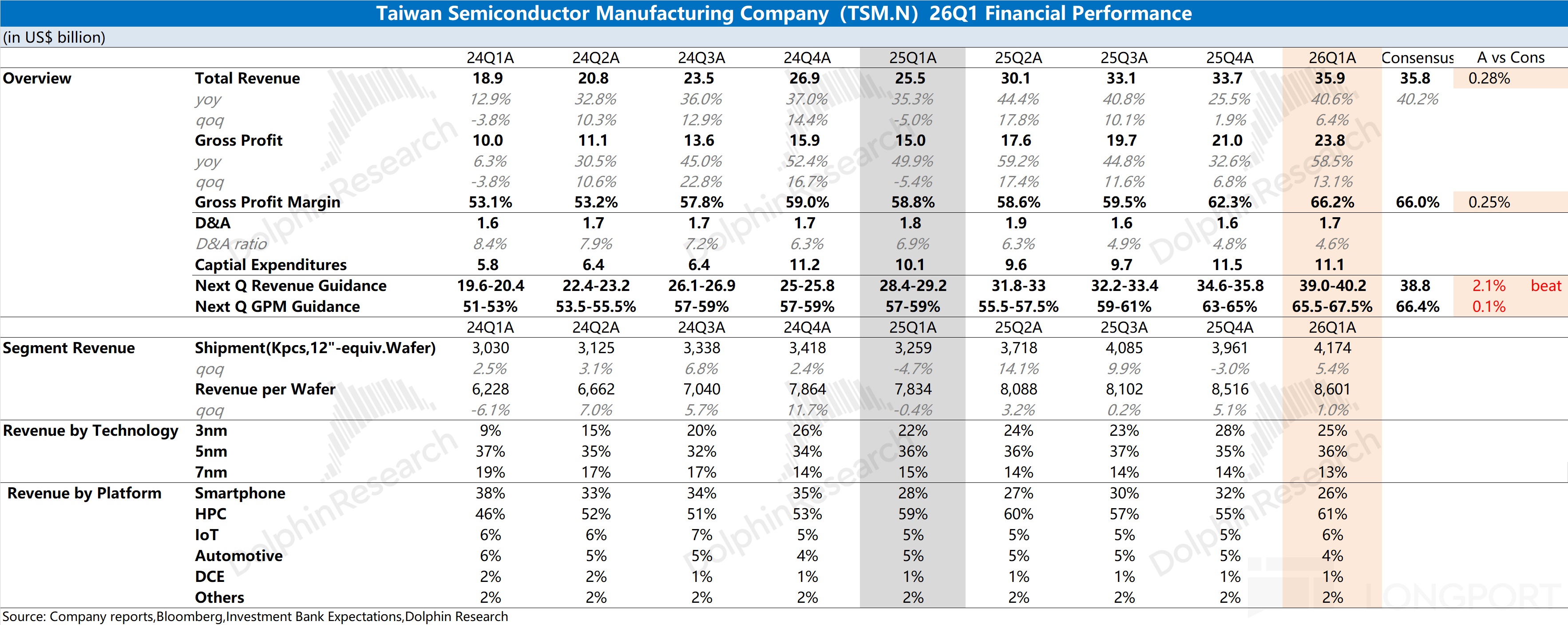
I. TSMC earnings highlights
1. Shareholder returns: The company committed to steady, sustainable per-share cash dividend increases on both an annual and a quarterly basis. In Q1, it declared NT$130bn in Q2 2025 cash dividends.
2. Outlook: Q2 revenue guided to $39.0-40.2bn (+10% QoQ, +32% YoY at the midpoint), with GPM of 65.5%-67.5% and OPM of 56.5%-58.5%. The Q2 tax rate is approx. 20% (due to undistributed earnings tax), with full-year at 17%-18%, and full-year revenue growth raised to >30% YoY (USD terms).
3. Key financials: Q1 revenue was $35.9bn, slightly above guidance. GPM was 66.2% (+390bps QoQ) and OPM 58.1% (+410bps QoQ), with EPS of NT$22.08 and ROE of 40.5%. Cash and marketable securities totaled NT$3.4tn ($106.0bn). Days inventory rose to 80 days, reflecting the N2 ramp and strong N3 demand.
4. CapEx: Q1 CapEx was $11.1bn. 2026 full-year CapEx guidance was raised toward the high end of the $52-56bn range; management expects CapEx over the next three years to be significantly above the prior three years (approx. $101bn aggregate).
5. Long-term profitability targets: Through-cycle GPM target remains ≥56%, with ROE in the high-20% (27%-29%) range. Capital intensity is not expected to spike in coming years, and revenue growth should continue to outpace CapEx growth.
II. Detailed call notes
2.1 Management commentary
1. GPM outlook
a. Q1 GPM of 66.2% beat the top end of guidance by 120bps. The upside was driven by higher-than-expected utilization and better cost improvements.
b. Q2 GPM midpoint is 66.5% (+30bps QoQ), supported by higher utilization and continued cost gains. This is partially offset by dilution from overseas fabs.
c. 2H watch items: early N2 ramp will dilute GPM by 2%-3% for the year, and overseas fabs dilute 2%-3% initially, widening to 3%-4% later. Middle East tensions could push up certain chemicals and gas prices, though the impact is hard to quantify. Positives include continued manufacturing excellence driving output, cross-node capacity optimization, and N3 GPM rising above the company average in 2H.
d. FX assumption is $1 = NT$31.7.
2. Materials and energy
a. For specialty chemicals and gases (incl. helium and hydrogen), TSMC has multi-source supply, carries safety inventory, and works closely with suppliers to bolster resilience. Recent operations have not been affected.
b. On energy, the Taiwan Gov. has secured LNG supply at least through May and is diversifying procurement. No operational impact is expected near term.
3. Demand outlook
a. Q2 will be supported by strong demand for advanced nodes. Consumer and price-sensitive markets face component price inflation, and Middle East tensions add macro uncertainty, so TSMC remains prudent.
b. AI-related demand is exceptionally strong. The shift from a gen-AI query model to Agentic AI for command execution is driving sharp token growth and strong demand for leading-edge wafers, with CSPs signaling very positive outlooks.
c. TSMC maintains high conviction in the multi-year AI upcycle. Full-year revenue growth is raised to >30% (vs. ~30% before), in line with market expectations.
4. N2 capacity ramp
a. N2 entered volume production in Q4 2025 with good yields, ramping in multiple phases across Hsinchu and Kaohsiung.
b. Strong demand from smartphones and HPC/AI is supporting the N2 ramp.
c. Derivatives N2P and A16 are being strengthened, and the N2 family is expected to be another large, long-lifecycle node.
5. Global N3 expansion
a. Taiwan: a new 3nm fab is being added to the Tainan Science Park GIGAFAB cluster, with volume production in 1H 2027.
b. Arizona: the second fab will use 3nm technology, construction is complete, with volume production in 2H 2027.
c. Japan: the second fab will switch to 3nm, with volume production in 2028.
d. TSMC is also converting 5nm tools in Taiwan to support 3nm and flexibly reallocating capacity across N7/N5/N3.
6. Mature node strategy
a. Focus is on high-yield specialty technologies rather than commodity capacity. Japan's JASM Fab 1 targets CMOS image sensors, and Germany's ESSMC targets auto and industrial.
b. TSMC plans to shut Fab 2 (6-inch) and Fab 5 (8-inch, pivoting to GaN) to free space for advanced nodes. Post-closure, capacity remains sufficient to serve existing customers.
7. A14 progress
a. The second-gen nanosheet transistor offers 10%-15% speed gains at iso-power or 25%-30% power reduction at iso-speed, with ~20% density uplift vs. N2.
b. Development is on schedule, with strong interest and engagement from smartphone and HPC customers. Volume production is planned for 2028.
2.2 Q&A
Q: What applications will drive multi-year strength at 3nm?
A: It's straightforward, mainly HPC and AI.
Q: GPM outlook for 3nm? What happens after full depreciation?
A: We expect N3 GPM to reach and exceed the company average in 2H this year. We cannot share specifics, but historically, fully depreciated nodes carry very high margins.
Q: What supports the move of CapEx guidance to the high end of the prior range?
A: Simple answer — demand is very strong, especially from HPC and AI. We are pushing hard to pull in tools as fast as possible. Supply is still very tight and demand keeps growing, so we work with suppliers to accelerate. That is why CapEx is skewing to the high end.
Q: With demand beating expectations and higher CapEx, how long will supply remain tight? Will you build cleanrooms ahead of tools?
A: Demand remains strong and the numbers keep going up. We have reconfirmed with customers, and CSPs provide very positive outlooks, so we must accelerate cleanroom builds and tool procurement. We are working with contractors and equipment vendors to pull in timelines. The reason is simple — AI is just too strong.
It takes two to three years to build a new fab. On the current timeline, we expect tight capacity even after 2027, which is why we announced three new fabs to meet demand.
Q: Thoughts on Elon Musk's 'Tera fab' and cooperation with Samsung? How will TSMC win back that customer?
A: Intel and Tesla are both TSMC customers, but they are also competitors. We view Intel as a strong rival and do not underestimate them. That said, there are no shortcuts. Foundry rules have not changed: technology leadership, manufacturing excellence, and customer trust. Most important is service — as Jensen Huang has also said, and we appreciate his endorsement.
It takes two to three years to build a new fab, and another one to two years to ramp. There are no shortcuts in this industry. As for 'winning back' customers — they remain our customers, and we are confident in our technology position. We will fight for every piece of business.
Q: Can a faster ramp help win back some customers, given capacity tightness drove some to leave?
A: It takes two to three years to build a new fab, and we are doing that to meet stronger demand. There are no shortcuts. Capacity is indeed very tight, but we are working to ensure we can meet customer needs.
Q: Some AI customers are developing larger reticle-size dies and considering EMIB-like substrates. How will TSMC respond, and would you allow competitors to package your front-end compute dies?
A: Today, TSMC offers the market's largest reticle-sized packaging solutions. We understand competitors also offer attractive technologies, and we welcome the competition because it gives customers more choice, and lets us do more with them. We will not pass on any business opportunities. We are developing larger-format packaging technologies and working with all customers, and progress is good.
Q: Does 'larger reticle' refer to CoWoS or CoWoS‑L/3.5D? Can die stacking solve planar scaling limits?
A: We currently have ultra-large reticle CoWoS. We are also developing CoPoS, aiming to provide sufficient capacity at reasonable cost, with CoPoS lines under construction and expected to come online in a few years. For now, the main path remains large-format CoWoS combined with System on Wafer, which we believe offers the best solution for customers.
Q: Capex intensity over the next few years? Relationship between revenue growth and CapEx growth?
A: As you noted, revenue growth has outpaced CapEx growth in recent years. If we execute well, we expect that to continue in the next few years. Therefore, we do not expect a sudden spike in capital intensity.
Q: In light of competition, will TSMC accelerate CapEx to avoid losing customers due to tight capacity?
A: We have repeatedly emphasized that we plan capacity based on customer demand, not competitors or other considerations. The most important thing is customer demand — customers partner with TSMC, and we plan capacity and CapEx accordingly.
Q: Full-year growth is raised to above 30% for 2026; how much upside remains? How do rising memory prices affect consumer demand?
A: Higher memory prices do affect price-sensitive end markets, particularly PCs and smartphones, and we have seen some softening. High-end smartphones continue to perform better, which benefits TSMC. As for how much above 30% we can grow, we will share a more precise number in Jul.
Q: With sustained demand strength, has management's view on long-term sustainable margins and returns changed?
A: As we said on the last call, we have raised our 2024-2029 long-term GPM and ROE targets. The current through-cycle targets are ≥56% GPM and high-20% ROE (27%-29%), above prior levels. Long-term planning is continuous, and we will update as things evolve.
Q: Arizona is becoming more strategic, and you recently bought a second plot. How do you see medium/long-term capacity plans and the economics in the U.S.?
A: We bought the second plot because we need it. We will build more fabs in Arizona to serve multi-year leading-edge needs of U.S. customers. We have accumulated significant experience in Arizona and are more confident than last year about making good progress, and we expect cost structures to improve.
Q: Do current profits fully reflect TSMC's value? How should investors view the earnings base?
A: You are essentially asking about pricing strategy. We always view customers as partners, we are clear about our value and position, and we will not make large or abrupt pricing changes. We ensure customers succeed in the market so we grow together. We must also earn our value to keep expanding to support them. Fundamentally, customer success is the first priority. Grow together, and remember the keyword — customers are our partners.
Q: You previously guided AI accelerator revenue CAGR at mid- to high-50% for 2024-2029. Given stronger token consumption, has that changed?
A: We continue to see very strong demand and very positive signals from customers and their customers. For AI accelerator CAGR, the trend is shifting toward the higher end.
Q: What is TSMC's advanced packaging strategy and model with OSAT partners? How do you co-plan front-end wafer capacity and advanced packaging?
A: Our priority is always to support customers. Wherever and however we do it, we must ensure customer product demand is satisfied by TSMC's front-end and advanced packaging. Advanced packaging is also very tight, so we must work with OSAT partners. We aim to add capacity to support customers while working hard to expand in-house capacity.
Q: Larger die sizes in AI create warpage and other challenges. Can SoIC or CoWoS solve this, and what is the roadmap for the next few years?
A: You are right — these are real challenges in advanced packaging. Mechanical stress is a big challenge for us electrical engineers, but we have built extensive know-how because we supply most of the market's leading-edge advanced packaging. We keep increasing die size and tackling warpage and thermal limits. It is a good challenge and plays to TSMC's engineering strengths, and we are confident we can solve issues together with customers and keep moving forward. We work with customers and move at their pace.
Q: Will TSMC redefine AI revenue to include data center CPUs (especially those for Agentic AI workloads)? Can you provide history and forecasts to 2029-2030 if CPUs are included?
A: CPUs are indeed becoming more important in AI data centers. But we cannot trace where CPUs ultimately go — PCs, desktops, or AI data centers — so we are not yet including CPUs in AI/HPC revenue. We may consider it at some point.
Q: NVIDIA added an LPU to its Vera Rubin platform, currently fabbed at a competitor (Samsung). How do you view this, and will you aim to win back LPU and future inference chips?
A: Jeff warned me this is a very specific customer and product, but to answer your question: we are working with that customer on the next generation. We are confident in our technology position and will fight for every piece of business.
<End of text>
Risk disclosure and statements:Dolphin Research disclaimer and general disclosures
