


SCHW (Trans): NIM Has Upside; Product Innovation in the Pipeline (crypto trading, AI features)
Below is Dolphin Research's summarized $Charles Schwab(SCHW.US) FY26 Q1 earnings call Trans. For our take on the print, see 'Charles Schwab: Solid organic growth; short‑term blemishes don’t warrant harsh penalties'.
I. Key takeaways
1. Shareholder returns: Repurchased $2.4bn of common stock in Q1, with the common dividend up 19% YoY. Management will evaluate redeeming or swapping upcoming callable preferreds later this year.
2. Outlook: Based on Q1 strength and the current rate path and client engagement, full‑year EPS is likely to exceed the Jan Winter Biz. Update scenario of $5.70–$5.80 (ex buybacks and Forge impact). A more comprehensive FY framework will come with the Jul Summer Biz. Update.
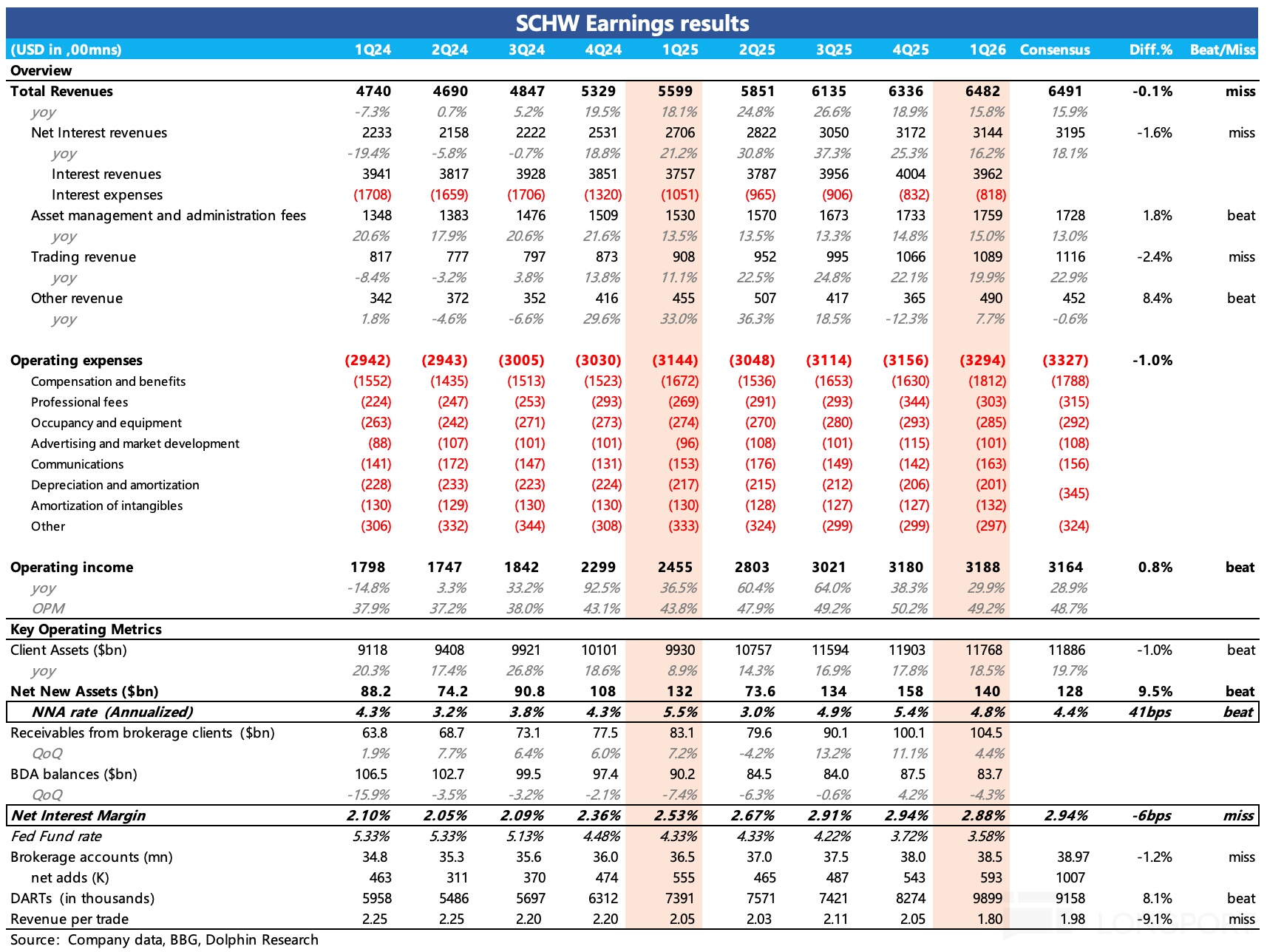
3. Key financials: Q1 revenue of $6.5bn (+16% YoY), a quarterly record. Adj. EPS was $1.43 (+38% YoY), also a record, with adj. pretax margin at 51.4%. NII rose 16% YoY; AM & admin fees were a record $1.8bn (+15% YoY); trading revenue grew 20% YoY.
4. Capital: Adj. Tier 1 leverage ratio was 6.8%, within the 6.75%–7% target range.
5. Expense discipline: Q1 adj. opex rose 5% YoY, reflecting seasonality and strong client activity.
II. Call details
2.1 Management highlights
1. Client growth & assets
a. Opened 1.3 mn new brokerage accounts in Q1 (+10% YoY). Ex one‑time MF liquidation outflows, core NNA was $158bn, a Q1 record, and total client assets reached $11.8tn.
b. Mar NNA was the second‑best month in company history, trailing only Dec 2021.
c. Managed investing net inflows rose 46% YoY to a record, with Schwab Wealth Advisory taking in $10bn (+90% YoY). ~30% of managed inflows came from former Ameritrade clients.
d. Bank lending rose 29% YoY, with Pledged Asset Line (PAL) balances at an all‑time high. Margin balances were nearly $127bn, up 13% vs. end‑2025.
e. DARTs hit a record 9.9mn. Q1 volumes included 600mn+ trades supported, 7.8mn service calls, and 570mn digital logins (+12% YoY).
2. Growth strategy & new products
a. Ongoing hiring of Financial Consultants and Wealth Advisors, with ~12 new branches planned for 2026. Clients with a direct advisor relationship show a +10pt NPS and contribute 2.4x the NNA.
b. Launched Schwab Teen Investor accounts (ages 13–17), with parental oversight enabled.
c. Closed the Forge acquisition, adding direct and indirect access to pre‑IPO shares (direct purchase, single‑name funds, and multi‑company funds). Rollout to clients will be phased in.
d. Newly launched Private Issuer Equity Services is building a healthy pipeline, combining Workplace capabilities with Capital’s flexible tech.
e. Increased the strategic stake in wealth.com and launched an AI‑powered estate planning tool, with AI tax planning to follow.
f. Successfully rolled out Structured Asset Line to advisors, expanding eligible collateral types, including alts.
3. Spot Crypto
a. An employee pilot has begun, with a phased client rollout expected in the coming weeks.
b. Initial support will cover Bitcoin and Ethereum (≈75% of crypto mkt). Pricing is 75 bps of trade value, competitive vs. major peers.
c. More coins and transfer functionality will follow, allowing clients to move existing digital assets into Schwab.
d. In‑house ledger and custody capabilities lay groundwork for future tokenization of securities.
4. AI strategy
a. Schwab has long embedded ML and AI, with AI tools deployed to all 33k employees. Over 8k technologists are using AI to assist design, coding, testing, and fixes.
b. Client‑facing AI: Portfolio Insights (AI‑driven personalized portfolio analytics) begins rolling out next month, with generative search on schwab.com later this year. An initial Investor AI Assistant launches in Jun (voice and chat) to handle tasks like beneficiary setup, with skills added over time, in partnership with leading AI agent firms.
c. Internal efficiency AI: Schwab Knowledge Assistant (instant answers to complex client questions), Schwab Research Assistant (synthesized mkt insights), Schwab AI Service Assistant (≈60k daily real‑time interactions with transcription, notes, and follow‑ups). A branch relationship assistant provides pre‑meeting summaries, recording, and action items, and LLMs analyze millions of calls for training.
d. AI is a growth accelerator, not a headwind. It will enable better experiences and new fee‑based products, and research shows over half of clients are willing to pay for AI financial tools.
5. Client cash management
a. Total cash is ~10% of client assets, with transactional cash ~4% (≈$10k per account).
b. Multiple nudges ensure cash allocations are deliberate and optimized: FC outreach, first‑screen prompts on login, and one‑click moves.
c. Cash is a highly flexible part of the biz. model, with multiple monetization levers if the economics evolve, including trading, wealth, lending, and AI‑enabled fee services.
6. Brilliant Basics service quality
a. Avg. service center hold time is under 30 seconds, and client NPS is up 9 pts YoY, near record highs.
b. Advisor Services continues to streamline RIA digital workflows (money movement, account opening, maintenance), while retail and Workplace expand digital experiences.
2.2 Q&A
Q: With the shifting rate path (markets now pricing no cuts), how do you view full‑year NIM and interest‑earning asset (IEA) growth?
A: Q1 client engagement was very favorable. In our Jan Winter Biz. Update we assumed two cuts (Jun and Sep), while markets now may expect none, which is better for us. Cash held up well in Q1, and while Q2 typically dips seasonally, organic growth should keep cash trending higher for the year.
Fewer cuts are a direct positive, and strong engagement brings new assets and cash, while lending remains robust to provide continued tailwinds. I am optimistic on NIM growth versus prior scenarios, with potential upside, and will share more in the Jul framework refresh.
Q: How will Schwab monetize its ETF distribution platform? Any difference between active and passive ETFs?
A: We see monetizable value in ETFs and are moving quickly. We are in negotiations with 400+ managers on the platform, starting with larger firms, and progress is solid. We are confident an ETF monetization program will be in place and live by year‑end.
On active vs. passive, we plan to charge a percentage of the ETF expense ratio. Active strategies typically carry higher fees, so the economics are richer.
Q: How do you balance growing IEAs (loans and other high‑yielding opportunities) with capital returns (buybacks)?
A: We feel good about demand given engagement. Bank lending is expanding, especially PALs, which earn much wider spreads than parking funds in cash or securities, and margin balances are also attractive.
As clients bring in cash and keep it on‑platform, those deposits efficiently fund lending and support balance sheet growth. While this quarter’s balance sheet growth was modest, it is accretive to earnings and capital.
On capital, our priority is to support franchise growth and evolving client needs. With strong EPS growth, we also have room to return capital within our framework—we already raised the dividend in Q1.
We will assess upcoming callable preferreds this year—whether to retain, redeem, or partially swap—and then consider buybacks. Overall, the trajectory of client growth and our ability to support it are encouraging.
Q: JP Morgan introduced tools to reduce brokerage cash friction. Is Schwab considering similar features, and how do you view competition and AI’s impact on cash economics?
A: We have long worked to make cash allocation simple and sensible. From FC outreach about balances and options, to first‑screen prompts like 'earn more on your cash at Schwab', to advisors tightly managing cash in a fiduciary role—we aim to make deliberate optimization easy.
Clients often choose to leave funds in sweep cash for good reasons: bill pay and everyday spend, with hundreds of billions moving monthly, and ≈$300bn of equities settling over T+2 requiring cash. So most client cash on our balance sheet is a conscious choice.
On agents, we will roll out AI agent capabilities this summer, starting with basic tasks and expanding over time. Over the long run, most actions done today on web or mobile via clicks will be agent‑driven, and one‑click cash moves will become an agent experience.
If clients want cash managed as part of a broader allocation, that is a paid advisory service, and we will be ready to provide it. Three points: first, clients are already optimizing cash deliberately; second, agents will make it easier; third, we have ample flexibility to price for value.
Our NPS is at historic highs and clients love working with us. We successfully pivoted our model when commissions fell, and we can adapt again if economics change—AI accelerates our strategy, not the reverse.
Q: Mar NNA was unusually strong. Did RIA inflows benefit from custodian switches, and was deposit growth driven more by risk‑off or tax‑season cash builds?
A: Mar was our second‑best month ever for NNA, behind a December, which is seasonally strong. You’re right that Advisor Services remains robust, but notably, Mar Investor Services (retail) NNA hit a record and actually exceeded Advisor Services—both channels were very strong.
For Advisor Services, we maintain a leading custody offering and keep investing to make it easier to work with us—expanding lending, and just launching the Structured Asset Line so advisors can borrow against alts, RSUs, and private shares. Previously, advisors had to bring in big banks for such loans; now they can stay with us and keep the wealth relationship whole.
The independent, fiduciary RIA model continues to win, and as they grow, so do we. On retail, growth reflects our value proposition, active markets attracting assets to Schwab, and our differentiated position in the industry.
In volatile markets, our client‑first approach stands out. On cash, Mar saw a clear build for several reasons: late‑month equity pullback and sentiment shift drove a more defensive stance; some long‑short activity produced cash; and strong NNA itself brought in cash.
I cannot quantify how much was for tax prep, and the above likely dominated. But that can mean post‑sale cash sits on‑platform and heads out in Apr for tax payments. So far Apr is tracking a typical tax season pattern, with transactional cash and MMFs both funding payments.
Q: If the sweep cash monetization model changes, what alternatives does Schwab have, and how do you track shifts in client behavior and preferences?
A: First, before discussing a change in economics—we do not see this as a major risk today. We believe clients are making deliberate cash choices, and we make it easy to select the right cash solutions, in both Advisor Services and retail.
Second, we have many levers if the model evolves. We earn across trading, wealth, and lending, with potential AI‑enabled fee services as well.
If someone wants us to proactively manage their cash without their involvement, that is advisory and will be priced accordingly, including agent‑driven advisory. With 47mn clients, deep long‑term relationships, and a highly regarded value proposition, we are confident in growing revenue under any backdrop.
When commissions fell, we adapted successfully, and we can again if needed. Importantly, sweep cash is under 4% of the overall relationship—our mandate is helping clients manage 100% of their financial lives, and there are many ways to monetize that.
Q: What is the strategic goal for crypto—defensive retention, new assets, or engagement? How will you encourage clients to transfer digital assets into Schwab?
A: We are launching crypto primarily because we stand for client choice. Many already access crypto at Schwab via ETPs, futures, or closed‑end funds, and they have asked for spot exposure—we are delivering that, the Schwab way, with strong value, research, and education.
On transfers, clients have been asking for the ability to bring crypto to us, so I expect they will do so proactively. Two reasons: they trust us as a safe institution; and the more of their financial life they integrate, the better we can guide them.
They know our service, pricing, and capabilities are unmatched, so we will not need to push, though FCs will encourage consolidation in conversations. Strategically, we are building with an in‑house ledger and custody.
That sets up optionality to let clients choose how they hold equities and fixed income in the future—potentially via tokenization. This rollout builds that future optionality.
Q: RPT fell notably in Q1 despite strong trading revenue. Beyond mix, were there pricing factors? How did you set crypto pricing?
A: Traders are more uncertain about geopolitics and the economic outlook. Two weeks ago a group of traders told me they are running smaller positions for shorter durations due to lower confidence.
So they trade more often, but in smaller sizes, driving down revenue per trade even as DARTs hit records. On crypto pricing, I believe our first‑trade pricing will be the lowest among major firms.
We want to be competitive, while recognizing crypto is costly and risky to launch, so we need healthy unit economics. We think 75 bps strikes the right balance between competitiveness and attractive economics.
Q: How do you view prediction markets, and will Schwab participate?
A: Your framing is right—we distinguish finance‑related events from sports, politics, and pop culture. We believe in long‑term investing and compounding—owning equities and fixed income over time leads to higher wealth—and we will avoid offerings that conflict with that.
Statistically, gamblers tend to lose, and as a firm focused on clients’ best financial lives, we steer clear of betting‑style markets like sports. This quarter has been our fastest pace of innovation ever—crypto employee pilot, major AI advances, new lending, teen accounts, and the Forge close.
When we ask clients what they want most, prediction markets rank low. A few weeks ago I polled a large client group on the topic and interest was limited.
That said, prediction markets may ultimately emerge. Intermediaries will likely launch related products—CBOE and NASDAQ are introducing binary options and contracts tied to financial events, which are functionally close.
We will evaluate those carefully, and integration would be straightforward for us. So while prediction markets are not near the top of our client priorities, we can act when appropriate—and we will stay away from gambling.
Q: Any update on Private Alts in retail? How are RIAs adopting evergreen private alts, and what is the balance sheet capacity for long/short tax‑advantaged strategies?
A: In aggregate, alts remain a relatively small share of advisor client allocations, but I expect growth over a 5–10 year horizon. We can do more curation and guidance on‑platform to help advisors select the right alts and build a highly useful marketplace—with monetization opportunities along the way.
Making alts easier to implement is critical and a focus this year, and we expect major progress by year‑end. Interest in long/short is rising.
From a balance sheet perspective, long and short exposures net against each other and we earn fees, so this is not capital‑ or balance‑sheet‑intensive. We work closely with managers to understand strategies and how they evolve in different markets, and we have ample capacity to support demand, with growth pacing dependent on the macro environment.
Q: Can you break down trading activity mix, participation breadth, and RPT drivers? How do you view Apr and the coming quarters for trading KPIs?
A: Q1 engagement was very strong, with DARTs at a record 9.9mn. In high‑vol and high‑participation environments, flow tends to skew to equities over derivatives, and that is what we saw.
As Rick noted, even within equities, position sizes were smaller—fewer shares per trade and fewer contracts per options trade—reflecting high vol and lower confidence. For the year, outcomes depend on the macro backdrop.
When vol spikes, DARTs surge, which is highly accretive to earnings, but RPT compresses. If vol normalizes, volumes may ease while RPT recovers modestly. Overall, supporting client engagement remains very EPS‑accretive.
<End>
Disclosures:Dolphin Research disclaimer and general disclosure
