


NFLX (Trans): FY revenue guidance already factors in potential price hikes this year
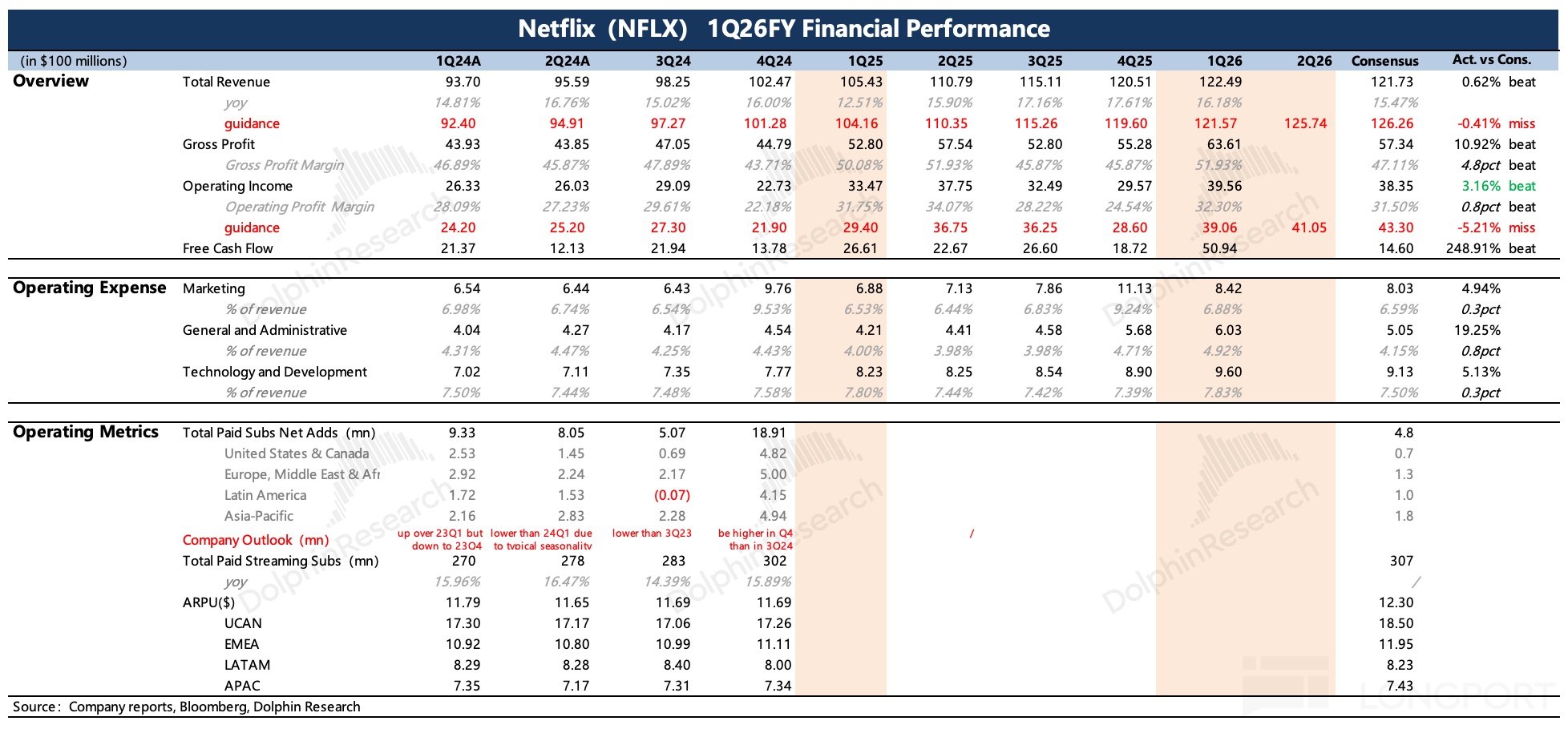
Below is Dolphin Research's$Netflix(NFLX.US) FY26Q1 earnings call Trans. For our take on the print, see Skipping WBD and Still a Bomb — Is Netflix Out of Steam?.
I. Key Takeaways
1. FY guide unchanged: 2026 revenue growth of 12%–14%, OPM at 31.5%, and ads revenue target of approx. $3 bn (double YoY).
2. M&A-related costs: Initial plan for $275 mn of M&A costs (incl. InterPositive and the Warner Bros. deal). While the WB transaction was dropped, some costs originally planned for 2027 were pulled into 2026, keeping the total broadly in line with the original budget and with no material impact on OPM.
3. Subs scale and penetration: Paid subs exceeded 325 mn by end-2025, reaching nearly 1 bn viewers. Penetration in addressable households is still below 45% (approx. 800 mn households), capturing only ~7% of addressable revenue (~$670 bn), with just ~5% share of global TV viewing time.
4. Advertiser base expanding: Advertisers rose 70%+ YoY to 4,000+ in 2025, with programmatic buying on track to exceed 50% of non-live ad spend.
5. Retention improved across regions: Q1 retention rose YoY in all geos, with APAC delivering the strongest FX-neutral revenue growth.
II. Call Details
2.1 Management Highlights
1. Three strategic priorities
a. Deliver more entertainment value: double down on core series and films while expanding into podcasts, regional live sports (e.g., World Baseball Classic), and games (incl. the new kids app, Playground). b. Elevate the experience through tech: apply innovation across the full stack from distribution and discovery to creation and production. c. Improve monetization: drive broad distribution (organically first, with partners as a complement), smarter pricing, and a growing ads biz.
2. Content and competition
a. High-competitive projects continue to land: including 'Strangers' starring Gwyneth Paltrow and 'Rabbit, Rabbit' starring Adam Driver. b. Healthy creator ecosystem: strong repeat collaborations, such as Beef S2 creator Sonny Lee's overall deal, multi-project work with Oscar Isaac, and ongoing partnership with Carey Mulligan. c. Dual-role relationships with studios: both competitor and customer (Running Point produced by Warner Bros.; licensed Watson from Paramount, etc.).
3. AI and tech applications
a. InterPositive accelerates GenAI in production, with tools purpose-built for filmmakers and distinct from generic GenAI video apps. b. AI is lifting engagement in recommendations; new model architectures improve personalization and speed iteration. c. In ads, AI enhances the Netflix Ads Suite, improving creative formats and contextual relevance.
2.2 Q&A
Q: What are the lessons from the WBD deal? Any change to your M&A approach or capital structure?
A: From day one we framed WBD as 'nice-to-have' rather than 'must-have'. Our biggest risk was losing focus on the core, but Q1 shows the team sustained discipline while exploring the opportunity. We have historically been a build-not-buy company, and some doubted our ability to execute a large deal. Through this process, the team proved capable, gaining deep experience in execution and early integration, and we won the bid while confident in regulatory clearance. Crucially, we stress-tested our M&A capability and investment discipline. When costs exceeded net value to the biz and shareholders, we set emotion and ego aside and walked away, setting a firm standard for everyday decision-making.
Capital allocation is unchanged: prioritize organic investment, complement with opportunistic M&A (e.g., InterPositive), maintain ample liquidity, and return excess cash via buybacks. M&A remains a tool to achieve goals, and we will stay highly disciplined.
Q: How did engagement quality trend in 2026? What metrics define quality?
A: Time spent still matters and we track it closely. Q1 viewing hours grew at a pace similar to 2H25, despite 17 days of heightened streaming competition during the Winter Olympics. But time spent is only one of several signals. Member quality is a growing focus within our measurement framework, built from multiple related inputs, and our primary member-quality metric hit an all-time high in Q1. We won't detail its construction, as it took significant effort to build and validate and competitors would love the playbook. We build confidence by testing how well it predicts and explains core outcomes like retention, which is why we believe moving this metric drives the biz.
We also need to understand the value created by new content formats. Live is a great example — it often delivers outsized member value even if hours trail scripted, and it shows a different acquisition profile. We will keep refining models to reflect these differences.
Q: Nielsen's methodology change lowered streaming's share in The Gauge. Any impact on Netflix ads?
A: The Gauge shift reflects a change in how Nielsen estimates the national TV universe, not viewing behavior. In practice, it down-weighted streaming-only homes and up-weighted linear homes, making streaming look smaller on a relative basis and linear larger. We have first-party streaming data and disclose it in our engagement report, using a straightforward method that others are increasingly adopting. For ads, The Gauge is not a trading currency. With no real change in consumer behavior or volumes, there is no impact on ad efficacy or targets, and we still expect ~$3 bn of ad revenue this year. With under 5% share of global TV time, our runway remains significant regardless of this change.
Q: How did the World Baseball Classic perform? What other global sports and live opportunities do you see?
A: WBC was a huge success. It was our most-watched title ever in Japan and the largest global baseball streaming event, reaching 31.4 mn viewers. These events matter because they deliver outsized business impact, proving not all engagement is created equal. Those days were extraordinary for members in Japan, driving the biggest single-day sign-ups ever in Japan and making Japan the top contributor to Q1 global net adds, with a record quarterly paid net adds for the market. It was also our first large live regional sports event outside the U.S., allowing us to develop capabilities to stream multiple concurrent games.
APAC was the strongest FX-neutral revenue grower in Q1, but not solely due to WBC. India performed very well, Korea was strong, and SE Asia also showed momentum. WBC's halo boosted viewing of recent originals, with some re-entering the Top 10, and One Piece also benefited.
Q: NFL is seeking new partners. How do you assess ROI for live sports vs. scripted content?
A: Our sports strategy is consistent — we are most interested in breakout tentpoles rather than full-season packages. Any pursuit must be economically rational, balancing viewing value with ad monetization. Sports is a core pillar of live, alongside other large live moments like Skyscraper Live, the Star Search reboot with live voting, and BTS's reunion concert. We already have multiple live sports wins: MLB Opening Day, Christmas NFL, heavyweight fights, and Japan's WBC, among others. NFL is a premium asset that can add value as part of the broader slate, and we are discussing an expanded partnership. Years of evaluating NFL and live have given us the experience to negotiate with discipline.
Our events strategy is working: on Tue we announced a multi-year rights deal with Concacaf in Mexico, plus the Women's World Cup in the U.S. and Canada, and our first large global MMA event. We are scaling sports globally because it creates value for members, leagues, and us.
Q: What's the podcast model and strategy?
A: Still very early, but the data is encouraging and shows podcasts add incremental engagement. Two signals stand out: first, podcast consumption is concentrated in daytime, a historically softer engagement window for us, expanding our coverage of that daypart. Second, podcasts skew heavily to mobile, whereas pro TV/film has long under-indexed on mobile. We are building a rich slate across licensed and owned. Licensed includes The Bill Simmons Podcast, The Breakfast Club, Therapuss (Jake Shane), and Pardon My Take; owned includes The White House with Michael Irvin, The Pete Davidson Show, and companion pods for super-fans like The Bridgerton Official Podcast. We also announced new shows from Brian Williams, Evan Ross Katz, Stephanie Soo, Ellison Barber, and David Kwong, and the slate keeps expanding.
Q: How is the advertiser base growing? What's the split between direct and programmatic, and have you penetrated mid-market?
A: Moving to our own ad tech stack made it easier for advertisers to buy. We continue to add DSPs, and programmatic is growing fast, set to exceed 50% of non-live ads. With stronger marketing, more sellers, and broader products, our advertiser base grew 70%+ YoY to 4,000+ in 2025. It remains concentrated in large accounts served directly by our sales team, whether via our own platform or through DSPs. Looking ahead, advertiser count and programmatic mix should keep rising. As programmatic scales and the base broadens, we will expand into a larger pool following standard industry patterns.
Q: What drove the recent U.S. price increase? Any impact on gross adds and churn?
A: It was part of a planned cycle. We monitor member signals — quality-weighted engagement, plan selection and migration, and our industry-leading retention — and we saw a clear step-up in perceived value before the increase. Our full-year guide at the start of the year already incorporated planned pricing actions, and we almost always include all changes in that outlook; surprise hikes are extremely rare. Early reads from the latest U.S. move are in line with history, and while the rollout continues, signals are consistent with past increases. Our pricing philosophy is unchanged: deliver more value, invest behind revenue, and when value rises, ask members to pay a bit more to fund even more entertainment. In the U.S., our cost per hour is the lowest among SVODs, with some peers at 2x; the $8.99 ad plan is a great entry point, offering standout value. Q1 retention improved YoY across all regions, confirming effective value delivery.
Q: Year five into gaming, what are the key learnings? How is it changing behavior, and where will you invest?
A: Gaming is a massive opportunity — consumer spend is about $150 bn (ex-China and Russia, excluding ads) and still growing. A large part of the market struggles with new player acquisition and low-friction discovery, where we can help. We have been laying the groundwork: build development capabilities, launch infrastructure, player connections, and high-quality experiences. As with series and films, we've validated that games improve retention and can drive acquisition, though the acquisition impact is still small — consistent with current consumer perception of us as a gaming platform. A recurring behavior: offering interactive experiences in the same universe for fans of our film/TV IP extends engagement and creates synergy, benefiting both interactive and non-interactive content and lifting overall value.
Focus areas include interactive games based on hit IP, TV Games on the big screen (opening a new canvas for players and devs), and dedicated kids experiences. We have been building for years, but we're only scratching the surface, and we are increasingly able to deliver on the original vision. We will keep scaling investment based on performance and returns.
Q: What is Netflix Playground, and how will you measure success?
A: Playground is a standalone kids gaming app. Kids are one of our four gaming pillars (kids, narrative, party/puzzle, mainstream), and the goal is to bring beloved worlds to life through games and interactivity. We have always treated kids as a special audience with dedicated experiences and robust parental controls (ratings, parental controls, PIN, etc.). Playground extends that ethos to games: a single app with a growing library of curated, age-appropriate titles based on popular IP like Peppa Pig, Dr. Seuss, and Bad Dinosaurs. There are no ads or in-app purchases, matching kids' natural viewing habits on mobile and tablets, and it is included in membership. Early signals are strong — as the catalog grows, engagement has ramped across both new and existing titles, and long term we see a major opportunity to serve families across games, TV, and film with parent-approved entertainment.
Q: How does the 2026 content competitive landscape look? Any differences by region, language, or format?
A: Competition is not new — consumers have always had many choices in entertainment. We keep growing by delivering great value, even as new services emerge globally. The fight for top-tier projects remains intense, which is exactly where we want to be. The content team recently secured several of the most competitive titles, and that is not just about paying up — relationships are critical. Providing a great creator experience and massive reach and buzz are the real differentiators, and repeat collaborations are the best proof.
Beef S2 launches this week; creator Sonny Lee just signed an overall deal. Oscar Isaac has a new film and projects after Frankenstein, Carey Mulligan will star in year-end Narnia, and Charles Melton and Cailee Spaeny are part of the 'Netflix family'. Running Point drops next week, building on our long-term partnership with Mindy Kaling. Internationally, La Casa de Papel creator Alex Pina is also developing new projects with Netflix.
We are also customers of many rivals: Running Point is produced by Warner Bros.; we licensed Watson and Mayor of Kingstown from Paramount; we have a Pay-1 with Sony; and a deal with NBCUniversal covering DreamWorks Animation and Illumination. Being both customer and competitor is common in entertainment, and we manage those relationships well.
Q: How will AI evolve in the creative process, and what is the strategy behind InterPositive?
A: We expect GenAI to make content better with improved tools and workflows. With strong tech DNA and scaled data assets, Netflix will remain at the forefront of AI in creative processes. Great art still requires great artists; AI does not change that, but it gives them better tools to realize ideas. Creators already use these tools for lookbooks, pre-vis, VFX, and shot planning, which also improves on-set safety, and we are only at the start. InterPositive accelerates our GenAI capabilities with proprietary tech built for filmmakers, unlike generic GenAI video apps. Though new, it has sparked strong creator interest and adoption is accelerating.
AI focus spans three areas: first, production. Second, member experience — on two decades of personalization, new model architectures improve recommendations and speed iteration, and in Q1 we saw engagement lift from these advances, making our large content investments work harder. Third, ads — using AI in the Netflix Ads Suite to design new creative formats, customize ads, and improve contextual relevance while making these capabilities easier for partners to use.
Q: Did Reed Hastings' decision not to stand for BOD re-election relate to the WBD pursuit?
A: No. Reed supported the WBD deal and advocated for it on the BOD, which was unanimous. Management and the BOD were fully aligned on WBD and his decision is unrelated. Reed is our founder and Chairman and will not stand for re-election at the next AGM. It is rare for founders to step off the BOD after transition, but Reed is not a typical founder and has always prioritized succession. He began this process over a decade ago, said he would stay ~10 years, and is acting sooner — that is Reed: fast and decisive. He will remain Chairman through the end of this term, and the BOD and Nominating & Governance Committee will progress the refresh in coming months.
Ted and Greg expressed deep appreciation for Reed's leadership: he set the bar for Netflix's leadership and culture, drove innovations that shaped the company and the industry, and expanded possibilities for creators and audiences worldwide. He pushes people to think bigger and be more candid, and fully supports decisions even when he disagrees, embodying an 'artist-leader' at the highest level.
<End of text>
Risk disclosure and statement:Dolphin Research Disclaimer and General Disclosure
