


What is the TXN options market betting on: Observations as the Q1 earnings window approaches
$Texas Instruments(TXN.US) enters the Q1 2026 earnings window this week (expected to be released after the market close on April 23-24, Beijing time). The behavior of the options market over the past few trading days has significantly deviated from its usual pattern, making it worth analyzing.
💡 Key Observations
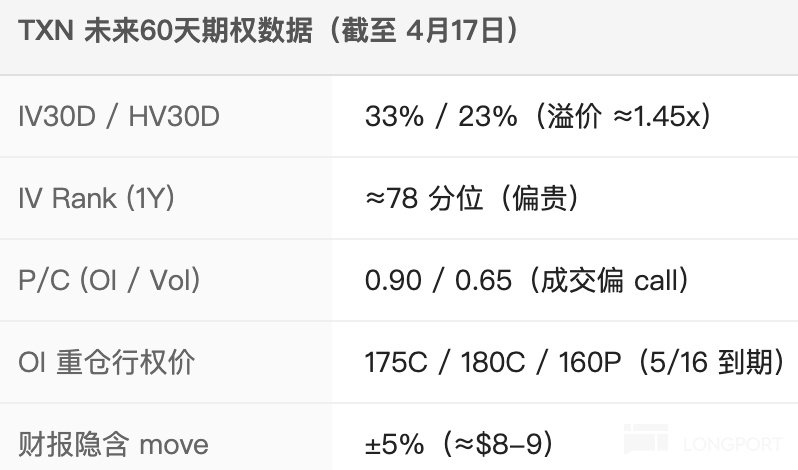
An IV premium of 1.45x is typical of pre-earnings buildup; during non-earnings periods, TXN's IV is usually around 1.1-1.2x. The IV Rank is at the 78th percentile over the past year, meaning options have only been more expensive than now about 20% of the time in the last year—making outright directional option purchases relatively costly, while spread structures are more cost-effective.
The trading P/C ratio (0.65) is significantly lower than the OI P/C ratio (0.90), indicating that new capital flow is skewed towards calls, while puts at the OI level appear more like existing hedges rather than new short positions.
The "Ceiling" Revealed by OI Distribution
💥 Recent Block Trade Characteristics
Several large block trades of May-expiry 180/185 calls appeared during the April 15-16 trading sessions, with single-trade notional values in the millions of USD. Combined with the concurrent uptrend in the stock price, this suggests active buying (trades hitting the ask). No hedging flows of similar scale were seen on the put side.
🤔 What is the Market Expecting?
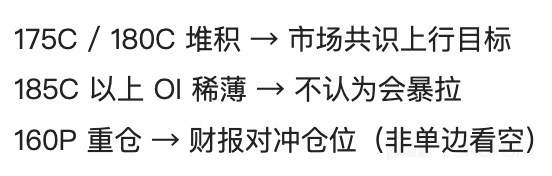
The options market is pricing in a "mild positive surprise" from the earnings, not a bet on a major jump. The accumulation of 175-180 calls indicates capital is waiting for a post-earnings move into that range, but the thinness above 185 suggests the market does not anticipate a sharp rally. The OI in 160 puts looks more like locked-in hedging, not a one-sided bearish view—this is clearer when combined with the declining trading P/C ratio, indicating selling pressure is not on the put side.
🆚 Implied Probability Distribution vs. Historical Comparison
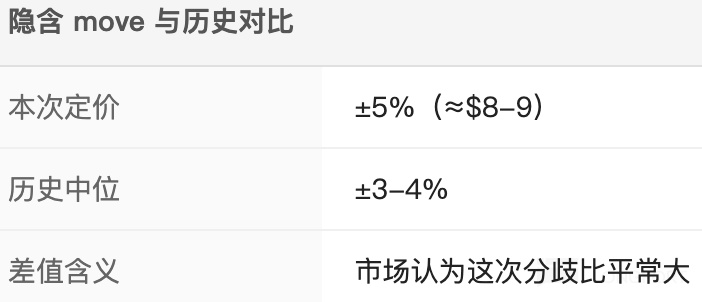
The divergence likely stems from the interplay of two narratives—whether the analog cycle inflection point is truly confirmed, and the pace of 2026 capex decline.
Synthesizing the flow and OI changes over the past week: institutions are skewed towards calls and are bullish, but strike prices are concentrated in near-month, near-the-money strikes (175-180) rather than far out-of-the-money bets on a surge. This is a "structurally long + cost-controlled" positioning, not an aggressive gamble. If earnings confirm the narrative of analog demand bottoming out and capex peaking, 180 is the first resistance level above. A breakout would depend on the quality of management's 2026 free cash flow guidance.
The copyright of this article belongs to the original author/organization.
The views expressed herein are solely those of the author and do not reflect the stance of the platform. The content is intended for investment reference purposes only and shall not be considered as investment advice. Please contact us if you have any questions or suggestions regarding the content services provided by the platform.
