


 Likes Received
 Rate Of Return
🚀 Once SpaceX goes public, capital won't just buy SpaceX itself: what the market will truly chase are "alternative plays" and the entire industry chain.
If SpaceX enters the public market, the core change isn't just one more stock; it's the entire "commercial space" sector being revalued. Capital won't concentrate on a single company but will spread along the paths easiest to trade and easiest to tell a story about.
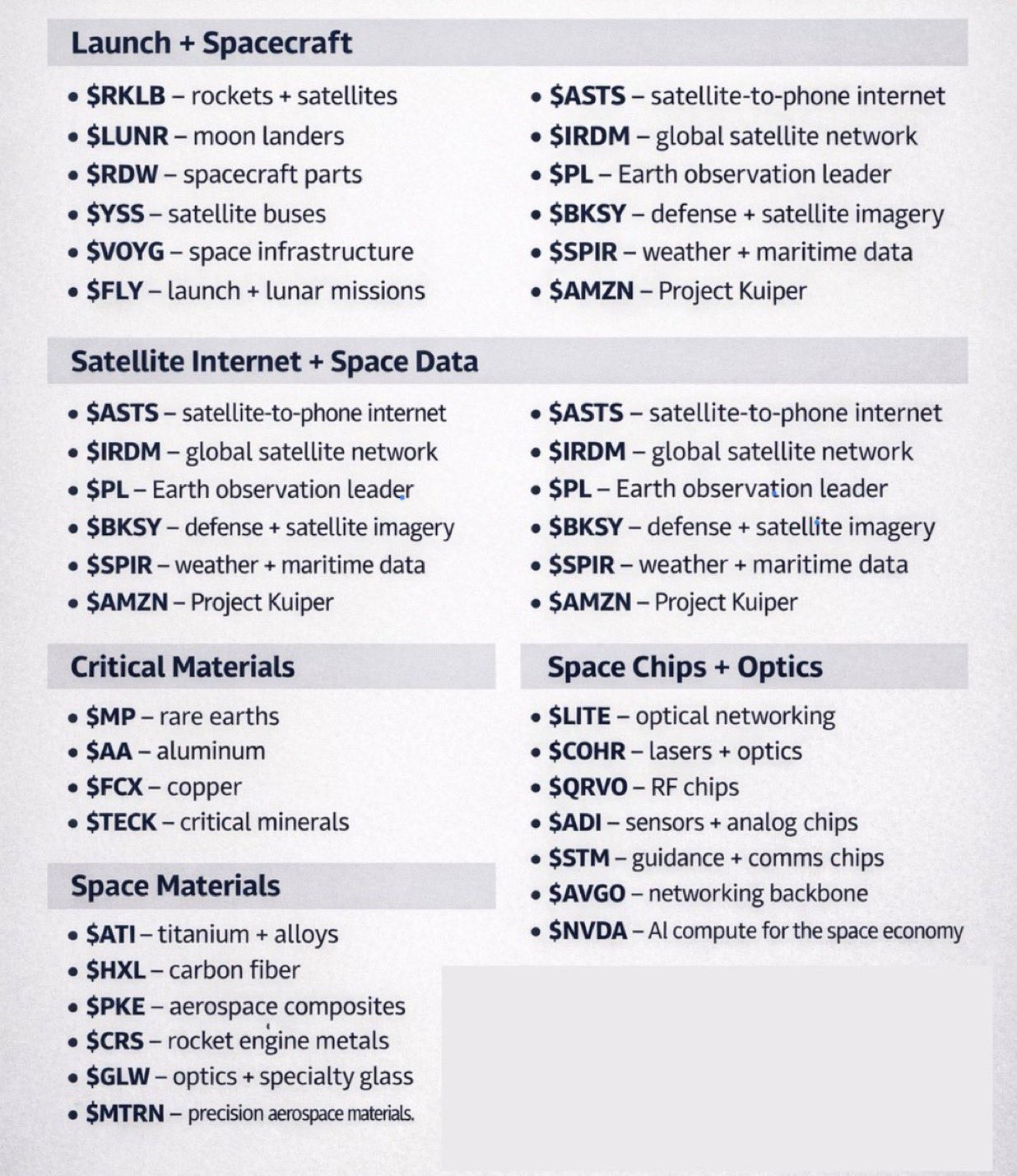
The first layer is the most direct mapping: launch and spacecraft. This layer is closest to SpaceX itself, so it often becomes the first wave of focus.
$Rocket Lab(RKLB.US)
$Intuitive Machines(LUNR.US)
$Redwire(RDW.US)
$York Space(YSS.US)
$Voyager Tech(VOYG.US)
$Firefly Aerospace(FLY.US)
These companies cover rockets, satellites, lunar missions, and infrastructure. When the market starts reinforcing expectations of "increased launch frequency and scaled commercial space," this layer typically gets capital attention first.
The second layer is satellite internet and space data, which is the core source of long-term value.
$AST SpaceMobile(ASTS.US)
$Iridium Comm(IRDM.US)
$Planet Labs(PL.US)
$BlackSky Tech(BKSY.US)
$Spire Global(SPIR.US)
$Amazon(AMZN.US)
From satellite-to-phone connectivity to global communication networks, to Earth observation and data services, this layer corresponds to sustainable business models. Compared to one-off launches, it's easier to form stable revenue structures here, making it more likely to be re-evaluated by capital in the mid-to-late stages.
The third layer is key raw materials, the cost foundation for the entire industry's expansion.
$MP Materials(MP.US)
$Alcoa(AA.US)
$Freeport Mcmoran(FCX.US)
$Teck Resources B(TECK.US)
Whether rockets or satellites, they fundamentally rely on basic resources like rare earths, aluminum, and copper. When the industry enters a scaling phase, these companies often benefit in a more stable way but are easily overlooked in the early stages.
The fourth layer is high-end aerospace materials, belonging to the manufacturing segment with higher technical barriers.
$ATI(ATI.US)
$Hexcel(HXL.US)
$Park Aerospace(PKE.US)
$Carpenter Tech(CRS.US)
$Corning(GLW.US)
$Materion(MTRN.US)
Titanium alloys, carbon fiber, composites, and specialty glass form the core structure of aerospace systems. If launch and manufacturing demand increases, the order flow and pricing power of this layer will change accordingly.
The fifth layer is chips and optics, the foundational support for the entire system's operation.
$Lumentum(LITE.US)
$Coherent Corp.(COHR.US)
$Alcoa(AA.US)OI
$QORVO(QRVO.US)
$Analog Devices(ADI.US)
$STMicroelectronics NV(STM.US)
$Broadcom(AVGO.US)
$NVIDIA(NVDA.US)
Communication, navigation, data processing, and AI computing all rely on these technologies. Without this layer, the so-called "space economy" cannot materialize, but this part is often underestimated in the early stages.
The key isn't the specific list of companies, but the change in capital flow paths. Once SpaceX IPOs, it essentially establishes a valuation anchor for the entire industry, and the market will prioritize those already listed, liquid companies to express this theme.
What's more worth watching is, when this logic is truly traded, whether capital will be more inclined to chase the most direct narrative plays first, or will it position ahead of time in segments with clearer cash flows.
The copyright of this article belongs to the original author/organization.
The views expressed herein are solely those of the author and do not reflect the stance of the platform. The content is intended for investment reference purposes only and shall not be considered as investment advice. Please contact us if you have any questions or suggestions regarding the content services provided by the platform.
