


ATFX: At 00:38, crude oil rose. At 00:40, news of the Iranian strike was released. How do we account for the time difference?
ATFX: Overnight, gold fell sharply, closing at $4,259. The decline continued in today's Asian session, with the latest price at $4,184, breaching the important $4,200 level. Overnight, crude oil first fell and then rose, with the daily K-line showing a long lower shadow, closing at $88.68. As of today's Asian session, the price is fluctuating around yesterday's closing price.
ATFX Chart▲
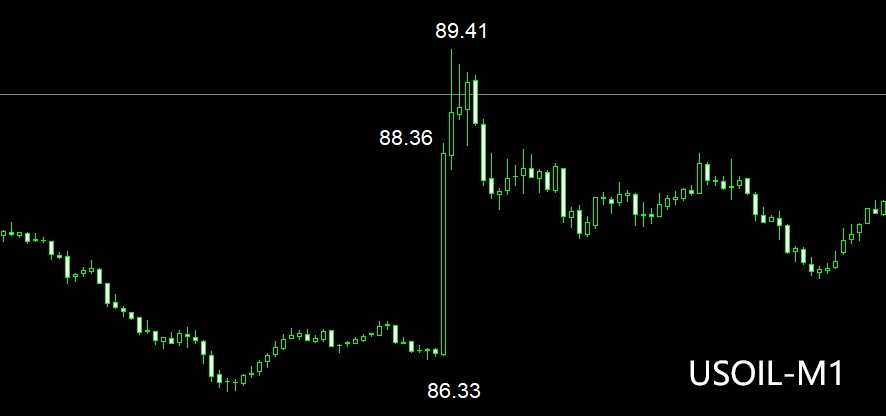
Today at 00:38, US crude oil experienced a sharp and unusual movement. Within one minute, the market price surged from $86.33 to $88.46, a gain of over $2. In the second minute, US crude oil surged further to $89.41, approaching the $90 level. If you were watching the market at that time, you must have had no idea what caused the sudden rise in US crude oil. Even if you checked the financial calendar, you wouldn't have found any major data releases scheduled for 00:38.

ATFX Chart▲
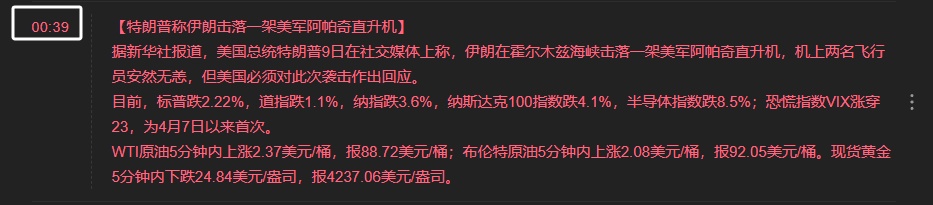
If you immediately checked the news feed, you still wouldn't have found any noteworthy content. Only two minutes after the price rise ended, at 00:40, did the news feed refresh with one item: Iran shot down a US Apache helicopter over the Strait of Hormuz. The cause was found, but the timing of knowing the cause was too late, a full two minutes behind the market movement.
ATFX Chart▲
Different media outlets have time differences. For example, in the image above, the news was released at 00:39, one minute earlier than 00:40, but for short-term trading, it still missed the main upward wave of the market. After traders see the news, it often takes about twenty seconds to interpret and react at the fastest speed. So in reality, we missed the main upward wave of the market by at least two minutes.
How to solve the time lag? We only mention the practices of large institutions here, because ordinary participants lack the financial resources to support the costs required to build earlier news sources.
1. Bloomberg and Reuters terminals. These are standard for large institutions. The news and information on these terminals are inherently faster than public financial information. Using these terminals, the delay from news release to acquisition is only about five seconds.
2. Dedicated news networks. Many pieces of news are not public or are not suitable for public release. Therefore, large institutions reach agreements with certain consulting firms and energy companies to be notified internally in case of major changes. Simply put, it can be understood as "inside information," but in reality, it's just that they paid a high price for internal data.
3. AI scanning. Using programmatic methods to scan the entire internet in real-time, tracking specific sources based on keywords or large language models. However, this is still public information. The release of information requires editing, organization, and proofreading, so the delay issue cannot be resolved.
For most individual participants, none of the above three methods can be implemented independently. Therefore, in the face of sudden news, it is wiser to avoid the first round of time-lagged impulse and directly participate in the second round of impulse.
ATFX Risk Warning, Disclaimer, Special Statement: The market carries risks, and investment requires caution. The above content only represents the analyst's personal views and does not constitute any operational advice. Please do not treat this report as the sole reference. The analyst's views may change over time, and updates will not be notified separately.
The copyright of this article belongs to the original author/organization.
The views expressed herein are solely those of the author and do not reflect the stance of the platform. The content is intended for investment reference purposes only and shall not be considered as investment advice. Please contact us if you have any questions or suggestions regarding the content services provided by the platform.
