


 SpaceX Option
💢💢💢
🎯 Obsessing over the Nasdaq 100 is a tactical mistake: the real winners are in the semiconductor track.
Over the past five years, if you've been stuck on the $QQQ path, you've missed the clearest profit opportunities right beside you. Semiconductors aren't "part of the tech industry"; they are the most direct profit channel in this AI cycle.
📈 The data is right there, but many can't see it
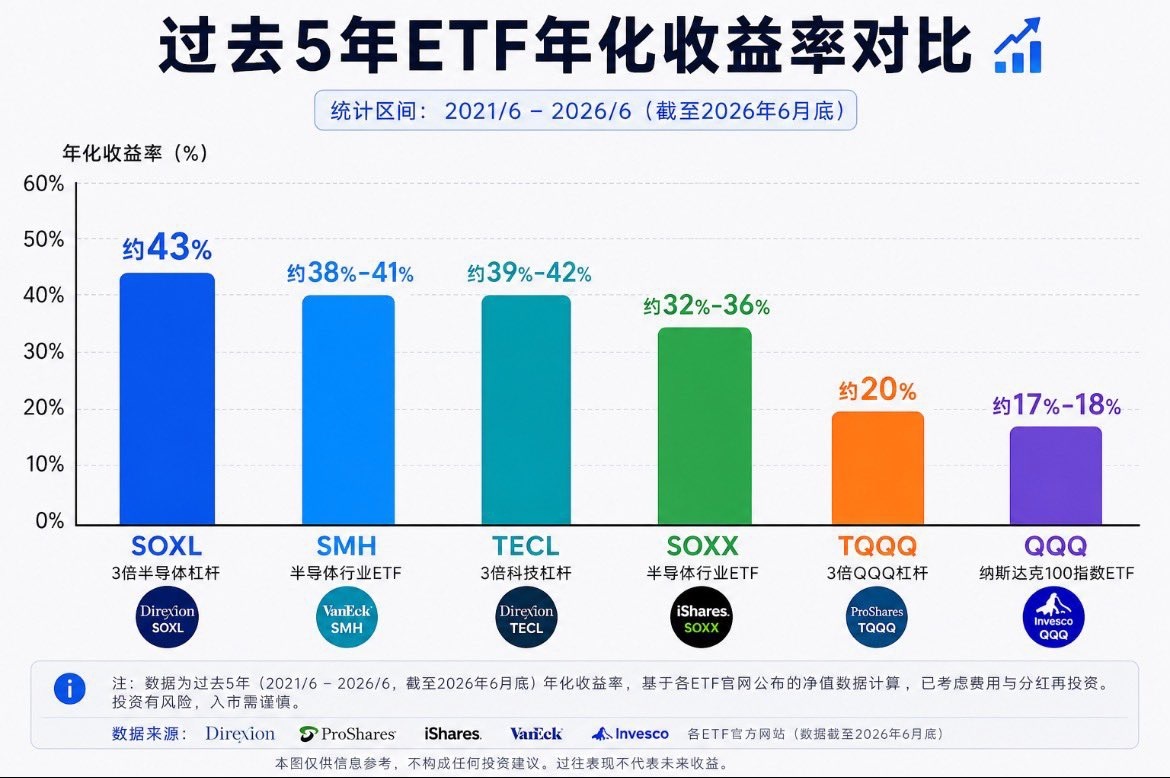
The annualized returns over the past five years brutally illustrate everything:
$SOXL (3x semiconductor leverage) ~43% annualized
$TECL (3x tech leverage) ~39-42% annualized
$SMH (Semiconductor Industry Select) ~38-41% annualized
$SOXX (Nasdaq Semiconductor Index) ~32-36% annualized
Then the broad-based tech funds:
$TQQQ (3x Nasdaq leverage) ~20% annualized
$QQQ (Nasdaq 100) ~17-18% annualized
Semiconductor-related tools have annualized returns 15 to 26 percentage points higher than QQQ. This isn't a "slight lead"; it's a difference in magnitude.
🔨 Why semiconductors became the biggest profit engine
In a gold rush, the real money is never made by the adventurers themselves, but by those providing the tools, equipment, and infrastructure.
AI's computing power demand is exploding exponentially—OpenAI locking 6GW, Meta locking 6GW, Google, Amazon, Microsoft are all pouring tens of billions of dollars into building AI clusters. What's the core material for these data centers? GPU plus HBM plus SSD plus network interfaces—almost all key components come from semiconductor manufacturers.
NVIDIA is of course making money, but second, third, and fourth-tier chip suppliers like SK Hynix, Micron, Samsung, AMD, Broadcom, Marvell are seeing their profit margins actually rise. Why? Because they sit at the tightest choke points of the entire value chain—memory is tight, interconnect chips are tight, power management chips are tight. Whoever controls these bottlenecks has pricing power.
This is why $SMH and $SOXX can consistently outperform the broader market.
💡 Betting on individual stocks vs. gaining exposure to the track
Many investors are still asking "Should I buy $NVIDIA(NVDA.US) or $AMD(AMD.US)," "Is there still a chance for $Intel(INTC.US)," "Will $Micron Tech(MU.US) go tenfold."
This is focusing on the wrong thing.
You don't need to precisely bet on which chip design company will jump from 5x to 50x market cap. You just need to participate in the macro trend that "semiconductors as an entire industry" will continue to benefit from the explosion in AI capex.
$SOXX covers key players across the global semiconductor supply chain—design (NVIDIA, AMD, Qualcomm), manufacturing (TSMC, Samsung), memory (Micron, SK Hynix), upstream equipment and materials (ASML, KLA, Lam Research). If any one benefits, the fund rises. If any one gets hit, the loss is diversified.
This is why $SOXX, despite its 32-36% annualized return being lower than $SOXL's 43%, has its risk digested more evenly.
🚀 AI infrastructure investment is accelerating, not slowing down
It's mid-2026. Hyperscaler AI capex is still hitting new highs—this isn't a cyclical phenomenon that will fade next year, but a multi-year structural demand.
More critically: the acceleration in demand is spreading downstream from the computing power layer (GPU). HBM, DRAM, SSD, optical interconnects, network switch chips—the entire storage and interconnect system is being upgraded. The demand growth rate for these components is even faster than for GPUs themselves.
And the vendors providing these components happen to be the main constituents of semiconductor indices.
⚖️ Why not bet on individual stocks, but on the track
Pick the right track but the wrong company, and you might make 50% in 3 years then lose 30% in 2.
Pick the right track and track it with a broad-based index, and you can enjoy the average returns of the entire industry's upcycle, without worrying about "a black swan event at a specific company."
The 32-36% annualized return of $SOXX over the past five years embodies this logic—not driven by a single chip company's surge, but by the entire industry's continuous advancement fueled by AI demand.
🎯 The current position
QQQ gained 17-18% annualized over the past five years.
The semiconductor track gained 32-43% annualized.
Will the divergence continue?
It depends on two variables: how long will AI capital expenditure keep burning, and when will semiconductor supply truly catch up with demand.
Looking at the current trajectory, both variables point to "continued tightness" before 2027.
So instead of arguing whether a specific chip stock will go tenfold, ask yourself a simple question—
What tool should I use to participate in this semiconductor cycle?
$SOXL gives you the highest returns but also the highest drawdowns.
$SMH gives you industry concentration but also more concentrated risk.
$SOXX gives you balanced exposure but more moderate returns.
Choose the right tool, and the track itself will make the decision for you.
The copyright of this article belongs to the original author/organization.
The views expressed herein are solely those of the author and do not reflect the stance of the platform. The content is intended for investment reference purposes only and shall not be considered as investment advice. Please contact us if you have any questions or suggestions regarding the content services provided by the platform.
