


 Likes Received
 Posts
PostsSemiconductor short positions ran into earnings that beat expectations
6/25 US market: opened high, plunged, then recovered. QQQ swung between 705 and 706 intraday, VOO was basically flat. But the semiconductor sector was severely torn apart—Nvidia fell below $200, Micron/SanDisk led the decline. Funds were buying puts on equipment/computing power chains while locking in long-term bullish positions against the trend. Looking at the following three unusual trades together paints a picture of "short-term bearish, long-term bullish, with bears buying at the point of getting their faces slapped."
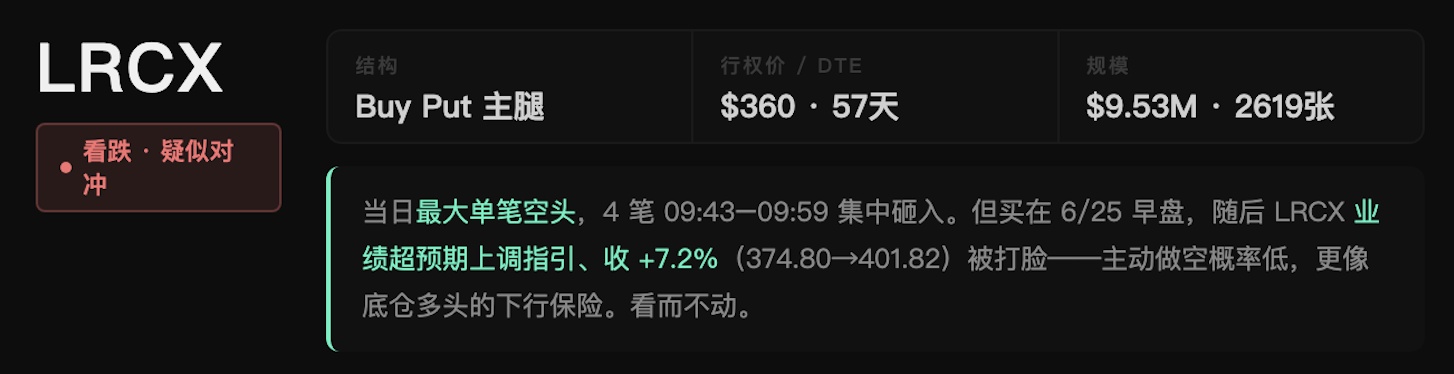
$Lam Research(LRCX.US)
Direction: Bearish (suspected hedge)
Structure: Primarily Buy Put + small Buy Call for top insurance
Strike: Put $360 (8/21) · Call $440/$420
Size: Put $9.53M / 2619 contracts (4 concentrated buys from 09:43–09:59), Call only about $1.06M total
DTE: 57 days
Insight: The largest single short position of the day, but bought in the early session on 6/25—subsequently, the company's earnings exceeded expectations and guidance was raised, closing +7.2%. The $9.5M Put was bought in the early session on earnings day and got slapped by a +7% move, making a directional active short less likely. It's more akin to institutional downside insurance for long core positions. Simply following the short now risks being bitten by fundamentals; watch if the Put continues to be added after the rebound to discuss direction.
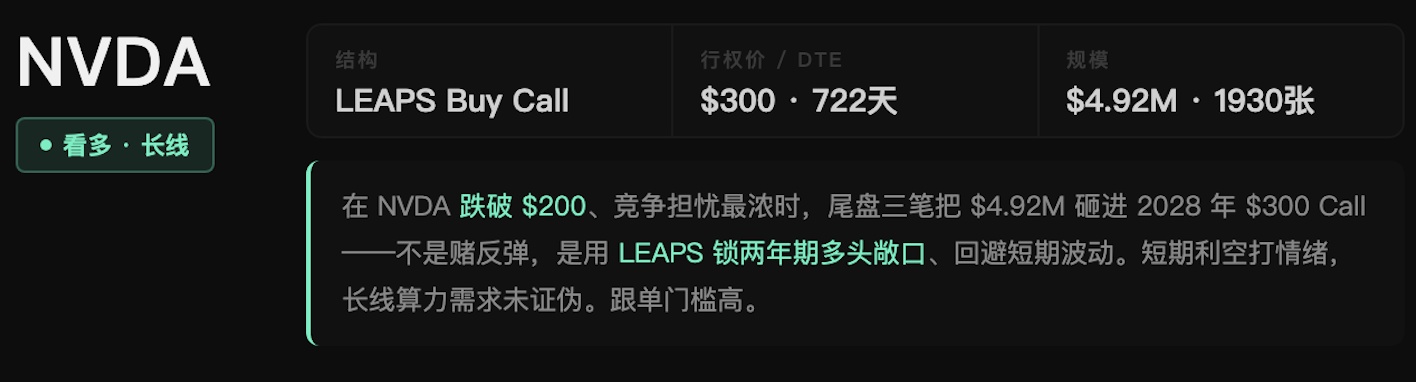
$NVIDIA(NVDA.US)
Direction: Bullish (long-term)
Structure: Buy Call · LEAPS stock replacement
Strike: $300 (2028-06-16)
Size: $4.92M / 1930 contracts (three stacked buys in the late session 15:29–15:54)
DTE: 722 days
Insight: At the moment when Nvidia fell below $200 and competition concerns peaked, three late-session trades poured $4.92M into $300 Calls expiring in 2028—this isn't betting on a rebound; it's using LEAPS to lock in a two-year bullish exposure, avoiding short-term volatility. The logic supporting this trade: short-term negatives (AMD/Qualcomm competition, Micron catching up) hit valuation sentiment, but long-term computing power demand hasn't been disproven. The entry barrier is high (two-year, deep out-of-the-money); ordinary positions are better off watching the $200 spot level rather than directly copying the LEAPS.
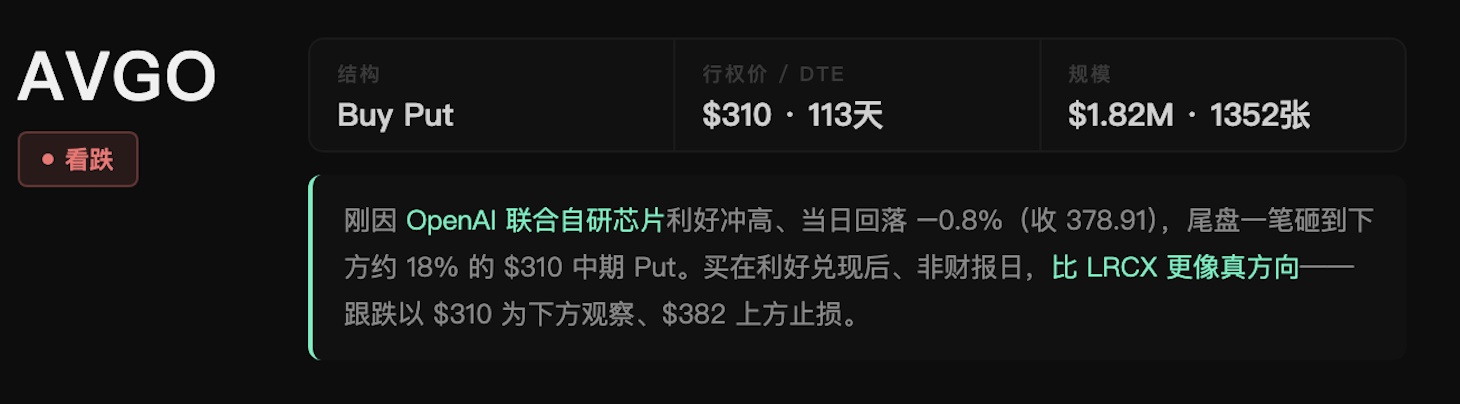
$Broadcom(AVGO.US)
Direction: Bearish
Structure: Buy Put
Strike: $310 (2026-10-16)
Size: $1.82M / 1352 contracts (single late-session buy at 15:41)
DTE: 113 days
Insight: Broadcom had just surged due to the OpenAI joint chip development news, then fell −0.8% that day. A single $1.82M late-session buy into the $310 medium-term Put (~18% below current price) is a medium-term bearish bet on "good news exhausted + semiconductor highs." This looks more like a true directional bet than the Lam Research one: bought after the news was realized, not on an earnings day, deep out-of-the-money medium-term. If following the downside, use $310 as the lower observation level and $382 above as a clearer stop-loss logic.
These three trades can be seen as a layered view of "medium-term bearish on semiconductor equipment/chips + long-term bullish on AI computing power leaders"—bears concentrated in segments where good news has been realized or expectations exceeded, while bulls used LEAPS to lock in Nvidia's two-year options exposure. Corresponding to the broader market, 6/25 was a structural pullback of "index flat, semiconductors under pressure alone," not a systemic shift.
Next focus points:
$NVIDIA(NVDA.US) whether the $200 round-number level can hold;
$Lam Research(LRCX.US) whether the $360 Put continues to be added after the rebound;
July Philadelphia Semiconductor Index (SOX) component earnings season
—Any one of these three turning points will determine which side of this "short-term bearish, long-term bullish" picture materializes first.
The copyright of this article belongs to the original author/organization.
The views expressed herein are solely those of the author and do not reflect the stance of the platform. The content is intended for investment reference purposes only and shall not be considered as investment advice. Please contact us if you have any questions or suggestions regarding the content services provided by the platform.
