


 SK Hynix Commentator
 MUFG Return Rate
The Two Storage Titans in June: One Dancing in the Cloud, One Walking on a Knife's Edge
June witnessed a tale of ice and fire in the memory chip sector.
SK Hynix: Topping the charts, circuit breaker, roller coaster
On June 22, SK Hynix's stock price surged to 2.945 million Korean Won intraday, setting a new historical record. Its market capitalization surpassed Samsung Electronics for the first time, topping the Korean stock market. Year-to-date gains expanded to 350%, with a staggering 1024% increase over the past year.
However, the day after reaching the peak, on June 23, SK Hynix plummeted 12.47%, triggering a circuit breaker in the Korean stock market. On June 26, it fell over 10% intraday again. On June 30, it once dropped over 5% intraday before a late-session rally closed it down 1.68%. In just one week, it went from the peak to the abyss and climbed back, like riding a roller coaster three times.
Micron: Blockbuster earnings couldn't stop the sell-off
The situation at Micron was equally thrilling. It plunged 13.18% on June 23, closing at $1051.77. After the market closed on June 24, it released its FY26Q3 earnings report—revenue of $41.456 billion, a massive 345.72% year-over-year increase, gross margin of 84.9%, exceeding expectations across the board. The stock soared 16% in after-hours trading. It closed up 15.7% on June 25.
But on July 1, Micron plunged 10.57% in a single day. Its stock price has already retreated over 12% from its 52-week high of $1213.56.
Similarities and Differences: Both are falling, but the logic is different
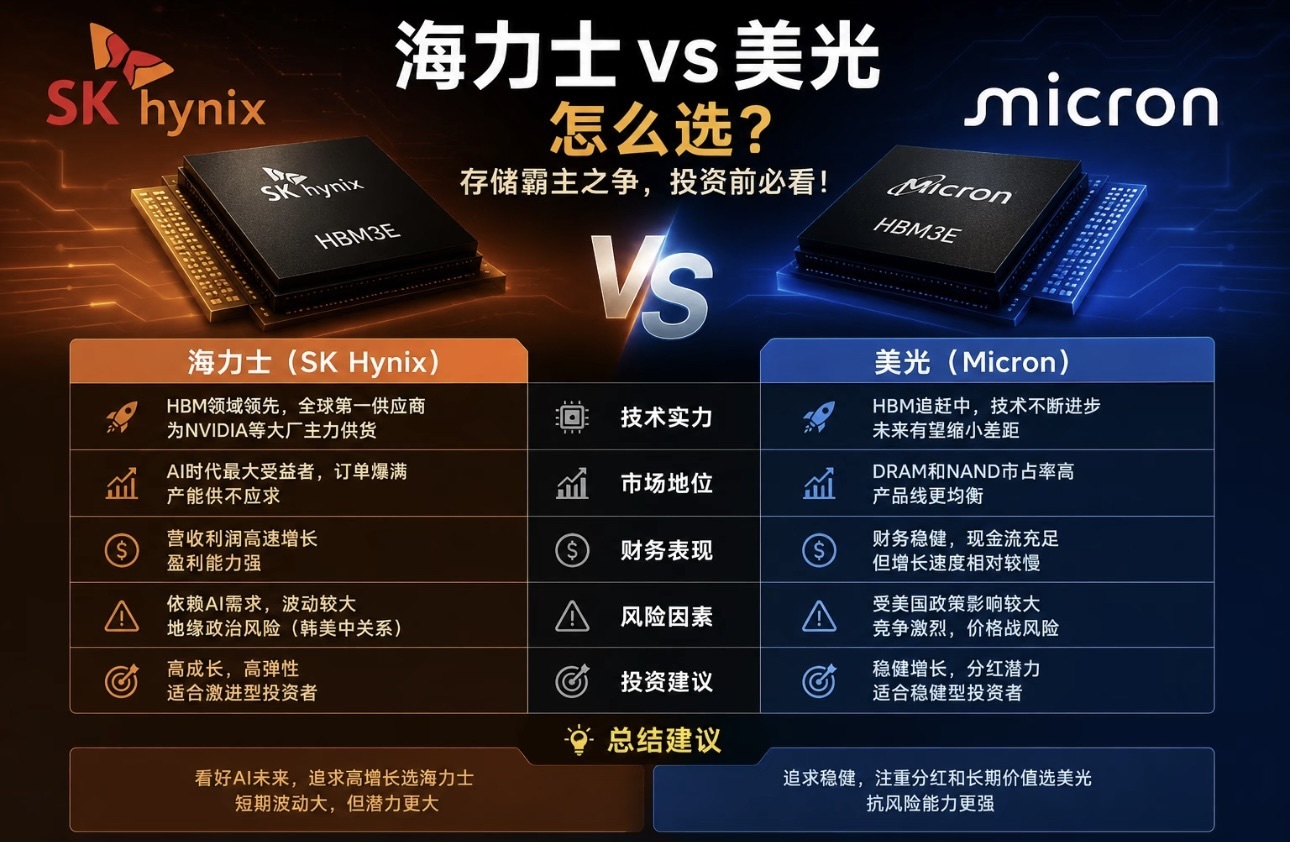
Similarity: Both are experiencing profit-taking stampedes. As of early June, Micron was up 249% year-to-date, SK Hynix up 218%, and Samsung up 174%. Crowded trades are a warning signal for risk accumulation. Any slight disturbance can trigger a stampede.
Difference: Micron's fall is about "valuation"—after a 301% surge in the first half of the year, capital expenditure has expanded sharply, exceeding $25 billion in FY2026, with an additional $10 billion in 2027. The market is asking: Can your returns keep up with all this spending? SK Hynix's fall is about "sentiment"—HBM4 has entered mass production, HBM4E samples have been provided to customers, and the proportion of HBM wafer starts is expected to increase from 18% in 2025 to 30% in 2027. The company's fundamentals remain healthy; it's just that market sentiment has pressed the volatility button.
Short-term vs. Long-term: A multiple-choice question
The short-term risk is straightforward: A single word from Meta, rumors of Apple price hikes, or OpenAI's delayed IPO can cause the sector to plummet. The cyclical nature of memory chips has never disappeared—they rise sharply and fall hard.
Long-term opportunities are equally clear: Micron's Q4 revenue guidance is as high as $50 billion, and tight memory supply is expected to persist beyond 2027. SK Hynix's HBM4 will ship in large volumes in the second half of the year, and its multi-year supply agreement with NVIDIA shows demand is shifting towards contract-based. The explosion in AI computing power construction demand is driving a long-term price increase cycle for memory.
Three sentences for ordinary investors
First, don't add to your position at the peak, don't panic sell at the bottom. Those who chased SK Hynix at its high on June 22 suffered a 12% limit-down the next day. Those who panicked and sold Micron on July 1 might have sold at a short-term low.
Second, distinguish between "valuation kill" and "logic kill." Micron's current situation is more of a valuation kill—what's expensive must fall, but AI demand is still there. If HBM overcapacity and price wars start one day, that would be a logic kill. Before that, every deep dip could be an opportunity.
Third, keep your ammunition ready and enter the market in batches. No one can precisely time the bottom. The first day of a sharp drop is often when sentiment is most extreme; the second and third days often see continued inertia-driven selling. The truly good buying points usually come on the second to fifth days, when volatility subsides and the K-line flattens out.
The memory chip cycle has always been a roller coaster. The June surge and crash tell us one thing: making money in this sector doesn't rely on predicting tops and bottoms, but on position management, emotional control, and long-term conviction.
The current volatility will eventually pass. Those who remain are always the ones who can withstand the bumps and see the distant horizon clearly. May you stay on this ride until the end.$XL2CSOPHYNIX(07709.HK) $Micron Tech(MU.US)
The copyright of this article belongs to the original author/organization.
The views expressed herein are solely those of the author and do not reflect the stance of the platform. The content is intended for investment reference purposes only and shall not be considered as investment advice. Please contact us if you have any questions or suggestions regarding the content services provided by the platform.
