



<p>Xiaocaiyuan proactively cuts prices, rebuilding the efficiency model for Chinese casual dining</p>
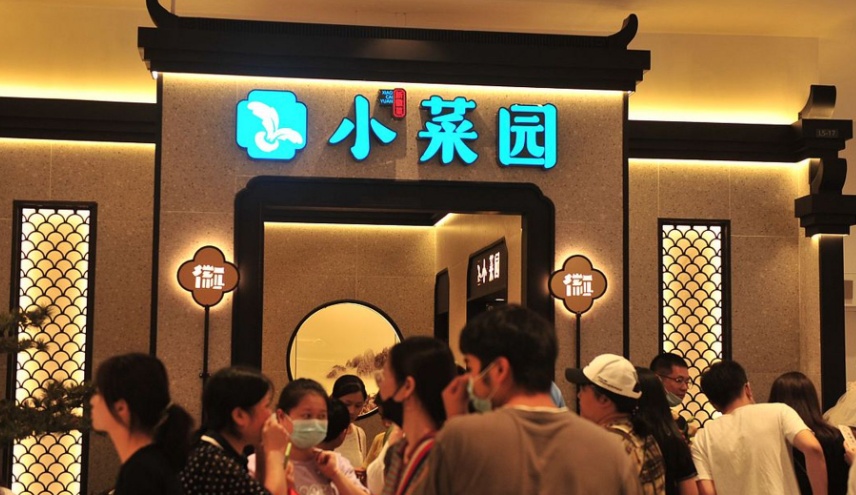
On August 14, Xiao Caiyuan released its interim results for the first half of 2026. Revenue reached RMB 2.903 billion in H1, up 7.0% YoY; profit attributable to equity shareholders was RMB 290 million, down 24.2% YoY. While the income statement faced pressure, a more pronounced shift in operating structure emerged: dine-in revenue grew 18.1% YoY to RMB 1.945 billion, while takeout revenue fell 10.6% YoY to RMB 945 million. Average spend per dine-in customer dropped from RMB 57.1 to RMB 50.5, and overall table turnover increased from 3.1 to 3.5 times.
Contextualizing this interim report within the broader industry landscape helps clarify the pressures at play.
Data from Tianyancha and the National Bureau of Statistics show that national catering revenue totaled RMB 328.22 billion in the first seven months of 2026, up 2.6% YoY, with July's single-month growth slowing further to 1.4%. Catering consumption retains resilience, but high growth has become scarce. According to the "2026 China Catering Chain Development White Paper" released by the China Chain Store & Franchise Association (CCFA), the domestic catering chain penetration rate rose to 25% in 2025, with industry expansion continuing to concentrate among leading players. Supply chain management, refined operations, and organizational efficiency are taking on greater importance.
Consequently, the challenges facing Xiao Caiyuan have evolved: scale remains important, but the operational quality behind that scale is even more critical.
Mass-market dining enters low-growth competition; post-customer-flow recovery relies on single-store efficiency
Xiao Caiyuan's proactive adjustments in H1 began with dine-in services.
The company described its strategy as 'trading price for volume' in the interim report. Following price adjustments, overall table turnover rose 12.9% YoY, and the share of dine-in revenue climbed to 67%. Meanwhile, the takeout business, which competes with dine-in for kitchen capacity, voluntarily slowed its pace, with orders decreasing from 16.8 million to 14.7 million.
Corporate resources are finite, especially in restaurants. Table space, chefs, servers, and kitchen capacity during peak hours cannot be infinitely expanded. A single takeout order and a dine-in table sometimes rely on the same production system. By reducing the weight of takeout, Xiao Caiyuan allocates more peak-hour capacity to dine-in, essentially redistributing the store's scarcest resource.
This path has already yielded improved customer flow, but also left issues that require continued digestion.
In H1, Xiao Caiyuan's same-store sales declined from RMB 2.529 billion to RMB 2.211 billion, a 12.5% YoY drop. The ratio of raw materials and consumables to revenue rose from 29.5% to 32.3%, and employee costs increased from 24.6% to 28.5%. Lower average ticket prices drove more consumers into stores, but the increased traffic has not yet fully offset the pressure on single-store revenue and expense ratios. For a directly operated catering company, these two cost items combined exceed 60% of revenue; even changes of a few percentage points can quickly impact profitability.
A more critical metric for H2 2026 than the number of new stores is how existing stores will re-establish profit balance. Higher table turnover is just the first step; narrowing the decline in same-store sales, improving labor efficiency, and stabilizing food cost ratios are needed to form a complete operational loop around the price cuts.
Some positive leading indicators have already emerged post-report. Media reports indicate that company executives revealed in an August interview that dine-in actual revenue grew 29.9% YoY in July, and dine-in order volume increased by approximately 54% YoY. As of late July, 88VIP members exceeded 1.5 million. The membership system and price adjustments continue to expand the user base for in-store consumption, though membership discounts also affect average ticket prices; final effectiveness will need to be verified by subsequent same-store revenue and cost ratios in future financial reports.
Catering business possesses a 朴素 (simple) long-termism: price can facilitate the first purchase, but stable taste, service, and experience determine whether consumers return. What Xiao Caiyuan is striving for is to slowly convert the traffic generated by one-time price cuts into more stable family dining demand.
Catering AI begins entering ordering, scheduling, and back-of-house; technical returns ultimately land on waste reduction and labor efficiency
Another underappreciated change in Xiao Caiyuan's interim report is that digital investment has moved from marketing to production.
KPMG's "2026 China Catering Enterprise Development Report" notes that AI applications in the catering industry are shifting from point breakthroughs to full-chain integration, while still facing issues such as high application costs, insufficient data quality, and superficial application. Peng Jianzhen, President of the CCFA, also stated in April this year that the next important breakthrough directions for catering AI focus on ToB scenarios, including scheduling and supply chain management.
This presents a natural difference from the AI commercialization paths of internet companies.
Internet platforms deploying AI can directly generate advertising, subscription, or cloud service revenue; it is difficult for a single restaurant to list 'AI revenue' separately. Technical investments are ultimately broken down into inventory, wages, food waste, meal speed, and table turnover efficiency. Thus, catering AI appears less dazzling but closer to financial statements.
Xiao Caiyuan has begun laying this infrastructure. Public interviews show the company's smart ordering system now covers all stores, generating ordering suggestions based on historical sales, customer flow, and weather data. Nearly 300 stores currently use cooking robots. The Ma'anshan central factory, officially put into production in H1 2026, introduced robotic production, AI visual quality control, and intelligent warehouse scheduling, with designed capacity to serve 3,000 future stores. The company further proposed in the interim report to build a data-centric technical architecture, connecting front-end store operations, mid-end supply chain, and back-office functions into a data closed loop.
Currently, these investments remain in a stage where costs occur first, with efficiency gradually verified.
In H1 2026, Xiao Caiyuan's other expenses increased 28.2% YoY to RMB 148 million, attributed by the company to supply chain distribution costs from new stores and digital investments. However, the supply chain has shown a quantifiable change: inventory turnover days decreased from 25.4 days at the end of 2025 to 19.7 days in H1 2026, attributed to improved inventory management capabilities. While inventory indicator changes cannot be entirely credited to AI, they provide an observational window into supply chain digitization entering financial metrics.
Compared to digital human live streaming, these changes are less likely to create viral hotspots but align better with the economic logic of the catering industry. Accurate ordering reduces daily waste incrementally, stable cooking processes reduce output fluctuations between stores, and intelligent scheduling better matches labor with peak customer flow. Catering profits are accumulated from countless small costs; technical returns similarly come from these fragmented links.
Wang Shugao, a chef by background, expressed restraint regarding AI. In August media exchanges, he stated, 'AI is a tool that makes management more convenient,' but catering still requires purchasing fresh ingredients and making good products. 'AI cannot replace chefs' dedication to cooking, nor employees' efficient operation.' AI serves as a supplement on this foundation. Technology entering the kitchen does not mean Chinese cuisine needs to erase the 'human' element; a more mature direction is handing standardized parts of experience to systems, while leaving taste, service, and emotional experience to the stores.
The upper limit of Chinese cuisine chains increasingly depends on organizational replication capability
As of June 2026, Xiao Caiyuan operated 824 stores, with 351 in third-tier and lower cities, contributing 40.5% of restaurant revenue. Compared to 672 stores in the same period of 2025, the network size continues to expand; calculating from 807 stores at the end of 2025, net additions in H1 were 17, indicating a significantly slowed opening pace.
For direct-operated catering, this slowdown carries another implication.
Direct operation allows store data, supply chain benefits, and digital efficiency to 沉淀 (accumulate/settle) directly within the corporate system, but also means headquarters must bear more personnel, lease, training, and capital investments. Hundreds of stores can solve many problems relying on excellent store managers, but as store numbers continue to expand, personal experience becomes increasingly difficult to cover the entire organization. Standardization capabilities will gradually replace 'expert management' as the foundation for scale expansion.
CCFA data shows that catering chain penetration reached 25% in 2025, while the beverage sector reached 54%. This gap reflects standardization difficulty: beverages can be replicated by temperature, weight, and time, whereas Chinese main courses must handle heat control, freshness, chef experience, and family-oriented tastes. Xiao Caiyuan's continuous investment in central factories, digital systems, and cooking robots aims to compress this 'experience fluctuation.'
The Ma'anshan factory's planned capacity to support 3,000 stores thus gains a more concrete explanation. At the current stage, there is still significant room between store scale and designed capacity, with supply chain infrastructure laid out in advance. As store scale expands in the future, factory capacity utilization, logistics density, and unit costs of digital systems will have further optimization space; if store expansion fails to keep pace, early investments will become costs requiring digestion.
Funding arrangements also reveal the company's choices. Net proceeds from the IPO were approximately HKD 795 million, with 37% planned for strengthening the supply chain, 13% for smart equipment and digital system upgrades, 40% for restaurant network expansion, and the remaining 10% for working capital and general corporate purposes. Supply chain and IT combined account for half of the raised funds, indicating the company's understanding of scale extends beyond stores to underlying infrastructure.
Cash flow provided a buffer for this round of investment. Xiao Caiyuan's net cash inflow from operating activities in H1 was RMB 639 million, still higher than the period profit of RMB 289 million, meaning cash creation capability did not stall synchronously with profit declines. However, compared to RMB 765 million in operating cash net inflow in the same period last year, there is still a decline; future expansion will need to maintain balance between capital expenditures, dividends, and operational efficiency.
Opening a good restaurant requires product; replicating a good restaurant requires process; replicating hundreds or thousands of restaurants requires supply chain, data systems, organizational structure, and talent mechanisms working together.
The ultimate test for Chinese cuisine chain expansion is whether hundreds or thousands of stores can maintain industrial-system stability while retaining 烟火气 (earthy charm/vitality) and service warmth. AI is merely one tool. The truly lengthy work is transforming the experience accumulated by a single restaurant into capabilities that the entire organization can repeatedly execute.
The copyright of this article belongs to the original author/organization.
The views expressed herein are solely those of the author and do not reflect the stance of the platform. The content is intended for investment reference purposes only and shall not be considered as investment advice. Please contact us if you have any questions or suggestions regarding the content services provided by the platform.
