


 Likes Received
 Posts
PostsMicron dropped 7%, yet someone bet on it rebounding within three days at the close?
On the same stock, some break even with just a 1.99% gain, while others need a 30.07% drop to do so. Both bets were placed on Micron on Aug 18, leaving a 32-percentage-point gap in between. The former is worth noting—it bought at the day's most painful spot and had an answer within three days; the latter requires far more conditions to hold.
First, the context of that day. Micron closed down 7.01%, ending a five-day rally—the previous session it had just broken four figures. This drop wasn't isolated: SanDisk fell 9%, SK Hynix dropped 9.2%, Marvell slid 7.8%, and Intel declined 6.6%; the storage chip index initially closed down 7.5%. Barron's attributed this to rising bond yields increasing corporate borrowing costs. The market's concern wasn't Micron's own debt (only $5.72bn as of late May), but whether its major clients would cut AI infrastructure spending due to costlier financing. Jefferies added detail: Anthropic disclosed annualized revenue exceeding $65bn ahead of its IPO. While large, the figure felt slightly below recent market estimates. Combined with profit-taking after a >700% surge over the past 12 months, a -7% bearish candle formed.
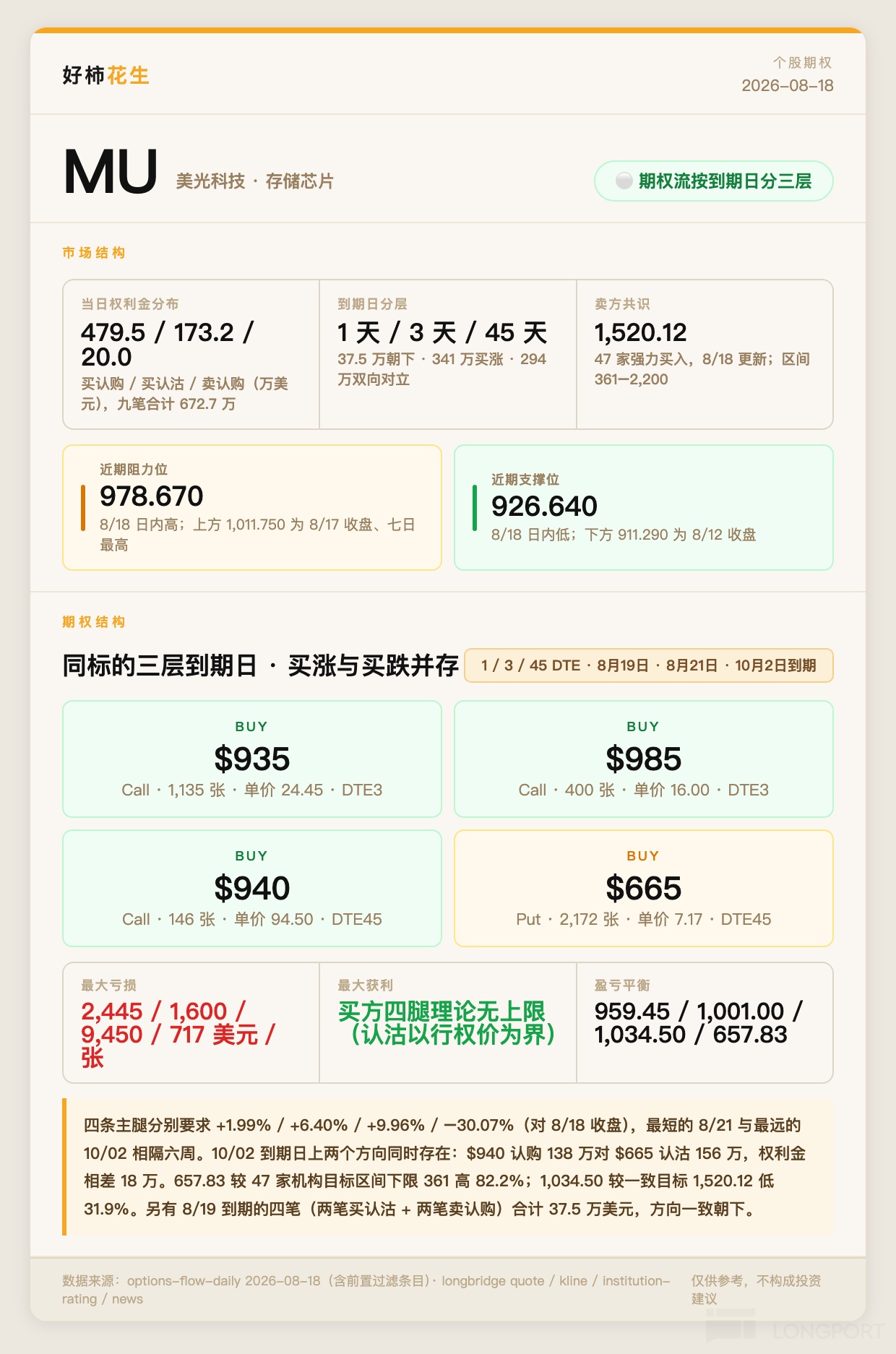
A total of nine unusual options trades occurred on Micron that day, totaling $6.727mn. Spread by expiration, they form three layers with entirely different implications.
The shortest layer expires on Aug 19, with just one day left. Four trades totaling $375k were all directional downside: two put buys at $940 and $950 (breakevens at 925.90 and 934.50), and two call sells at $960 and $980 (premium caps at 968.80 and 996.95). These positions clustered within 2-3% of the current price, typical intraday setups waiting for settlement rather than expressing a directional view.
The middle layer sits at Aug 21, expiring in three days. All $3.41mn went into long calls. The $985 trade executed in the morning: 400 contracts, $640k, unit price $16.00, breakeven at 1001.00 requiring a 6.40% rise—a six-point jump in three days lacks clear justification. The standout was the late-session $935 buy: 1,135 contracts, $2.77mn, unit price $24.45, breakeven at 959.45, needing only a 1.99% gain to break even, with max loss of $2,445 per contract. Buying at the tail end of that bearish candle, it bet on a bounce, not a trend—three days isn't enough time to install other variables.
The furthest layer is set for Oct 2, six weeks out, where two opposing views collide. The bullish side: $940 ATM call, 146 contracts, $1.38mn, unit price $94.50 (equal to 10% of share price), breakeven at 1034.50 requiring a 9.96% rise, max loss $9,450 per contract. The bearish side: $665 put, 2,172 contracts, $1.56mn, unit price just $7.17, breakeven at 657.83 requiring a 30.07% drop, nominal exposure $144.4mn, max loss $717 per contract. These were Micron's largest single trades of the day, expiring on the same date with opposite conclusions.
I weigh the $665 put more heavily. Paying $1.56mn for a '30% drop in six weeks' thesis sounds extreme, but it targets a specific bear case: memory is a commodity, and prices must eventually crash. Freedom Capital's tech research head stated plainly that while memory companies' fundamentals are currently 'excellent,' bears have been waiting for that 'inevitable' price collapse. The same report offered a counterargument: Micron and SanDisk recently signed multi-year contracts with customers guaranteeing minimum prices higher than peaks seen in previous memory booms. If these contracts hold, the $665 bet doesn't just require a 30% drop; it must also overturn established price floors—two requirements of vastly different difficulty.
Seller-side sentiment lies at the opposite end. A consensus of 47 institutions rates it a Strong Buy, with a target price of $1,520.12 (+61.58% vs. current), updated on Aug 18: 32 Strong Buys, 9 Buys, 5 Holds, 0 Sells. Target ranges span from $361 to $2,200, with FactSet averaging $1,566. The $657.83 breakeven is still 82.2% above the lowest analyst target of $361 among the 47—meaning put buyers don't need the most pessimistic analyst to be proven right; a drop to the lower half of the range suffices. Conversely, $1,034.50 is 31.9% below consensus, achievable if half the consensus materializes. Neither threshold is overly 苛刻, explaining their simultaneous execution.
Thus, this day serves as an observation line for me, not a conclusion. The most noteworthy trade to watch is the late-session $2.77mn buy—it's the only one that 'bought at the most painful spot yet breaks even on just a 1.99% move,' resolving on Aug 21 close, much cleaner than waiting six weeks. I keep the $665 position on the sidelines; its vulnerability is time, not direction: within six weeks, both a 30% drop and the overturning of long-term contract floors must occur simultaneously.
Under what scenarios would the logic of these three layers unravel? If Aug 19 breaks below $926.640 (the intraday low on Aug 18), the $3.41mn long calls on Aug 21 would first bleed time value, and the 1.99% buffer on the late-session trade would vanish in a day. Conversely, if it reclaims $978.670 (the Aug 18 intraday high) within three days, the $935 trade goes in-the-money, while $665 holders face a common stock still near four figures. I've noted 926.640 and 978.670; before Oct 2, I'll only watch which line gets hit first.
The copyright of this article belongs to the original author/organization.
The views expressed herein are solely those of the author and do not reflect the stance of the platform. The content is intended for investment reference purposes only and shall not be considered as investment advice. Please contact us if you have any questions or suggestions regarding the content services provided by the platform.
