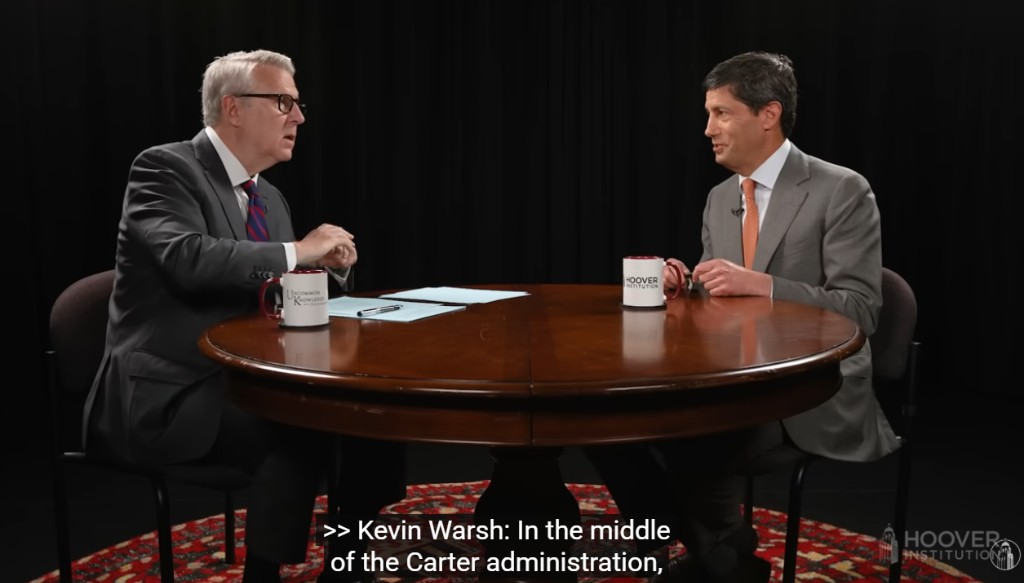
The interview that best reflects the policy stance of Walsh: Inflation is a choice of the Federal Reserve

In a deep interview, Walsh bluntly stated that inflation is the responsibility of the Federal Reserve and cannot be attributed to external factors. As a popular candidate to succeed Powell, his reform proposal is not about starting over but advocates for the Federal Reserve to "revive" rather than "revolutionize." Regarding the dilemma of high interest rates, Walsh believes that low interest rate space can be obtained by reducing the balance sheet. "If we let the printing press quiet down a bit, interest rates can actually be lower."
Recently, Trump may have trusted confidants to nominate Warsh as Federal Reserve Chairman. If Kevin Warsh takes over the Federal Reserve next year, the market may witness one of the most significant policy shifts at the Federal Reserve in decades.
Earlier this year, in a conversation with Hoover Institution host Peter Robinson, Warsh candidly pointed out the chronic issues within the current Federal Reserve system and put forth a statement: “Inflation is a choice.” He dismissed the excuses of blaming inflation on supply chains or geopolitical factors, insisting that central banks have the full capability to determine price levels, and the current situation is a result of the Federal Reserve's poor choices.
Warsh's core argument is built on a critique of “complacency.” He noted that after the Great Moderation, the Federal Reserve mistakenly believed inflation was dead, leading to an excessively large balance sheet during non-crisis periods. Quoting Warsh's original words: “When you keep printing a trillion here and a trillion there, it will eventually come back to haunt you.” He believes that the Federal Reserve's failure to withdraw timely during the stable period from 2010 to 2020 forced it to cross more red lines when a real crisis (like the pandemic) occurred, resulting in today's inflationary consequences.
As a potential successor to the Federal Reserve Chair, Warsh is not only a critic but also a reformer. He proposed a specific policy path: “If we quiet down the printing press, our interest rates could actually be lower.” This is a very critical incremental piece of information—Warsh may lean towards controlling inflation through balance sheet reduction (QT), thereby creating space for lowering nominal interest rates.
This is logically consistent with the Trump administration's desire to lower borrowing costs. He referred to this strategy as “pragmatic monetarism,” advocating that the Federal Reserve and the Treasury must “each do their part”: the Federal Reserve is responsible for managing interest rates, while the Treasury manages fiscal accounts, and the two need to reach some sort of “new agreement” to address the issue of excessive debt interest, rather than having blurred boundaries and entanglements as in the past.
Regarding the market's concerns about “radical reforms,” Warsh provided reassurance. He clearly stated that there is no need to “smash” the Federal Reserve for reform, but rather to undertake a “revitalization.” He likened it to: “It’s like restoring a great golf course, inspired by the past but not bound by it.” The American economy he envisions is not one of recession, but a productivity boom driven by AI, similar to the Reagan era. As long as policies return to rationality, the U.S. economy will demonstrate remarkable resilience.
As current Federal Reserve Chairman Jerome Powell is set to step down in May 2026 (note: his term as a governor will end on January 31, 2028), former Federal Reserve governor and Hoover Institution researcher Kevin Warsh has become one of the most popular successors nominated by President Trump. **In this critical time window, revisiting Warsh's in-depth interview at the Hoover Institution this May may be crucial for understanding the direction of U.S. monetary policy over the next four years ** Kevin Warsh is not only a witness to the 2008 financial crisis but also a staunch monetarist.
The key points of the interview are summarized as follows:
- Return to Core Mission: The Federal Reserve has deviated from its core mission of maintaining price stability, experiencing "institutional drift," and must reform to regain credibility.
- Inflation is a Choice: Warsh bluntly states that inflation is not an accident caused by Putin or supply chains, but rather a "choice" of the Federal Reserve. The central bank has the full capability to determine price levels by controlling the money supply.
- Federal Reserve "Repair Rather Than Revolution": Regarding the future of the Federal Reserve, he advocates for "Restoration" rather than "Revolution"—preserving its core structure while eliminating the erroneous policies of the past decade, rather than completely overturning it. The core of the reform is to reduce its balance sheet, which has reached $7 trillion, to curb inflation, which in turn may create space for lowering interest rates, as rate cuts are more important for the real economy.
- Severe Criticism of Normalized Quantitative Easing (QE): He supports the emergency injections during the 2008 crisis (QE1) but strongly opposes the continued printing of money during stable economic periods (such as QE2, QE3, and the post-pandemic period), arguing that this is not only ineffective but also fuels asset bubbles. He believes this broke the initial understanding of "withdrawing after the crisis ends" and resigned in protest.
- Pragmatic Monetarism: Warsh proposes a unique path: controlling inflation through balance sheet reduction (QT), thereby creating space for lowering interest rates.
- Federal Reserve "Mission Creep": Warsh believes that the Federal Reserve has transformed from the "lender of last resort" for the banking system to an omnipresent "first intervener," and this overreach must stop.
- Clear Division of Responsibilities between the Federal Reserve and the Treasury: He calls for a new agreement between the Treasury and the Federal Reserve, similar to that of 1951, to clarify their respective boundaries: the Federal Reserve is responsible for interest rates, while the Treasury is responsible for fiscal accounts, avoiding role confusion.
- Collusion of Fiscal and Monetary Policies: He points out that the Federal Reserve's purchase of government bonds (fiscal dominance) has indirectly encouraged Congress's reckless fiscal spending, leading to a surge in U.S. debt.
- Optimistic about U.S. Productivity and AI: Despite criticizing policies, he is extremely optimistic about the U.S. economic outlook, believing that AI and deregulation will bring about a productivity explosion similar to that of the 1980s.

【Full Transcript of the Interview】
Recording Date: May 28, 2025
Host: Peter Robinson
Guest: Kevin Warsh
Institution: Hoover Institution, Stanford University - "Uncommon Knowledge"
(The following is a Chinese translation of the interview, assisted by AI tools)
Host Peter Robinson 00:00
The Federal Reserve System has been responsible for maintaining price stability and combating inflation for over a century. How has the Federal Reserve performed? Our guest today says it should have done better. Kevin Warsh is here on "Uncommon Knowledge."
Welcome to "Uncommon Knowledge," I'm Peter Robinson. Kevin Warsh is from upstate New York, where he earned his undergraduate degree from Stanford University and his law degree from Harvard University. Mr. Warsh worked on Wall Street and in Washington early in his career. In 2006, President George W. Bush appointed him to the Federal Reserve Board, where he served until 2011. Note that Mr. Warsh was at the Federal Reserve during the 2008 financial crisis, the worst financial crisis in over half a century. Mr. Warsh now splits his time between New York and Stanford, working at an investment firm in New York while also being a fellow at the Hoover Institution. Kevin, welcome back to "Uncommon Knowledge."
Kevin Warsh 01:10
It's great to be back. You hid the most important point, which is that the investment firm I happen to work for has one of the greatest investors in world history, a man named Stan Druckenmiller. But you tried to keep it low-key, and I appreciate that. No, I just wanted to brag about my friend.
Peter Robinson 01:24
You can continue with that part because I want to get him on the show sooner or later. Let's start flattering him now. Okay, Kevin, the first question. The Federal Reserve was created over a century ago as the institution responsible for maintaining the value of our currency—the dollar. Two quotes. The first quote is from the late legendary investor Charlie Munger: "Destroy the currency, and God knows what will happen."
Peter Robinson 01:53
The second quote is from your speech in April this year to a banking organization called the "Group of Thirty." I extracted some of your descriptions of the current Federal Reserve from it: institutional drift, failure to fulfill its statutory duties, fueling a surge in federal spending, overreaching and underperforming. Kevin Warsh, you are attacking a sacred institution. Each of us relies on this institution every day to ensure the integrity of the money we earn and spend. What exactly are you trying to do?
Kevin Warsh 02:33
In the field of central banking, we are taught to keep our criticisms well hidden. So I didn't do well in that speech. Peter, I described it as a love letter rather than a cold critique. You may not have felt it was a love letter. I'm not sure the current board members
Peter Robinson 02:53
I skipped over... I glossed over the parts where they were sweet-talking each other.
Kevin Warsh 02:54
The reason it's a love letter is because the importance of this institution, as you hinted in your opening remarks. The reason it's a love letter is that if this institution can reform itself, it could bring great achievements for both the institution and the country. But it does mean it's time to get things back on track.
Kevin Warsh 03:14
I should also say this. This is our third experiment with a central bank in America, and the reason it's the third is not because the first two went well—they messed it up, right? It's not like winning a third Super Bowl championship, Peter, you know, the more you win, the better. The first two failures were because they lost the consent of the governed and lost the ability to deliver on their promises.
Kevin Warsh 03:37
This isn't a history lesson, but you can think about the Jacksonian era, when some would say that the central bank seemed to only care about those special interest groups on the East Coast while forgetting what was happening in the middle of our country.
Kevin Warsh 03:54
This is similar to my concerns today. So, this central bank has been around for over 100 years, and if they can reform themselves, they will usher in another glorious century. Otherwise, I worry. Okay.
Peter Robinson 04:07
We'll come back to your speech later, but first, walk me through this. I'm a layman on these issues. You are a skilled central banker and investor. You understand this world, and I don't. So walk me through it. I have a few very basic questions. Give me a moment to lay this out.
Peter Robinson 04:25
The Federal Reserve System was established in 1913 and has the power—this might be a bit of an oversimplification, but essentially—that it has the power to set interest rates and regulate the money supply to achieve price stability. These powers are significant. How has it performed?
Peter Robinson 04:41
This is what Nobel laureate Milton Friedman said in 1994: “In America, no institution has such a high public status and such a poor performance record. The Federal Reserve began operations in 1914, leading to a doubling of prices during World War I, and it caused a major recession in 1921. The principal culprit of the Great Depression was undoubtedly the Federal Reserve System. Since then, it has led to another doubling of prices after World War II. It financed the inflation of the 1970s. The Federal Reserve's harms far outweigh its benefits, and I have long advocated for its abolition.” Kevin, why do we need the Federal Reserve System?
Kevin Walsh 05:29
So…
Peter Robinson 05:31
This is not new to you. Milton Friedman was at Stanford when you were an undergraduate.
Kevin Walsh 05:35
Milton… I was fortunate to be his student. He had a tremendous impact when he came here, not just on me, but on generations of students that followed. I spent quite a bit of time in the Hoover Institution archives studying what Milton had said. For example, regarding the Chairman of the Federal Reserve, our own Jennifer Burns has a great book that includes some of that correspondence. But I had them search and provide me with all the correspondence between Paul Volcker, Milton Friedman, and Alan Greenspan.
Peter Robinson 06:06
Okay, give us some date context. Volcker was appointed Chairman of the Federal Reserve by Jimmy Carter in the late 1970s and early 1980s, specifically…
Kevin Walsh 06:14
Midway through the Carter administration. I don’t have the exact date.
Peter Robinson 06:17
Then Ronald Reagan reappointed him, and he served until the end of the Reagan administration. Right. Then Alan Greenspan took over and served until…
Kevin Walsh 06:26
He served for 17 years, until Ben Bernanke came in during the crisis in 2006.
Peter Robinson 06:30
Okay.
Kevin Walsh 06:30
I remember this because I recall that I was a junior staffer at the White House at the time, and I found that not only did Chairman Bernanke (who came from the Federal Reserve to the White House and was going back to take over Alan Greenspan's old job) want me to go with him to replace his former position on the Federal Reserve Board. So I remember that day.
Kevin Walsh 06:55
Okay, back to Milton. In those correspondences with Milton, it was remarkable how he continually reexamined his previous views. He kept questioning whether the data and conclusions he had drawn in one year still applied the next year, whether his judgments about the institution still held. In most of the correspondence during the Volcker and Greenspan eras, he was quite pleased with the changes in methodology, the new ways of thinking about the economy, and the success of what later came to be known as the "Great Moderation." So I wouldn’t say Milton thought the Federal Reserve was a bad institution. He believed they had bad periods and good periods. I can only speculate on what he would say about the "Great Inflation" of the past five or six years, how he would foresee it, how he would warn about it, and likely, the Federal Reserve would not…
Peter Robinson 07:46
Listen. Okay, so another basic question. Milton Friedman famously said: “Inflation is always and everywhere a monetary phenomenon.” Since inflation is a monetary phenomenon, and the Federal Reserve is responsible for the money supply, then inflation is ultimately always the fault of the Federal Reserve. Why don’t you describe what Paul Volcker did? When Carter appointed Volcker, you would know this. I just recall that when Carter appointed Volcker, I believe we were suffering from the highest inflation since the Civil War When Paul Volcker left office, the inflation rate had dropped to around 2%, almost 2%. So, Milton Friedman said the Federal Reserve is always responsible.
Kevin Warsh 08:34
Yes, so I believe in Milton's point and what you just conveyed, which is, as you said in your opening, "Inflation is a choice." The responsibility for ensuring price stability is entrusted to the Federal Reserve by Congress, most recently in the review of its charter in the 1970s, so that there is an institution accountable for prices. No more blaming others. We hand the baton to you, central bank. Go solve it. But from the comments in recent years, you wouldn't think inflation is a choice at all. In fact, during the past five or six years of rampant inflation, what have we heard about the causes of inflation? It's because of Putin and Ukraine. Yes. It's because of the pandemic and supply chains. Milton would be furious to hear this. And I, in my own subtle way, feel uneasy hearing this too. These things do cause price changes; after all, in a market economy, Walmart's prices change every day. That's how a market economy works. It's not the central bank's responsibility to regulate those prices. But that's not inflation. That's a one-time change in the price level of goods. Inflation occurs when that one-time price level change becomes self-reinforcing. That is, higher prices lead to higher prices. This means inflation will ultimately affect every household's dinner table and every company's boardroom because, as a decision-maker, you don't know what the price level will become. It's not about Putin or the pandemic. It's about the Federal Reserve. It's about the central bank. I'm afraid that in recent years, this may be because the central bank has become part of our culture, and we have gotten a bit used to saying, "Well, it's not my fault; it's someone else's fault." I think this is where Milton would feel the most anger in recent times. The central bank can achieve any price level it wants, any level of inflation. We may not like the way they achieve it, but the idea that they should blame others, I think, goes against good economic history.
Peter Robinson 10:35
And, in our upcoming conversation, it may be important to reiterate, not only that "inflation is a choice," but also that "a strong dollar is also a choice." Volcker did this in our generation's memory. This has been achieved. We suffered from inflation, and then the Federal Reserve controlled it again. Okay, let's get to another fundamental question.
Kevin Warsh 10:59
If I may, they controlled inflation, and I guess this is a bit of a cliché for economists, but after the so-called "Great Moderation," they became complacent about controlling inflation during that period when prices remained relatively stable for over a generation. I think some people in my field believe this is easy; in fact, inflation was controlled because we all became very good at it. We may all have become a bit complacent about this, but economics is not that simple. And I think it is precisely because of the recent pandemic and the crisis of 2020 that we shifted our focus
Peter Robinson 11:42
You've used this term several times. Let's define it. The "Great Moderation" period began in the mid-1980s when Volcker and the Federal Reserve, during Ronald Reagan's presidency, truly brought inflation down to a low single-digit level, and inflation remained there, with the economy continuously expanding until the 2008 crisis, with only a few quarters of recession in between, lasting about a quarter of a century. Am I right? Is this what you mean by the "Great Moderation"?
Kevin Warsh 12:12
Absolutely correct. We don't want to sound like every year was perfect, and central bankers made no mistakes, but those mistakes were relatively small and manageable. For the audience, I think inflation is still a very abstract concept. We want price changes to be so small that no one talks about it in the economy. That way, we know we've done our job. And what do we know about what has happened in the past five or six years? Almost anything, almost anything people are talking about. Right.
Peter Robinson 12:42
This is the last foundational question I want to ask. Gold. President Nixon took us off the gold standard in 1971. Before that, the dollar could mostly be exchanged for precious metals, primarily gold, at a fixed weight. This constrained the money supply.
Peter Robinson 13:00
Journalist and investor James Grant wrote last year: "The opposite of the gold standard, which is the system we have today, is actually the system that the United States practices today. Some might call it the 'PhD standard.' It is a system of discretionary manipulation of interest rates by PhDs in economics." So James Grant implies that if not gold, then at least some kind of fixed basket of commodities.
Peter Robinson 13:31
Milton Friedman, around the same time, when I just quoted him, said during his long-standing advocacy for the abolition of the Federal Reserve that the Federal Reserve should be replaced by a fixed annual increase in the money supply that is announced in advance. That would be completely transparent, and the market could plan a decade in advance. Both statements are saying, let's find some objective standard here. Let's find a way to constrain the money supply so that the market can know in advance, rather than leaving everything to the subjective impulses, groupthink, and those who truly understand the latest econometric research within the Federal Reserve system. Now, how would Kevin Warsh respond?
Kevin Warsh 14:24
There is no "good old days" to return to. I have many right-leaning friends who believe, well, let's go back to the gold standard. The world has changed. If we had made different choices back then, would things be better or worse? But you have to deal with the issues at hand. I think that's what Orwell said. And between "let the machines do it" and "let the central bankers' latest whims be completely discretionary," there must be a third way.
Kevin Warsh 14:52
I think you and I may have learned the essence of conservatism from Edmund Burke: resist whimsical ideas. We central bankers, both past and present, need to resist whimsical ideas. There is a way to make the central bank's reaction function to incoming information clear. If Milton were with us today, I wouldn't want to speak for this great man, but I think he would say that there is too much "scientism" and "academic philosophy" trying to quantify things we still do not understand well.
Kevin Warsh 15:27
Most of us in the economics community, if we are a bit better than average, would try to focus on the numbers to the left of the decimal point rather than those to the right. Now, if our craft were more sophisticated, if we were smarter, we would be physicists and mathematicians. And most of us who work in this field initially started in those areas and then moved to economics because, frankly, it is easier. So we do not perfectly understand how the economy works. If we did, we could create machines, we could create formulas. But the economy changes every day. It is extremely dynamic. So I hesitate to say we have a perfect rule. Good.
Peter Robinson 16:07
Now let's talk about modern history, your modern history and the modern history of the Federal Reserve, and the impact of the financial crisis. During the 2008 financial crisis, you served on the Federal Reserve Board, and that crisis led to the most severe economic contraction since the Great Depression, and the United States...
Kevin Warsh 16:27
10% unemployment rate. Peter, are you implying a causal relationship there? I am not...
Peter Robinson 16:31
I am guiding the topic. Just pure bad luck. The Federal Reserve took a series of actions in response, but perhaps the most dramatic was injecting a massive amount of liquidity into the system. Let me give you a sense of the scale of the Federal Reserve's actions: between the first and second quarters of 2008, the Federal Reserve's balance sheet—an indicator of the supply of reserves in the banking system—doubled from $1 trillion to $2 trillion in one quarter. Now you have written that you strongly supported that decision. So, before we discuss QE2, 3, 4, etc., which deeply concern you (or at least, well, you will explain later), tell me why you supported the massive injection of funds into the market in 2008.
Kevin Warsh 17:26
First of all, we keep mentioning the word "money." On this, I should clarify. As you hinted, Milton believed that monetary policy and inflation are about "money." This is heresy in modern academia. It is not taught in the introductory economics courses at most elite universities. Most come from different schools, not this monetarist school, but are more inclined towards the Keynesian school. In that Keynesian school, money is hardly mentioned. In fact, if you look at the minutes of the Federal Reserve meetings, they record most of what we say within the Federal Open Market Committee. You have to look for a long time to see the word "money."
Kevin Warsh 18:07
I think money, strangely enough, is related to monetary policy. It has been absent from the discussion. I believe this is part of the reason for the resurgence of inflation. Because, well, I believe Milton himself would not fully adhere to the model he had in mind 30 years ago. He would say money is related to this. And during the brewing period of the great inflation before and after the COVID-19 crisis, we saw a surge in money, whether it was the money we could measure or the velocity we observed.
Peter Robinson 18:37
MV=PQ, I’m trying to recall a long-ago class... I thought this was foundational in the discussions at the Federal Reserve.
Kevin Warsh 18:46
It, it, it is absent in most discussions among modern economists. Now, Milton used to say, this is the last tribute to Milton, and then we turn to current events. Yes, Milton, I was probably 19 or 20 years old, and there was a small group of us sitting around the table, a bit more than there are now. I asked him a question, probably wanting to show off. I seemed to understand something about something I didn’t understand. He said, “Kevin, the only thing we understand in economics is Economics 101. Everything else is made up.” I remember thinking at the time, Peter, you know, maybe this old guy is confused. Maybe his time has passed, you know, the Nobel Prize was awarded some time before that. It wasn’t until the financial crisis you just mentioned that I realized this old guy was completely right. No one predicted it. No one saw it coming, because what we really understand about economics is all taught in Economics 101. At least before the dominant economic schools of thought in these elite departments, we talked about money being related to monetary policy. I still believe that’s true.
Peter Robinson 19:50
By the way, I suddenly thought, as we sit here today, it’s been almost 20 years since the financial crisis broke out. So, why don’t you take a moment to explain what that felt like? You were in Washington, a Federal Reserve governor, calling friends in New York. How bad was it? What do we need to understand?
Kevin Warsh 20:10
About that crisis? I occasionally teach at a business school not far from where we’re recording. Over the years, I would talk about the global financial crisis, and they would look at me, these students who now have some memories, they weren’t in business at the time, but they remember how their parents looked when they came home, or they remember seeing it on TV. Now, when I talk about the global financial crisis, they’ve heard of it, I might as well be talking about the Great Depression, right? So that was a long time ago.
Kevin Warsh 20:35
How did it feel for me? You know, I was 35 at the time, and ultimately because of President Bush and Ben Bernanke, I found myself in this solemn position. I sat in a nice office for about six to eight months, and life was good. Someone would come in to stoke the fire. Another person would, you know, refill my little pitcher of ice water. I thought everything was great
Kevin Warsh 20:58
I had no idea that was the calm before the storm. In hindsight, I think it was scarier than it felt at the time because we were, in some sense, all in the bunker together.
Kevin Warsh 21:10
Well, I don’t know if Ben Bernanke fully agrees with what I said a few weeks ago at the IMF G30 meeting? He is a very outstanding and excellent battle commander. We were all in the bunker, and he was very open to a small group of people who could sit around the table like this and debate what was happening and why. He was quite open to heretical thoughts. I don’t know if such heresy is still allowed in today’s industry or central banks.
Kevin Warsh 21:42
But during the darkest days of that crisis, maybe we handled it well enough to get a “B.” We could have done more earlier. We made a lot of mistakes. We also had some successes. The deterioration of the real economy was faster than any historical reference we had. Financial market stock prices fell by 60%, 70%, and perhaps most concerning were the Treasury market auctions. The world’s most important securities—synonymous with the dollar—had very few participants in the auctions at first. The bid-ask spread was wide, and we were worried that the U.S. economic system was on the brink of collapse.
Peter Robinson 22:24
So, if I understand correctly, injecting liquidity into the system and pushing funds into the system was an emergency measure aimed at keeping the exchanges running, maintaining market operations, with the theory being that keeping the market functioning, keeping it open and operating, and providing people with enough money to buy and sell was the best and most direct thing anyone could do. The market itself would gradually resolve the issue, I guess. Is that the reasoning?
Kevin Warsh 23:05
So I would say it goes back to first principles, right? The third central bank experiment you mentioned, we are still in it, created in 1913, was established to respond to a panic that occurred less than a decade earlier. Central banks were originally created, or this generation of central banks was created, to respond to such panic situations. In the past, what we now call deep recessions or financial crises were times of market failure, when there was a spread between buyers' bids and sellers' asks, and the central bank's job was to come in with various funds (there’s that “dirty” word again) to get those markets functioning, not to set prices, but to ensure that buyers and sellers could transact, with the central bank providing liquidity when no one else was willing to.
Kevin Warsh 23:57
We are the backstop of the banking system, not just in the U.S., but elsewhere in the world. Because if we mess it up, it will be worse for the rest of the world. So that’s what we did in the crisis. And, you know, some of my right-wing friends, including people in institutions whose views we highly value, thought at the time that we should let the system burn. The phoenix would rise from the ashes. You really had no reason to do that
Kevin Warsh 24:23
That's not my view. My view is that central banks were created to respond to panic. We encountered one. Although we recognized it late, we demonstrated overwhelming power. The word you used, I think, is correct. It was an emergency, right? So you are prepared to cross more boundaries than in normal times. In a sense, you are ready to go to the edge of your power, as Paul Volcker famously said. But we made an implicit commitment to each other at the table, as well as to the Treasury, to members of Congress (I broadly refer to other departments of the U.S. government).
Kevin Warsh 25:00
When the crisis is over, we will exit. We will return to being a rather boring central bank. That should appear on the 12th page of the newspaper, six small paragraphs: “The Federal Reserve met today, and they raised or lowered rates by a quarter of a percentage point.” But from that moment until now, the central bank has become front-page news. And I think the role it plays is larger than what our founding fathers would feel comfortable with, and larger than what the creators of the central bank should feel comfortable with.
Peter Robinson 25:30
Okay, so let’s sort through from 2008 to now. I’m sure I’ll get it wrong, so correct me. Let me run through it quickly. QE1. QE stands for quantitative easing, which is a fancy way of saying injecting money into the system. QE1 happened in 2008. We just discussed it. The Federal Reserve's balance sheet rose from just below $1 trillion to just above $2 trillion. Kevin supported that one. QE2 happened in 2010. The Federal Reserve's balance sheet rose to just below $3 trillion. QE3 happened in 2012. The Federal Reserve raised its balance sheet to $4 trillion. QE4 occurred during the COVID lockdown in 2020, which needs to be discussed because that was also an emergency. By 2022, before COVID ended, its balance sheet rose to $9 trillion. Since then, the Federal Reserve has reduced it to $7 trillion. But as you pointed out, the Federal Reserve's balance sheet today is nearly ten times what it was when you joined the Federal Reserve in 2006 (in our generation's memory). Okay. We have discussed QE1, QE2, QE3, the monetary supply expansion before COVID.
Kevin Warsh 26:52
You know, printing a trillion here and a trillion there will catch up with you sooner or later, Peter. I mean, think back to when you were in Washington and I was there, various departments of economic institutions would spend millions on this project and billions on that project. Our economy is huge and robust, and we can withstand such things, even if those projects are not perfect. But when the Federal Reserve prints trillions, especially in stable times, it changes everything. It's almost sending a signal to other departments of Congress: We are doing this, so you can too. So let’s get back to the essence of quantitative easing for a moment. QE1, by the way, at that time we tried to market it as—this probably worked for a week—“credit easing,” which was the name we liked, “Kleacher” (Nominal Kleacher? However, the term "QE" spread like wildfire, and there was nothing we could do about it.
Kevin Warsh 27:41
How did we say it at the time? We debated internally whether to do it this way. The story goes like this. Peter, Treasury Secretary Paulson was issuing bonds on Monday and Tuesday. Why don't we buy them on Thursday and Friday? I don't like to disclose the confidences of those sitting around the table. But I remember someone saying, well, this sounds like a Ponzi scheme. Do you have any other way to get us out of the global financial crisis? We provided some explanations; the Bank of Japan had done a small-scale version of this trick about ten years ago, but nothing on this scale. We weren't quite sure how it would work at the time, but it turned out to be effective. It was radical at the time. Now, if you open an economics textbook, even an introductory one, they present this as standard operating procedure.
Kevin Warsh 28:32
At the time, it seemed like a gamble, but we were in a moment where we needed to take a gamble, so we did. But that was QE1. I supported it, and many of my colleagues supported it, on the condition that we would put these very dangerous, high-risk things back behind bulletproof glass until the next crisis came. But we never really did that. So the story about subsequent QEs that you were about to tell happened during a phase where I think growth was quite strong, financial markets were relatively stable, and prices had remained stable for a reasonable period. We started doing this indiscriminately, without regard to the season or reason. By doing so, we raised the threshold for the next crisis because whatever you did before might not be enough. I just want to mention one thing; you went through my resume, and I should be grateful. I resigned. You really did.
Kevin Warsh 29:26
When QE2 was launched in 2010. Okay, I left office in early 2011. My colleagues, including Chairman Bernanke, whom I have great respect for as a combat commander, and other colleagues at the Federal Reserve, decided that we should continue doing this.
Peter Robinson 29:44
What was the rationale? If you could make the best argument for their position, what would it be?
Kevin Warsh 29:50
That is, we see no costs. We found a free lunch. Look around, asset prices are higher. Market liquidity is more abundant. The economy is doing well. And, gosh, if we withdraw, we don't know what will happen. In a sense, I think they violated the consensus that was initially reached. Did any of us know what would happen under various scenarios? No, because, once again, in economics, unlike physics, there is no control group, at least not a good one. I should also say that another difference between economics and physics or mathematics is that the "atoms" we track—the individuals in the economy—they can change their minds, right? So we don't know how individuals will respond to a series of things. But their argument was that the costs were small, the benefits were large, so let's keep doing more of the same. Okay
Peter Robinson 30:46
QE4 occurred during the COVID-19 period. Economist Paul Sheard wrote in 2021, “As governments suppressed economic activity to contain the pandemic, fiscal policy needed to play an important social safety net role by providing income support to households and small businesses. The more monetary policymakers demonstrated their determination to achieve inflation targets through aggressive quantitative easing (injecting more liquidity into the system), the higher their credibility in fighting inflation.” Kevin, there’s a lot to unpack in that quote.
Peter Robinson 31:30
Please unpack it.
Kevin Warsh 31:31
When you’re in a crisis, like the 2008 crisis and the COVID-19 crisis, you know, I used to be known for saying, “Once you’ve seen a financial crisis…” So no two are exactly alike. But again, if I were to transplant my thoughts from the pandemic in 2020, sitting as an observer in cheap seats at Stanford and New York, I would also say, well, this is a moment where we must take aggressive action. But the problem is, for most of the decade from 2010 to 2020, we didn’t have a crisis. This was the time for central banks to step back. However, central banks have been front and center. I should also point out that during that relatively calm, relatively peaceful, and prosperous period, Congress said, well, since the central bank is buying all the bonds, we can spend trillions of dollars. Therefore, the fiscal authorities—Congress and the President—thought the cost of all this spending was very low because the Federal Reserve was subsidizing it, as we were the most important buyers of these bonds.
Kevin Warsh 32:41
Then, when you find yourself in a crisis, yes, I sympathize with my colleagues in crisis. Do what needs to be done in times of crisis. But if you treat every day over a decade as a crisis, then when a real crisis comes, you have to cross more boundaries. You have to intervene deeper into the private sector. And doing so, going back to where you started, you end up with an economic institution that is no longer “first among equals,” but the primary and most important institution in the world. You will see governments of both Republicans and Democrats…
Peter Robinson 33:14
And…
Kevin Warsh 33:16
You will see members of Congress. Importantly, you will see businesses that are now hiring lobbyists to seek relief from the central bank. This is unprecedented and, in my view, dangerous. It brings the responsibility and accountability of fiscal policy to the central bank. While my colleagues may have good intentions and may even make some good judgments, many things are not their responsibility.
Peter Robinson 33:42
Kevin, let me respond on behalf of the Federal Reserve. Yes, everything you said. But the situation today is this. Inflation is now below 2.5%, and despite all this, the economy is still growing. So rather than blaming the Federal Reserve, you should say, ladies and gentlemen, well done
Kevin Warsh 34:07
"Mission accomplished" is a very dangerous thing for policymakers in Washington. What you just tried to say was "mission accomplished." So let me put it this way. Peter, after most crises, such as after the 9/11 crisis and the global financial crisis, there are a series of post-mortems, congressional reviews, and blue-ribbon commissions. How did this happen? Well, after this bout of inflation, I'm still waiting for such a review. Instead, we just did a little bit of cleaning up, but in my view, this institution is still greatly exceeding its proper role, and inflation remains above target. The Federal Reserve says they are doing some post-mortem reviews. They are examining their goals. They will release this report in August of this year. I doubt whether their report can… can adequately address the review of this major failure, the prices of goods and services have risen by more than 30% since the day before the pandemic, and federal government spending has increased by 63%. Five years ago, I don't remember thinking this was an efficient, well-functioning government. So we shouldn't sweep these consequences under the rug. So I appreciate this snapshot. The situation is much better, but this mistake has a cost, and those costs are being borne by our least affluent people.
Peter Robinson 35:37
Let's… you've mentioned some, but I want to talk explicitly about the damage the Federal Reserve has caused. The Wall Street Journal, this is an extraordinary thing to congratulate you on, I've never seen anything like it. The Wall Street Journal reprinted your speech here (excerpted and rewritten as a column), and then on the same day's paper, the headline editorial commented on your speech. Winning a Nobel Prize doesn't compare to appearing on both sides of the editorial page of The Wall Street Journal at the same time. So, The Wall Street Journal says: when you joined the Federal Reserve in 2006, federal debt was about 34% of GDP. Today, federal debt is about 100% of GDP and is heading toward about 124%. And The Wall Street Journal quoted your speech: "Irresponsible spending surged, especially after the pandemic. I find it hard to absolve the Federal Reserve for the nation's profligacy. Federal Reserve leaders encouraged government spending during difficult times but did not call for fiscal discipline during periods of sustained growth and full employment." Now I want to turn the question back to you, Kevin, because so far I've been providing little defenses for the Federal Reserve's policies. Now I want to turn the question back to you: the growth of federal debt, as Neil Ferguson recently pointed out in a very compelling column, no government in history has maintained great power status after its debt interest payments exceeded defense spending. Friend, rather than saying you're sounding the alarm, your attacks on the Federal Reserve are too mild. This is an outrage.
Kevin Warsh 37:31
So now you want me to defend the Federal Reserve. Yes.
Peter Robinson 37:34
Role reversal. I want to see how you respond to this. So…
Kevin Warsh 37:39
I believe the Federal Reserve is crucial. I believe the Federal Reserve has the ability to reform. It is important for all institutions to "heal themselves." It is not too late now, but they need to raise and answer significant, difficult strategic questions, rather than just covering these issues up. Congress itself should also be criticized for its reckless and irresponsible spending, and I believe that because the Federal Reserve has largely purchased these bonds and sent signals to the world (when the Federal Reserve buys bonds, what do we tell global investors? The water is warm, come on in. You should do the same), it has made such spending easier to accept. But the president and Congress should also be heavily criticized for pushing massive spending during times of peace and prosperity. So, this is very dangerous.
Kevin Warsh 38:37
I want to point out one last thing, irresponsibility is two-way. The connection between fiscal spending (i.e., what Congress does) and monetary printing (i.e., what the central bank does). When one side is irresponsible, the other side often becomes irresponsible as well. We often do not see the damage caused immediately. As Milton famously said, there is a "long and variable lag," but there is no free lunch here. I want to make a broader point. When the most important economic institutions in the world treat normal times as emergencies, Peter, they will do the same. In terms of irresponsibility, no one can compete with us. Other countries have long held a view of the United States: well, we don't really like them showing up at G7, G10, or G20 meetings and lecturing us. But before the 2008 crisis, do you know what they thought? Well, those Americans, they might be a bit aggressive, but they really know how to operate a banking system—until we didn't. Then, before the COVID crisis, what did they think? Well, those Americans, they are different from us, but they seem to really believe in federalism, freedom, and human agency—until we didn't. Then, well, that central bank, maybe we were too harsh on them, but they maintained price stability for 40 years. That's pretty good—until we didn't. When these institutions continuously fail on important matters, the rest of the world is watching. And the rest of the world is watching the central banks today. If central banks can get their internal order in shape, disappear from the front-page news, and encourage Congress to be more responsible in spending, then America can shine again as a city upon a hill, Kevin.
Peter Robinson 40:24
Okay, Herbert Stein used to say, if something cannot last, the late economist Herbert Stein, I think he was the chairman of the Council of Economic Advisers under President Nixon, right? Okay. I think he never served at the Federal Reserve, right?
Kevin Warsh 40:38
As far as I know, no. Okay.
Peter Robinson 40:39
So the late economist Herbert Stein often said, "If something cannot last forever, it will not." The question is: we have been running an essentially Ponzi scheme. The Federal Reserve, the Treasury issues bonds for sale The Federal Reserve buys them. This is as close as you can get to turning on the printing press to print money. Yet the world still buys Treasury bonds. In other words, why hasn’t the market, why hasn’t the global market punished the United States yet?
Kevin Warsh 41:17
So I want to be clear…
Peter Robinson 41:18
Because it seems like Ben Bernanke was right. It seems like there’s no cost.
Kevin Warsh 41:24
That was our host Peter Robinson saying this is a Ponzi scheme. That’s not something his guest (referring to me) mentioned in a private discussion about how this would play out. In fact, I believe the United States… I’d rather hold this hand than anyone else’s in the world, right? I believe we are on the eve of a productivity boom. I believe that U.S. economic growth is the most important thing and can handle this debt better than anything else. To give a simple data point, look at the latest report from the Congressional Budget Office, and I want to state that I am a member of the Economic Advisory Panel of that office. They don’t necessarily care what I say. They project that U.S. economic growth over the next 10 years will be 1.7% or 1.8% per year. I think in the future, well, 10 years…
Peter Robinson 42:17
They don’t know. Sorry, I’m not on your panel, but they don’t know what the growth will be over the next 10 years.
Kevin Warsh 42:25
We don’t even know what will happen in the next 10 minutes. That’s right. So I agree, but whatever our government does, I’m willing to bet that growth will be higher. It turns out, well, I wasn’t born a U.S. citizen, but we are a highly productive society. Our government may have tried to distort prices through quantitative easing over the past 15 years or so, but the American people will show impressive vitality and adaptability. If our annual growth rate can exceed the Congressional Budget Office’s forecast by 1 percentage point, that would bring an additional $4.5 trillion in revenue to the federal treasury in most cases. Right? Well, that’s a good way to mitigate this debt. So it’s not too late. But regarding your question, “If something cannot go on forever, it won’t”…
Peter Robinson 43:16
Where are the alarm signals in the global market?
Kevin Warsh 43:18
Or in our own market, we don’t want to reach that tipping point and see the flashing yellow and red lights again, because even now, I believe we are the best economy with the most promising moments. We can see some concerning things, but I don’t want to say it’s unfixable. But the longer we drag out the problems, the closer we get to the tipping point. And the best way to avoid the tipping point is not to get so close that we see it. Okay.
Peter Robinson 43:52
So, according to a document released by the House Budget Committee in March: “In an attempt to eliminate the inflationary pressures caused by Biden’s deficit spending spree, the Federal Reserve raised interest rates 11 times between March 2022 and July 2023 Therefore, the average real interest rate on national debt has doubled from 1.7% to 3.4%, and the net interest cost has risen from $352 billion to $881 billion. It is this $881 billion that means our current spending on debt interest exceeds the spending of the Pentagon, which is about $800 billion.
Peter Robinson 44:36
So, Kevin, the Federal Reserve still has a $7 trillion balance sheet. How does it shrink that balance sheet? How does it pull back funds without raising interest rates? In other words, we are in a difficult situation now, caught between a rock and a hard place. This is a terrible dilemma. And current members of the Federal Reserve might say, Kevin, yes, don’t you understand? We are doing our best. In other words, what kind of reform agenda can you propose that neither makes the situation worse nor improves it?
Kevin Warsh 45:09
This might unsettle part of your audience, Peter. So I have to issue a "Trigger Warning" first—this is a popular practice on campuses now. I believe this administration inherited a mess, a fiscal and monetary mess, and it is the responsibility of this administration to clean it up. No one said this would be easy. We did not fall into this predicament overnight. We will not get out of it overnight either.
Kevin Warsh 45:32
To make the numbers you mentioned easier to understand, I think it can be said that the day before the COVID-19 pandemic, we were paying about $1 billion in interest every day. Now we are paying over $3 billion in interest every day. None of this money is being used to strengthen the military or help our least affluent citizens. This money is being wasted.
Kevin Warsh 45:53
So what do I suggest? As you pointed out, and as you and I have discussed, but I am not sure the economics community believes this, monetary policy has two tools. One is setting interest rates, right? The other is this "money" we have been talking about. We call it quantitative easing, we call it the central bank's balance sheet. If we can quiet the printing press a bit, then we can have lower interest rates because what we are doing now is injecting a lot of money into the system, which is causing inflation to be above target. This is the $7 trillion balance sheet you mentioned, which is an order of magnitude larger than when I joined the Federal Reserve. Meanwhile, you have another monetary policy tool, which is interest rates. They do not work perfectly in sync. They are not perfect substitutes for each other, but they are both monetary policy, and too many people working in central banking say, no, that balance sheet has nothing to do with monetary policy. Well, if it is related to monetary policy when it is growing, then it should also be related to the implementation of monetary policy when it goes in the other direction. I think we need to be honest about these two tools, and because I believe that growth in the real economy is a more important part of fiscal revenue, equity, efficiency, and growth.
Kevin Warsh 47:17
Because a larger balance sheet has led to higher inflation, we want to shrink it. We cannot do it overnight. We hope that the Treasury and the Federal Reserve can reach some kind of agreement, similar to the agreement reached between the Treasury and the Federal Reserve in 1951
Kevin Walsh 47:34
Who is responsible for what? Who will manage interest rates? The Federal Reserve. Who will handle the fiscal accounts? The Treasury Department. We have blurred the lines of responsibility. When a president takes office, his Secretary of the Treasury should take responsibility as the fiscal authority, rather than vaguely pushing the responsibility onto the Federal Reserve, which only brings politics into the Fed and, I believe, interferes with their normal operations.
Kevin Walsh 48:04
In my judgment, we should shrink the central bank's balance sheet and let the Federal Reserve exit these markets, unless and until a crisis occurs. By doing so, you will reduce inflation. What you and I might call "pragmatic monetarism." I think this is a mistake in our knowledge, or rather something our intellectual mentors might consider. By doing this, you might actually achieve lower interest rates, and interest rates are more important to the real economy than the balance sheet. Good.
Peter Robinson 48:37
Kevin, let me end by discussing two visions for this country. Let me set the stage with a few more quotes. This is you, Kevin Walsh, saying: “For about 40 years—starting from the 'Great Moderation' period, which began in the mid-1980s—Americans have hardly considered changes in price levels. Things were supposed to work this way. We could take it for granted because smart, hardworking people kept the rest of the country running smoothly.”
Peter Robinson 49:14
Right. Okay, this is former Federal Reserve Chairman Alan Greenspan testifying to Congressman Henry Waxman during the 2008 financial crisis: “I made a mistake in assuming that organizations—particularly banks—were self-interested enough to protect their own shareholders and equity.” Coming from Alan Greenspan, who began his career as a fan of Ayn Rand and is one of the deepest believers in American free-market ideology of the 20th or 21st century. This is a statement. Waxman said: “In other words, you found that your free-market ideology was not working?” Greenspan: “That is precisely why I was shocked, because I had been adhering to that view for 40 years and there was a lot of evidence that it was valid.”
Peter Robinson 50:10
Okay, so this is one vision: Starting with Federal Reserve Chairman Paul Volcker and President Reagan in the 1980s, we achieved low inflation and a strong dollar. Overall federal spending was low enough to allow economic growth. In fact, it grew faster than federal spending. By the time George W. Bush took office, before the new wars began, we were actually running, or expected to run, surpluses for several years, but that ended. The financial crisis changed the world. The COVID lockdowns, and now we have over a decade of fiscal irresponsibility and market-distorting loose monetary policy. Now you have market professionals like James Grant and Ray Dalio expressing skepticism about the entire monetary system. Young entrepreneurs are buying Bitcoin because they no longer trust the dollar. Kevin, something fundamental has ended and cannot be reversed. What do you think of this vision?
Kevin Warsh 51:18
This is ridiculous. I really, I am not a quitter. This country is not a quitter. This country is on the brink of a productivity boom. In my view, this will make the productivity boom you knew when you served as a presidential aide in the Oval Office—the one in the 1980s—look like we can do it again. AI.
Peter Robinson 51:42
Not just AI. So tell me your vision. Tell me what will happen if we don’t continue to mess things up. Our…
Kevin Warsh 51:50
The government has been trying its best to intervene and undermine the market economy for more than 15 years. Despite our best efforts to weaken America and its role in the world, we have sadly failed.
Kevin Warsh 52:03
The 21st century can be America’s century, right? We have real competitors, a G2 competition, just like you once competed with the Soviet Union on the other side of the globe. We must take it very seriously. But, my gosh, I’d rather hold our cards than theirs. The overall implementation of public policy doesn’t have to be perfect. You and I can imagine, along with our colleagues here, what kind of trade policy, regulatory policy, or tax policy would be perfect. Of course, perfection is not a necessary factor. We just need to make the policies a little better than they are now, directionally returning to some meaningful monetary and fiscal policies, and the American economy will thrive.
Kevin Warsh 52:46
There is a tendency among some of our peers now to say, well, we should do what Reagan did. But those days are gone. Hayek, I think, had a famous saying: the job of people like you and me is to restate the ideas of the past and rethink them in the minds of a new generation. So it’s not about going back to Reaganism, but about crafting a new set of economic policies in a new world that can drive the American spirit, drive individual freedom and liberation. Importantly, they need to restore institutions like the Federal Reserve to what they once were: important institutions that are mostly in the background, only intervening in specific situations and then stepping back. By doing so, we will have more responsible fiscal policies, higher economic growth, and it will start with a new generation of technologies in America, and I believe America will be a huge beneficiary. This is not destined, nor is it an inherent right, but I believe it is not only possible but likely to happen.
Peter Robinson 53:56
Two final summary questions. The Federal Reserve does not need to be completely overthrown. It does not need to be smashed and rebuilt. It just needs to correct its current course by a few degrees. Adjusting an aircraft carrier takes time, but a few degrees can solve the problem. Am I understanding this correctly?
Kevin Warsh 54:17
**I think so. The Federal Reserve does not need a revolution. It has already undergone a revolution in the past decade. What it needs is some degree of revival. Now, I don’t know… I know you’re not a golfer, but I learned this from a famous golf course designer, Gil Hanse When he examines these golf courses and thinks about how to make them great again, he says he is inspired by their past but not bound by it. True to the vision in the designer's mind of that golf course—here it is the central bank. True to it, but not necessarily recreating it in a literal sense.
Kevin Warsh 54:56
It's like we can't go back to the regulatory policies of the Reagan era, or the fiscal or tax policies of the Reagan era. We can't go back to the monetary policy of the Reagan era, but we can look back at an institution and try to restore its best elements while keeping in mind that the world is changing. You mentioned Bitcoin, and I seem to hear a hint of disdain when people buy something like Bitcoin.
Peter Robinson 55:20
Isn't it true that Charlie Munger, in the two or three years before he passed away, criticized Bitcoin? He called it evil, partly because it would begin to undermine the Federal Reserve's ability to manage the economy.
Kevin Warsh 55:32
Or it could provide market discipline, or it could tell the world that problems need fixing. Bitcoin…
Peter Robinson 55:39
Doesn't that make you nervous?
Kevin Warsh 55:40
Bitcoin doesn't make me nervous. I can recall a dinner here in 2011 with another guest who has been on your show. I won't name him. Well, I just did.
Kevin Warsh 55:55
Marc Andreessen showed me that white paper, the original white paper. I really wish I had understood as clearly as he did how transformative Bitcoin and this new technology would be.
Kevin Warsh 56:08
Bitcoin doesn't trouble me. I think it is an important asset that can provide information when policymakers get it right or wrong. It is not a substitute for the dollar. I think it can often serve as a good overseer of policy. If I speak more broadly, what might Charlie Munger and others have thought? A plethora of securities have emerged under various names, many of which, if not most, are trading at prices that are not worth that much.
Kevin Warsh 56:42
So what did Charlie say, and perhaps his friend Warren said? There are innovators, imitators, and incompetents. There are indeed real innovators acting around that new technology. What I want to emphasize to businesses and bankers is the underlying technology that Marc was trying to show me in that white paper? It is essentially just software. It is just the latest, coolest software that will enable us to do things we have never been able to do before. Can this software be used for good and evil? Yes, both, like all software. So I don't disparage it that way. If I were to say one last thing, it is that these technologies are being built here. I'm not just referring to the Stanford campus.
Peter Robinson 57:49
Last question, Kevin. Last question. You return to Manhattan to work with one of the greatest investors of the past half-century, Stanley Druckenmiller. You are known for macro investing. You look at global trends
Peter Robinson 58:03
So you see, and I know you’ve seen the details because I know you’ve been to China for on-site inspections many times. Since the late 1970s, China has lifted hundreds of millions of people out of poverty and established a modern economy. We are now seeing India grow, and India is more open to the market. It lags behind China but is catching up. We even see, and the reason I say “even” is that for many people, these places have been seen as problem areas for decades. But in sub-Saharan Africa, places like Nigeria and Kenya show real signs of economic growth. Given all this, understanding all this, Kevin Walsh remains optimistic about the United States in the long term.
Kevin Walsh 58:52
Absolutely. If I could say a few words. Of course, you mentioned that the United States is the innovator of almost all these technologies. Now, could they be used elsewhere? Absolutely possible. The most talented people in the world still want to come here. The most talented people in America want to build here.
Kevin Walsh 59:19
I believe that over the past six months, economic policy has been shifting in a better direction than before. Economic policy is not perfect and will never be perfect. But the American people are ready to be liberated from the constraints they have been enduring.
Kevin Walsh 59:37
All the policies discussed here, around this table, and elsewhere. We have not yet mentioned the regulatory burden that has caused significant damage to U.S. economic growth over the past decade. I believe that, in part, this burden is being alleviated, and we talked about this productivity revolution. We talked about technology in a sense. But I think humans are underestimated, especially Americans, and their ability to adapt to new technologies and thrive is very real. This may sound blindly optimistic to some of your listeners, but what we used to call the microfoundations of macroeconomics, I would broadly translate into another trigger word, which is the culture happening in society, the willingness to take risks, fail, and take risks again. These are still happening in America more than anywhere else. They are not happening at this speed in France and Germany. This is a very exciting time as we remove that regulatory burden and restore some economic policies that worked better in the past.
Kevin Walsh 01:00:55
As we now reform institutions. I would bet on the upside potential of U.S. economic growth, and I would bet that the central bank will fix those things that have been broken and achieve price stability again. The rest of the world may not love us, but they will look to America again and say, despite some things we don’t like, their economic growth is faster, and that is where we want to send capital.
Peter Robinson 01:01:23
Kevin Walsh, thank you.
Kevin Walsh 01:01:25
Thank you, Peter. It’s an honor to be on the show again.
Peter Robinson 01:01:28
This is "Exceptional Knowledge," Hoover Institution and Fox Nation, I am Peter Robinson.
Note: The Chinese translation may not be 100% accurate