


No chance of a rate cut by the Federal Reserve at the end of the month? The "New Federal Reserve News Agency" states that the December non-farm payrolls pave the way for inaction, with traders expecting little possibility in January
The "New Federal Reserve News Agency" pointed out that the unemployment rate fell to 4.4% in December, temporarily alleviating the most serious concerns about the deterioration of the labor market. It was these concerns that prompted the Federal Reserve to cut interest rates in the past three meetings, despite facing an increasing number of minority dissenters who believe that there is no need to cut rates. After the employment report was released, the interest rate swap market showed that the probability of a rate cut in January dropped to zero, with traders expecting the first rate cut of the year to occur in June
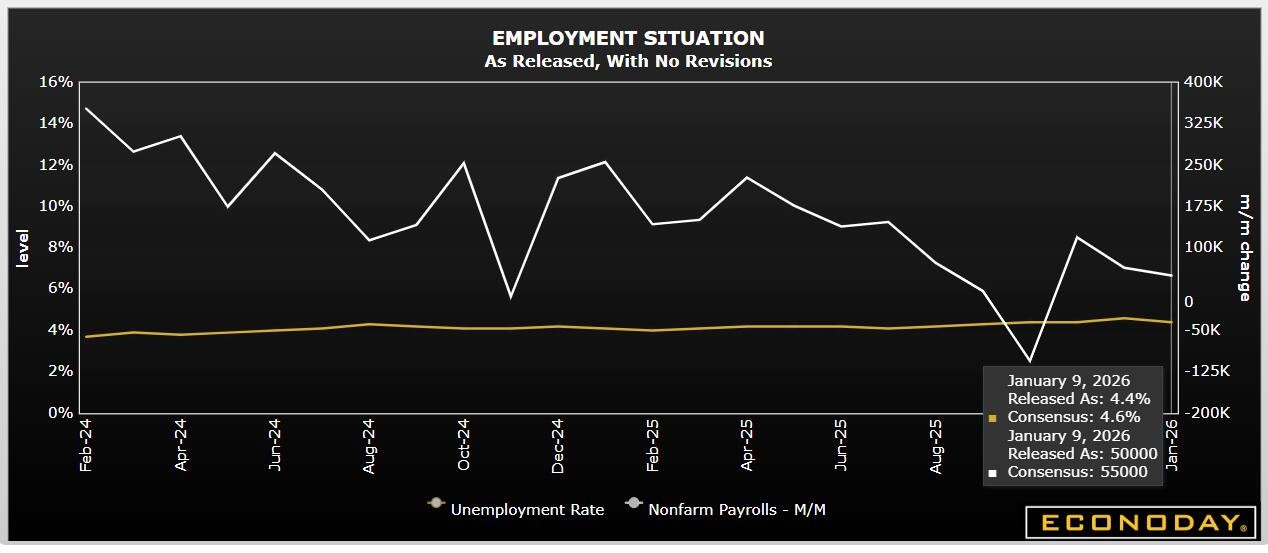
The December Non-Farm Payroll Report seems to have completely dashed market expectations for a rate cut by the Federal Reserve at the end of this month. Although only 50,000 jobs were added in December and the data for the previous two months was significantly revised down, the unemployment rate unexpectedly dropped to 4.4% in December, providing ample justification for the Federal Open Market Committee (FOMC) to maintain its current monetary policy stance.
After the non-farm payroll report was released, Nick Timiraos, the chief economics reporter for The Wall Street Journal, known as the "new Federal Reserve press agency," commented that the report cleared the way for Federal Reserve officials to remain on hold at their January meeting.
The unemployment rate in December fell from a preliminary figure of 4.6% in November to 4.4%, temporarily alleviating the most serious concerns about a deterioration in the labor market. It was these concerns that prompted the Federal Reserve to cut rates at its last three meetings, despite facing an increasingly vocal minority of dissenters who argued that a rate cut was unnecessary.
U.S. Treasury traders reacted swiftly to the employment report, almost completely reversing bets on a rate cut in January after the report was released.
Following the report, U.S. Treasury prices fell across the board, with yields rising by as much as 3 basis points. The interest rate swap market indicated that the probability of a rate cut in January dropped to zero, with traders now expecting the Federal Reserve's first rate cut of the year to occur in June, one month after Chairman Powell's term ends, with an expected total cut of about 50 basis points for the year, equivalent to two standard rate cuts.
This data highlights the contradictory situation in the labor market: persistent weakness in hiring alongside a declining unemployment rate, complicating the Federal Reserve's decision-making path.
Job Growth at Its Weakest Since the Pandemic, Three-Month Average Falls into Negative Territory
The non-farm payroll report showed that the U.S. added only 50,000 non-farm jobs in December, below Wall Street's expectation of 65,000. More concerning is that the job numbers for the previous two months were revised down by a total of 76,000, with October's figure revised further down from a loss of 105,000 to a loss of 173,000, and November's figure revised down from an increase of 64,000 to 56,000.
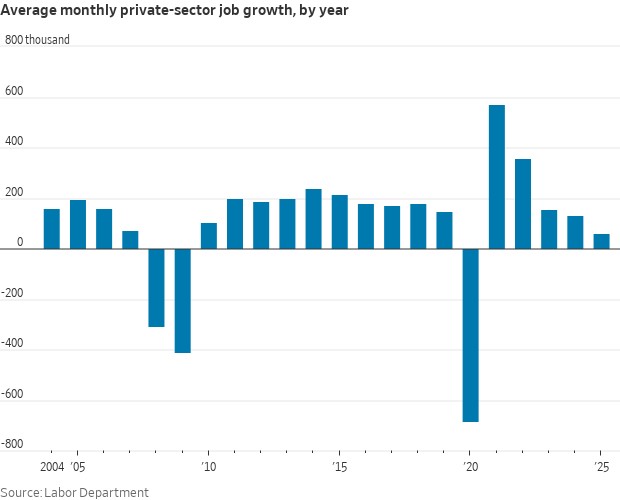
Nick Timiraos pointed out that the average number of jobs added in the private sector over the last three months has fallen to 29,000, the second-lowest level of the year. For the entire year of 2025, non-farm employment increased by only 584,000, marking the weakest annual performance since the pandemic caused a sharp decline of 9.2 million jobs in 2020. The private sector added an average of 61,000 jobs per month, the lowest level of job growth in the private sector during a non-recession period since 2003, when job recovery was sluggish.
 By industry, healthcare added 21,000 jobs, and the leisure and hospitality sector also contributed to growth, but retail trade, construction, and manufacturing all saw job losses. Out of 11 major industries, 5 experienced a decline in employment.
Nevertheless, wage growth remains resilient. In December, the average hourly wage increased by 0.3% month-on-month, with the previous value revised up to 0.2%. Over the past 12 months, wage growth was 3.8%, about 1 percentage point higher than the inflation rate.
Timiraos believes,
The December non-farm payroll report solidifies market expectations that the Federal Reserve will keep interest rates unchanged at its meeting on January 27-28, while the weak employment data indicates that the debate over the health of the labor market is far from over.
Timiraos pointed out that two voting members of the FOMC with voting rights in 2026 both hinted earlier this month that no action should be taken in the near term.
Among them, Philadelphia Fed President Anna Paulson stated that if inflation cools, it may be appropriate to further cut rates later this year, but she also suggested that she is not in a hurry to take action.
Minneapolis Fed President Neel Kashkari indicated that he believes the Fed has brought rates down to a level close to a difficult-to-observe "neutral" level, which neither stimulates nor suppresses economic activity.
Unemployment Rate Decline Closes Rate Cut Window
The unexpected decline in the unemployment rate became a key highlight of this non-farm payroll report and is a core basis for the Fed's inaction. The unemployment rate fell from 4.5% in November to 4.4%, below the expected 4.5%. Notably, the initial value of the November unemployment rate was rounded to 4.6%, and this report slightly revised it down.
Nick Timiraos analyzed that this decline temporarily alleviated the most severe concerns about a deterioration in the labor market. Although weak hiring data further proves that the debate over the health of the labor market is far from over, the employment report solidified expectations for the Fed to remain inactive in January.
The decline in the unemployment rate in December was partly due to a drop in the labor force participation rate to 62.4%. This means that some unemployed individuals left the labor market and are no longer counted as "actively seeking work." The unemployment rates for teenagers, Black individuals, and those who did not complete high school all saw declines.
Robert Tipp, Chief Investment Strategist at PGIM Fixed Income, stated:
"This (report) keeps the Fed on track to continue slowly cutting rates this year. They are at the top of the neutral (interest rate) range, or at the upper limit of that range. Therefore, they may feel that the current level of rates is not impacting the economy and could consider skipping a meeting (for a rate cut)."
Traders Bet on Rate Cuts Delayed Until Mid-Year
After the data was released, the U.S. Treasury market quickly repriced. On Friday, during trading, the yield on the two-year U.S. Treasury bond, which is sensitive to interest rates, rose by 3 basis points to 3.52%, while the benchmark 10-year U.S. Treasury yield rose to 4.17%. Traders maintained expectations for a rate cut of about 50 basis points for the entire year of 2026, but the timing of the first rate cut was pushed back to June, with another potential cut expected in the fourth quarter Subadra Rajappa, head of U.S. interest rate strategy at Société Générale, stated: "The decline in the unemployment rate and rising wages support the Federal Reserve's decision to hold steady in January."
John Briggs, head of U.S. interest rate strategy at Natixis, pointed out: "For us, the Federal Reserve will focus more on the unemployment rate rather than the noise in the overall employment numbers, so in my view, this is slightly bearish for U.S. interest rates."
Bloomberg economist Anna Wong indicated that the December non-farm payroll data showed weak hiring, and the downward revisions of data from the past few months indicate momentum is weaker than expected. The unusually cold weather in December may have had some impact on hiring. More useful signals may come from the household survey, which shows robust hiring and a drop in the unemployment rate to 4.4%. The employment report this Friday may catch the Federal Reserve slightly off guard, but it is not enough to convince the FOMC to cut rates further.
Wong expects that the CPI to be released next Tuesday, January 13, will show strong performance, further supporting the view that the Federal Reserve will not cut rates in the near term. She also believes that data after March will support the forecast of a 100 basis point rate cut this year.
In the week leading up to the data release, major Wall Street banks, including Citigroup, JP Morgan, and Morgan Stanley, maintained their predictions for a rate cut in January, but this expectation has completely evaporated following the data release. The focus of Federal Reserve officials will now shift to inflation data and subsequent labor market performance to determine the pace and magnitude of rate cuts this year
