


Foreign Capital Feedback: What Our Clients Are Asking After the Plunge (1)
Forwarded from: Xingzhi US Stocks
This article is a record of communication between foreign trading desks and clients after the sharp decline in US stocks, which accurately conveys the emotions and views of institutional investors in the current US stock market.
What has happened in our market?
In just one night, the market narrative surrounding artificial intelligence has undergone a complete transformation, while the year-to-date gains of Nasdaq futures have been entirely wiped out.
In the past 24 hours of client discussions, many sharp questions have been raised. The most critical question is: What is the efficiency of AI capital expenditures and the sustainability determined by it?
In other words, this actually reiterates doubts about the return on AI investments and the rationality of expenditures, while also emphasizing the potential disruptive risks that have sharply evolved in this field since November 2022.
Undoubtedly, the upcoming earnings reports from major US tech companies (especially Microsoft and Meta on Wednesday evening) will face immense pressure.
At the very least, the market needs some assurance that the "carpet" of AI capital expenditures will not be suddenly pulled away.
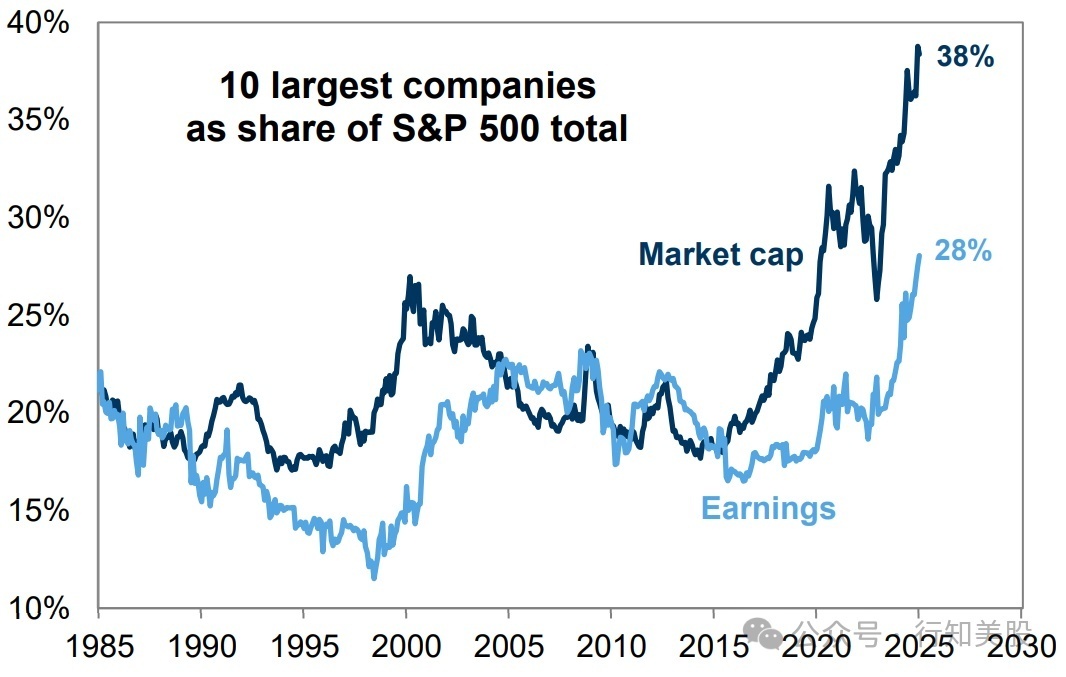
We are also very curious whether there will be aggressive discourse regarding the origins, behaviors, and qualities of emerging competitors. However, the undeniable reality is the chart below — it shows the enormous compound growth of US market capitalization, and today, this growth will be fiercely debated:
Here, we can quote the wisdom of a great person:
"Imagine if we were sitting here in 1999 discussing the internet... I don't think anyone would have estimated the scale of the internet 20 years later. At that time, we didn't have the iPhone, Uber, Facebook, etc. However, if you bought the Nasdaq index in 1999, you would have experienced an 80% decline until these achievements materialized. AI will not replicate this situation of the internet, but there may be similarities — AI may experience massive capital expenditures like the internet, which, while bringing incremental returns every day, may require four to five years for truly large-scale returns."
It is important to clarify that we remain confident in the structural dominance of US tech companies — and these companies may now have more motivation to increase expenditures.
However, from a tactical perspective, we suspect that retail investors will see a rapid reduction in positions in the coming days (hedge funds have been actively reducing exposure for months, so this actually concerns the reaction of retail investors).
What feedback are we receiving from our clients?
Today's discussions largely revolve around the potential beneficiaries and losers of the events developing this weekend, rather than directly negating the narrative of "US exceptionalism" that has dominated the market since the start of 2025. **
In this regard, we find Gavin Baker's following insights on X to be very enlightening—
“Conclusion:
-
Lowering training costs will enhance the ROI of AI.
-
In the short term, this does not bode well for AI training capital expenditures (capex) or the 'power' theme.
-
The biggest risk faced by current winners in the AI infrastructure space (covering technology, industrial, utilities, and energy) is that streamlined versions of the r1 model can run locally on high-end workstations (some have mentioned Mac Studio Pro).
This means that similar models could run on super smartphones within two years. If inference moves to the edge because it is 'good enough,' we will live in a vastly different world with vastly different winners—the largest PC and smartphone upgrade cycle in history. Computing power has long oscillated between centralization and decentralization.
- Artificial Superintelligence (ASI) is very, very close, and currently, no one really knows what the economic returns of superintelligence will be.
If a $100 billion inference model trained on 100,000 copies of the Blackwell Handbook (assuming it represents high-level knowledge) can cure cancer or invent a warp drive, then the returns of ASI will be very high, with training capital expenditures and power consumption steadily increasing; Dyson Spheres may once again be the best explanation for Fermi’s paradox. I hope the returns of ASI are high—this would be very exciting.
5) For companies using AI (such as software, internet, etc.), all of this is very favorable.
-
From an economic perspective, this greatly enhances the value of distribution and unique data—such as YouTube, Facebook, Instagram, and X.
-
U.S. labs may stop releasing their most cutting-edge models to prevent this refinement of the r1 model, although in this regard, 'the cat may have already completely escaped from the bag' (i.e., irretrievable). That is to say, r1 may be sufficient to train r2, and so on.”
$NVIDIA(NVDA.US)
The copyright of this article belongs to the original author/organization.
The views expressed herein are solely those of the author and do not reflect the stance of the platform. The content is intended for investment reference purposes only and shall not be considered as investment advice. Please contact us if you have any questions or suggestions regarding the content services provided by the platform.
