



Zhipu and MiniMax go to Hong Kong, opening up valuation space for independent large models?


As AI large models transition from technological exploration to the deep waters of commercialization, the path to capitalization for independent large model companies has become a focal point for the industry.
Recently, Zhipu HuaZhang, originating from the "Tsinghua faction," and MiniMax, born from "former SenseTime executives," both passed the Hong Kong Stock Exchange's listing hearing and are set to jointly enter the capital market, marking the beginning of the "capitalization twin stars" for China's independent large model industry.
Although both companies belong to the pure large model track, they have taken distinctly different development paths: Zhipu has deeply cultivated the B2B market with "Model as a Service (MaaS)," while MiniMax focuses on C-end AI-native products, achieving 200 million cumulative users through global expansion and seizing the initiative in overseas market.
The commonality, however, is that while both have achieved exponential revenue growth, they remain constrained by R&D-driven massive losses, making IPO a critical choice to alleviate cash flow pressure and support technological iteration.
Similarities and Differences Between MiniMax and Zhipu
Both companies are independent (i.e., pure large model) AI large model companies: Zhipu, founded in 2019, originated from Tsinghua's technology transfer, with its co-founders all having backgrounds at Tsinghua University, primarily providing foundational large models; MiniMax, founded in 2021, was established by Yan Junjie, who has a background at $SENSETIME-W(00020.HK), having been Vice President and Deputy Dean of the Research Institute at SenseTime, and also conducted postdoctoral research at Tsinghua University, with several executives also hailing from SenseTime.
MiniMax focuses on two key areas: developing advanced large models and creating AI-native products, benchmarking against OpenAI, Anthropic, Doubao, DeepSeek, etc.
Zhipu adopts a Model as a Service (MaaS) product development and commercialization model, with the majority of its current revenue coming from enterprise users (B-end), and a significant portion of these users opting for on-premise deployment, i.e., clients requiring customized private AI models; MiniMax, on the other hand, follows a "model as a product" approach, with individual users (C-end) likely being its primary users, emphasizing application-side development rather than Zhipu's private domain focus.
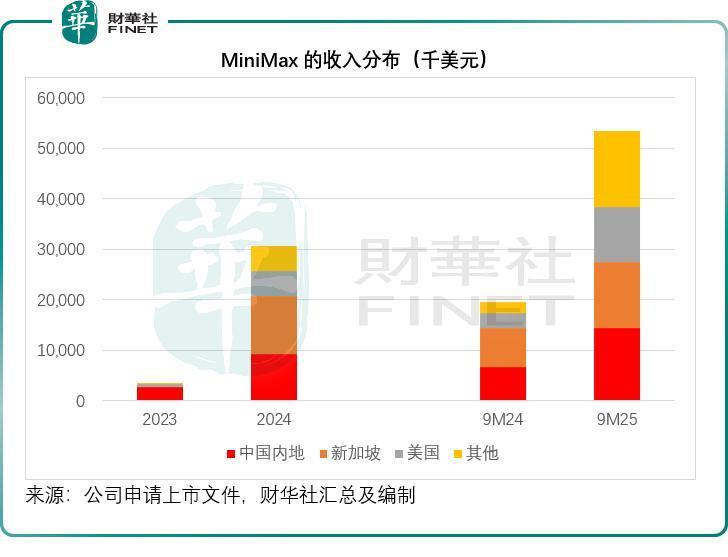
Zhipu's revenue primarily comes from mainland China, with expansion into more regional markets starting in the second half of 2024, including Southeast Asia and other regions, but the mainland remains its main revenue source, contributing 88.39% of its total revenue in the first half of 2025; MiniMax's revenue distribution is much broader, with the mainland accounting for only 26.95% of its total revenue in the first three quarters of 2025, with revenue also coming from Singapore, the U.S., etc., as shown in the figure below.
MiniMax's Core Business
MiniMax offers a large model portfolio including large language models, video generation models, and voice and music generation models.
The large language models include the MiniMax M series, consisting of M1 and M2. MiniMax M1, launched in June 2025, is an open-source large-scale hybrid attention inference model capable of handling a context window of one million tokens, supporting the development of more powerful AI Agents. MiniMax M2 is its latest large language model, designed specifically for code and Agent tasks.
The video generation model, Hailuo-02, can generate high-quality video content from various forms of input and has achieved large-scale commercialization since its release.
The voice generation model, Speech-02, is designed to generate natural, high-quality speech from text input.
Leveraging its full-spectrum large model portfolio, the company provides AI-native products and services to global individual users, developers, and enterprise clients. Among these, MiniMax is its intelligent agent application, capable of autonomously executing multiple tasks through natural language instructions; Hailuo AI integrates its Hailuo-02 model to generate high-quality images and videos in real-time; MiniMax Voice integrates its Speech-02 model to provide users with audio generation capabilities; Talkie for the international market and Xingye for the domestic Chinese market are its AI-native full-modal interaction platforms, enabling users to interact with AI agents or virtual characters to create emotional connections.
MiniMax's revenue primarily comes from two sources: AI-native products and the open platform and other AI-based enterprise services. As shown in the figure below, AI-native products, primarily targeting the C-end, account for the majority of the company's revenue, reaching 71.1% in the first three quarters of 2025, while Zhipu derived at least 85% of its revenue from enterprise on-premise deployments in the first half of 2025.
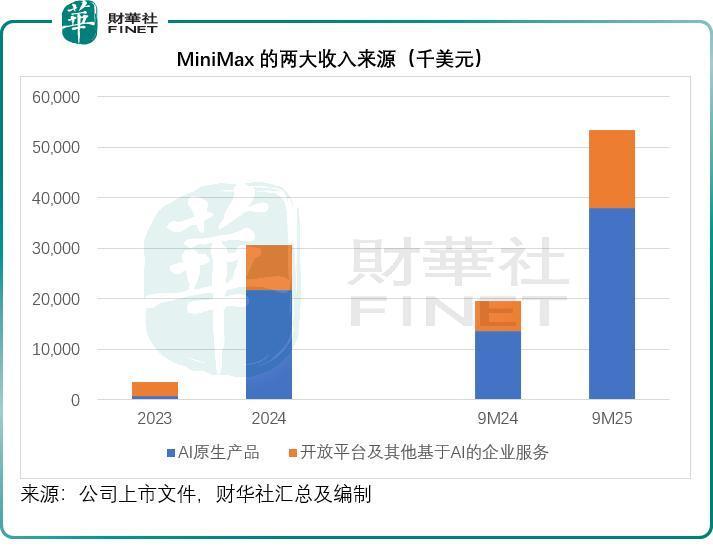
Among MiniMax's AI-native products, Hailuo AI (i.e., image and video generation tools) and Talkie/Xingye (i.e., AI-native full-modal interaction platforms) are the main revenue drivers, contributing 2.6% and 35.1% of revenue in the first three quarters of 2025, respectively, while enterprise services accounted for only 28.9% of its income.
MiniMax monetizes its AI-native products primarily through in-app purchases and subscriptions. The company revealed that its monthly active users (MAU) averaged 27.6 million in the first three quarters of this year. The cumulative users of AI-native products exceeded 212 million, while the number of paying users for AI-native products reached 1.7716 million.
At the same time, the company is also expanding its enterprise user base, with approximately 2,500 paying users on its open platform in the first three quarters of 2025, compared to Zhipu, which primarily serves enterprise clients and had 12,000 institutional clients during the same period.
MiniMax's Finances and Funding
Like Zhipu, MiniMax is also in a state of significant losses. Its revenue growth in the first three quarters of 2025 was very rapid, with a year-on-year increase of 175% to $53.437 million, approximately RMB 376 million, which is 1.75 times its full-year 2024 revenue. In comparison, Zhipu's revenue scale in the first half of 2025 was approximately RMB 191 million.
While revenue grew rapidly, MiniMax also significantly increased operating expenses, with R&D spending being its most significant outlay. In the first three quarters of 2025, this expenditure was 3.37 times its revenue scale, resulting in severe losses for MiniMax, with adjusted losses reaching $186 million in the first three quarters of this year, three times higher than its revenue.
However, MiniMax aims to improve its loss-making situation by leveraging the rapid development of large models, continuously enhancing model intelligence, attracting more users, expanding the performance channels for AI-native products, and optimizing organizational efficiency and scalability—but first, it must address its cash flow issues.
MiniMax disclosed that its cash balance as of September 30, 2025, was $1.0462 billion, consisting of $363 million in cash and cash equivalents, $644.2 million in current financial assets measured at fair value through profit or loss, and $39.4 million in unused bank financing. However, in 2025, the company expects monthly cash burn to be approximately $27.9 million. By this calculation, its current cash position could sustain operations for 37 months, or about three years—assuming operating cash flow does not increase, the price of AI-related computing investments does not rise due to supply shortages, and other infrastructure investments do not increase.
MiniMax plans to list on the Hong Kong Stock Exchange (00388.HK) to raise funds for R&D over the next five years, including the development of large models and AI-native products, with the remainder allocated to working capital and general corporate purposes.
According to the information provided, MiniMax has likely completed seven rounds of financing to date. After the Pre-B++ round concluded on August 19, 2025, its post-investment valuation may have reached $4.2402 billion, approximately RMB 29.848 billion, while Zhipu's valuation after completing its eighth round of financing (B6 round on May 29, 2025) may be RMB 24.377 billion.
Early investors in MiniMax likely include Alisoft China, a subsidiary of $BABA-W(09988.HK), currently holding approximately 15.04%; miHoYo holds 7.05%; IDG may hold 3.08%; and $TENCENT(00700.HK) may hold 2.84%.
MiniMax appears to have adopted a dual-class share structure. From its equity composition, it is evident that major investors such as Alibaba, miHoYo, and Tencent already hold significant stakes, but founder Yan Junjie retains 59.21% of the voting rights while holding only 22.35% of the equity.
Conclusion
This "twin charge into Hong Kong" capital sprint is not only a significant leap for both companies from financing blood transfusions to market fundraising but also reflects the differentiation and maturation of China's large model industry—leading independent players have already formed differentiated competitive landscapes, moving beyond homogeneous technological competition to comprehensive contests of business models, market choices, and resource integration.
Their post-listing performance will not only set valuation benchmarks for the industry in terms of "technical value + commercial potential" but also pave the way for subsequent independent large model companies to access capital markets. In the future, amid persistently high R&D investments and fierce market competition, whether Zhipu can consolidate its B-end advantages and reach an inflection point of profitability, and whether MiniMax can expand C-end user stickiness and control cash burn, will not only determine their own fates but also influence the competitive dynamics between China's independent large model track and the tech giant camp, providing important references for the industry's commercialization exploration.
For more on Zhipu, see "Tsinghua's Hardcore AI! Zhipu Charges into Hong Kong to Become the 'First Large Model Stock'".
By Mao Ting
The copyright of this article belongs to the original author/organization.
The views expressed herein are solely those of the author and do not reflect the stance of the platform. The content is intended for investment reference purposes only and shall not be considered as investment advice. Please contact us if you have any questions or suggestions regarding the content services provided by the platform.
